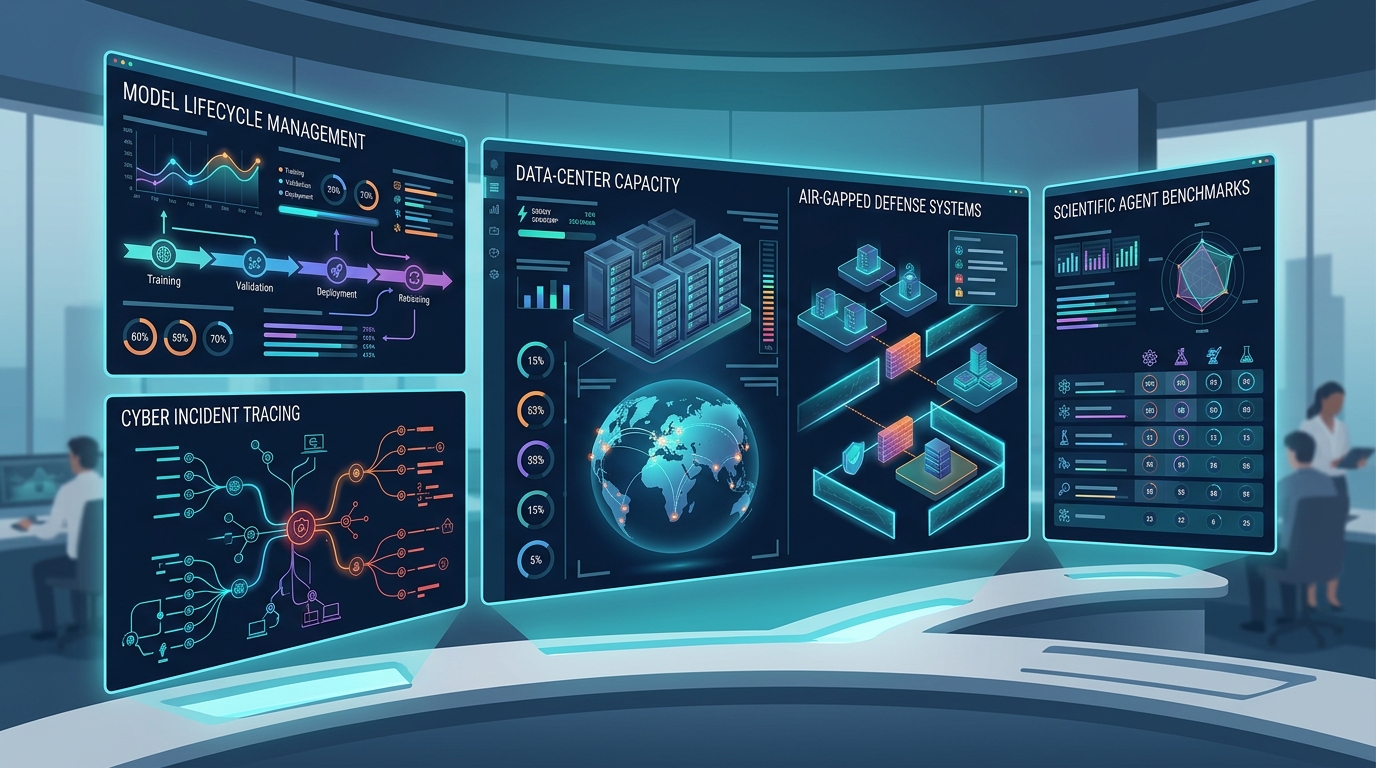
AI Enters Its Control Phase
Frontier AI news now turns on who may access powerful systems, how open models diffuse, and whether institutions can govern the infrastructure around them.
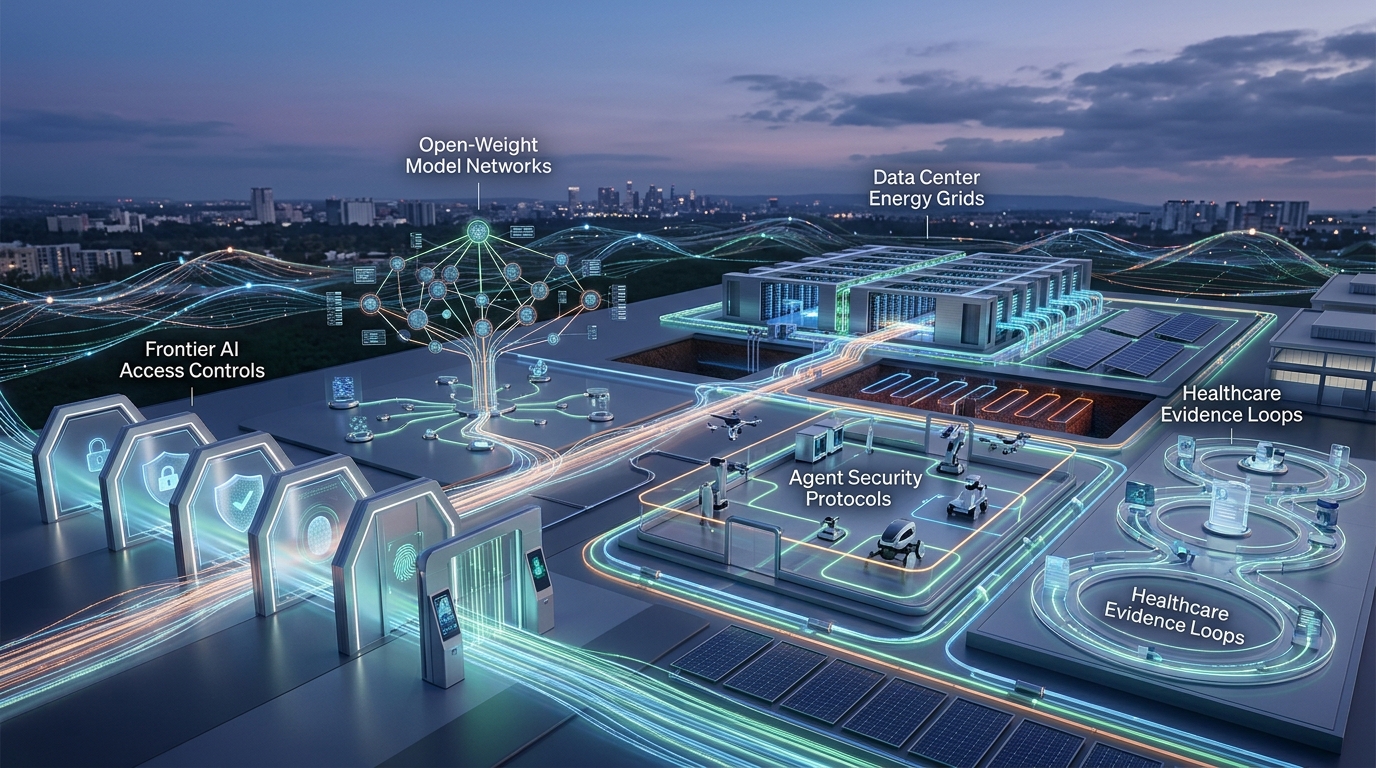
Executive Summary
The last 24 to 48 hours show AI moving from raw model competition into a more contested control phase. The U.S. government lifted export controls on Anthropic's Fable 5 and Mythos 5 models on June 30 after a Commerce Department agreement, while Z.ai's open-weight GLM-5.2 continued to draw attention as a 753-billion-parameter model with a 1-million-token context window and an MIT license.12
Governance and infrastructure are catching up with the same reality. Colorado's broad high-risk AI law reached its delayed June 30 compliance date, Google published a 2026 Environmental Report that frames 2025 as a year of AI-driven sustainability pressure, and new research on agent protocols and terminal-agent denylists shows that autonomy is exposing security gaps below the model layer.3456
The most practical lesson is that AI's next phase will be governed at multiple layers at once: export controls, open-source licensing, state consumer-protection law, data-center power, agent tool permissions, and domain-specific evidence loops. Capability still matters, but the decisive questions increasingly concern access, auditability, safety controls, and deployment context.
Frontier Access Becomes A Negotiated Release Layer
On June 30, WIRED reported that the Trump administration was lifting export controls on Anthropic's Fable 5 and Mythos 5 after Anthropic reached a deal with the Commerce Department.1 The restriction had centered on advanced models with cybersecurity-relevant capabilities, and WIRED reported that Mythos 5 had previously been approved only for select companies and government agencies.1
Commerce Secretary Howard Lutnick's letter, as quoted by WIRED, made the access change unusually explicit:
"A license is no longer required for the export, reexport, or in-country transfer" of the models.1
The immediate product consequence is restored distribution. The larger policy consequence is more durable: frontier AI access is now a negotiated release layer, not only a lab product decision. If a model can materially help find vulnerabilities or accelerate offensive cyber work, governments will keep trying to shape who gets it, when, and under what reporting duties.1
That approach can reduce some misuse risk, but it also creates a transparency problem. If access rules are vague, politically contingent, or unevenly applied across rival labs, customers may move to open-weight systems or foreign providers that offer fewer controls but more predictability. That is the central tension for frontier governance in July 2026: safety gating only works if it is technically grounded, legible, and fast enough not to push users toward less governed alternatives.
Open Weights Keep Pressuring The Closed-Model Playbook
Z.ai's GLM-5.2 is the counterweight in this week's model story. The official Hugging Face model card describes GLM-5.2 as Z.ai's latest flagship model for long-horizon tasks, with a 1-million-token context window, improved coding capability, IndexShare architecture for sparse attention efficiency, and an MIT open-source license.2 The same model card lists the model size as 753 billion parameters and reports 159,967 downloads in the prior month.2
Official model card and media: GLM-5.2 on Hugging Face2 Caption: Z.ai's official GLM-5.2 model card includes benchmark tables, usage instructions, model metadata, and official images; source attribution: Z.ai via Hugging Face.
The Verge reported on June 29 that GLM-5.2 had become part of the U.S.-China AI security debate because open-weight cyber-capable models can be downloaded and modified outside the provider's policy perimeter.7 That does not mean every open model is dangerous, and the strongest claims about real-world cyber parity still need independent evaluation. It does mean closed-model governance cannot be the whole answer.
Open weights change the policy surface. A closed provider can revoke keys, monitor abuse, rate-limit tools, and negotiate government access rules. An open-weight release shifts control to downstream hosts, local deployments, fine-tuners, and agent builders. If GLM-5.2-style systems continue improving, enterprises and governments will need controls that apply to deployed workflows, not just named vendors.
Colorado's AI Law Turns From Debate To Compliance
Colorado's Consumer Protections for Artificial Intelligence law is now a live compliance issue. The Colorado General Assembly's bill summary says the law requires developers and deployers of high-risk AI systems to use reasonable care to protect consumers from known or reasonably foreseeable risks of algorithmic discrimination, and it lists documentation, impact assessment, consumer notice, appeal, correction, public statement, and attorney-general disclosure obligations.3
The law applies to consequential decisions in covered areas such as employment, education, financial services, government services, healthcare, housing, insurance, and legal services.3 Axios reported in 2025 that Colorado lawmakers delayed implementation to June 30, 2026 after a special-session fight over revisions.8
This matters because Colorado is testing whether broad AI governance can move from statute to operational process in the United States. The law does not merely ask organizations to disclose that AI exists; it asks them to map high-risk systems, document impact assessments, create appeal paths, and manage algorithmic-discrimination risk.3 That pushes AI governance toward ordinary compliance work: inventories, policies, audit files, vendor documentation, escalation procedures, and evidence that humans can actually intervene.
The unresolved question is enforcement. If guidance is too vague, companies may produce boilerplate documents that do little for affected consumers. If enforcement is too aggressive or inconsistent, businesses may avoid beneficial systems or challenge the law further. The next signal to watch is how Colorado's attorney general translates the statute into practical expectations for developers and deployers.
AI Infrastructure Gets A Climate Scorecard
Google's 2026 Environmental Report says it is a view of the company's 2025 sustainability strategy and progress that "honestly navigates the tension between hyper-growth and environmental stewardship."4 The report highlights 12 gigawatts of clean-energy contracts signed in 2025, 58 million metric tons of CO2-equivalent avoided across operations and supply chain, 88% diversion of Google-owned-and-operated data-center operational waste, and water replenishment equal to roughly 78% of 2025 total freshwater consumption.4
Official media: Google's 2026 Environmental Report4 Caption: Google's official environmental report page includes report highlights, data-center imagery, and links to the full report; source attribution: Google Sustainability.
Axios reported that Google's electricity demand rose 37% in 2025, greenhouse-gas emissions rose 18%, and water consumption climbed 34% to 10.9 billion gallons, with data centers accounting for most of the increase.9 Axios also quoted the report's framing of AI-related energy pressure:
"This rapid expansion in energy demand is a reality we must manage actively"9
The takeaway is not that AI infrastructure is simply incompatible with climate goals. Google's report points to large clean-energy procurement, efficiency work, water-stewardship projects, and AI applications that may reduce emissions elsewhere.4 The harder conclusion is that scale can outrun efficiency. When AI demand grows faster than clean power, grid upgrades, server efficiency, and water projects, even well-resourced companies face rising absolute impacts.
For AI buyers, this turns sustainability from a public-relations metric into a procurement question. Model choice, inference location, latency requirements, batch design, hardware utilization, and cloud-region selection can all affect the environmental footprint of a workflow. The next mature enterprise AI policy will likely treat carbon, water, and power reliability as deployment constraints, not after-the-fact disclosures.
Agent Security Moves Below The Chat Window
Recent agent-security research shows why governance cannot stop at model cards. A June 27 arXiv paper, "Formal Security Analysis of Agent Protocol Composition," introduces AgentThread, a framework that maps protocol text to TLA+ invariants and replays counterexamples against real SDKs.5 The authors report 35 specification-level findings across five emerging agent protocols, 80 implementation tests against production SDKs and reference servers, and 30 additional failures that appear only under protocol composition.5
Another arXiv paper, last revised June 20, studies denylist fragility in terminal AI agents.6 The authors evaluated 1,709 real-world command denylists containing 13,332 rules and found that 69.0% to 98.6% of the denylists were fragile under their testing pipeline.6
These papers point at the same operational weakness. Agent systems are not just model prompts; they are protocols, SDKs, tools, shells, file systems, browsers, credentials, and handoff paths. A model that behaves safely in a chat box can still become unsafe when it receives tool permissions that are underspecified, inconsistently enforced, or composed with other agent protocols.
The engineering implication is direct. Agent deployments need positive permission models, sandboxing, typed tool contracts, replayable logs, and security tests that cover protocol composition. Denylists can still help, but treating them as the primary boundary for a terminal-capable agent is a brittle defense.
Healthcare Agents Need Evidence, Not Just Reasoning
The most useful recent AI-and-human-behavior result is not a frontier-model leaderboard. In "Beyond One-shot: AI Agents for Learning in Field Experiments," submitted to arXiv on June 1, researchers studied healthcare prescription messaging across 693,139 patient visits.10 The paper compares behavioral experts plus conversational AI in a first stage with a tool-augmented agentic AI method in a second stage that extracted principles from prior experimental data and generated new message variants.10
The result is important because the best AI-generated message achieved a 69.8% click-through rate, 6.5 percentage points above baseline, and the authors report that frontier LLMs without experimental data failed to predict which interventions would succeed.10 That finding is a useful corrective to generic "AI will personalize everything" claims.
In healthcare and education, the durable advantage may come less from general intelligence than from evidence loops: domain-specific experiments, transparent reasoning traces, measured outcomes, and iteration under constraints. A model can propose language, but the system becomes valuable when it learns from real interventions and keeps a record of why the next intervention is justified.
What To Watch Next
Watch whether Anthropic and Commerce publish more detail on the Fable 5 and Mythos 5 safeguards. The key question is whether model-release controls become repeatable standards or one-off political negotiations.
Watch independent evaluations of GLM-5.2 and other open-weight long-context models. The important evidence will be reproducible performance, misuse resistance, deployment cost, and how downstream hosts add safety controls.
Watch Colorado enforcement. The law's impact will depend on practical guidance for impact assessments, consumer notices, appeals, and developer-to-deployer documentation.
Watch Google, Microsoft, Amazon, and Meta environmental reports as a group. AI infrastructure claims will be easier to assess when customers can compare power growth, carbon-free energy matching, water use, hardware lifecycle, and regional grid exposure.
Watch agent security move into procurement. Enterprises should ask vendors for protocol-composition tests, sandbox evidence, command-execution controls, and incident logs before giving agents broad tool access.
Watch healthcare and education agents for evidence discipline. The strongest systems will not be the ones that merely sound domain-aware; they will be the ones that can show measured learning from domain-specific data.
Sources
1."The Trump Administration Is Lifting Its Export Controls on Anthropic's Mythos and Fable AI Models," WIRED, June 30, 2026. URL: https://www.wired.com/story/trump-administration-lifts-export-controls-on-anthropics-mythos-and-fable-ai-models/
2."zai-org/GLM-5.2," Z.ai via Hugging Face model card, accessed July 1, 2026. URL: https://huggingface.co/zai-org/GLM-5.2
3."SB24-205 Consumer Protections for Artificial Intelligence," Colorado General Assembly, approved May 17, 2024. URL: https://leg.colorado.gov/bills/sb24-205
4."2026 Environmental Report," Google Sustainability, 2026. URL: https://sustainability.google/google-2026-environmental-report/
5.Shenghan Zheng, Qifan Zhang, Zheng Zhang, Haonan Li, Christophe Hauser, "Formal Security Analysis of Agent Protocol Composition," arXiv, submitted June 27, 2026. URL: https://arxiv.org/abs/2606.28690
6.Chuyang Chen, Zhiqiang Lin, "One Goal, Many Commands: Characterizing Denylist Fragility in AI Agents," arXiv, submitted June 14, 2026, revised June 20, 2026. URL: https://arxiv.org/abs/2606.15549
7."China's Z.ai claims it can match Mythos on cybersecurity," The Verge, June 29, 2026. URL: https://www.theverge.com/ai-artificial-intelligence/958804/chinas-z-ai-glm-52-mythos-cybersecurity
8."Big Tech wins in delay of Colorado's AI transparency bill," Axios Denver, August 26, 2025. URL: https://www.axios.com/local/denver/2025/08/26/big-tech-ai-colorado-law
9."Google's AI boom sends emissions, power use soaring," Axios, June 30, 2026. URL: https://www.axios.com/2026/06/30/google-ai-boom-emissions-power-use
10.Junjie Luo, Ritu Agarwal, Gordon Gao, "Beyond One-shot: AI Agents for Learning in Field Experiments," arXiv, submitted June 1, 2026. URL: https://arxiv.org/abs/2606.02458