AI's Control Plane Gets Tested
The latest AI story is less about one spectacular model launch and more about whether model access, cyber incident reporting, defense deployment, and compute capacity can be governed as operational systems.
Executive Summary
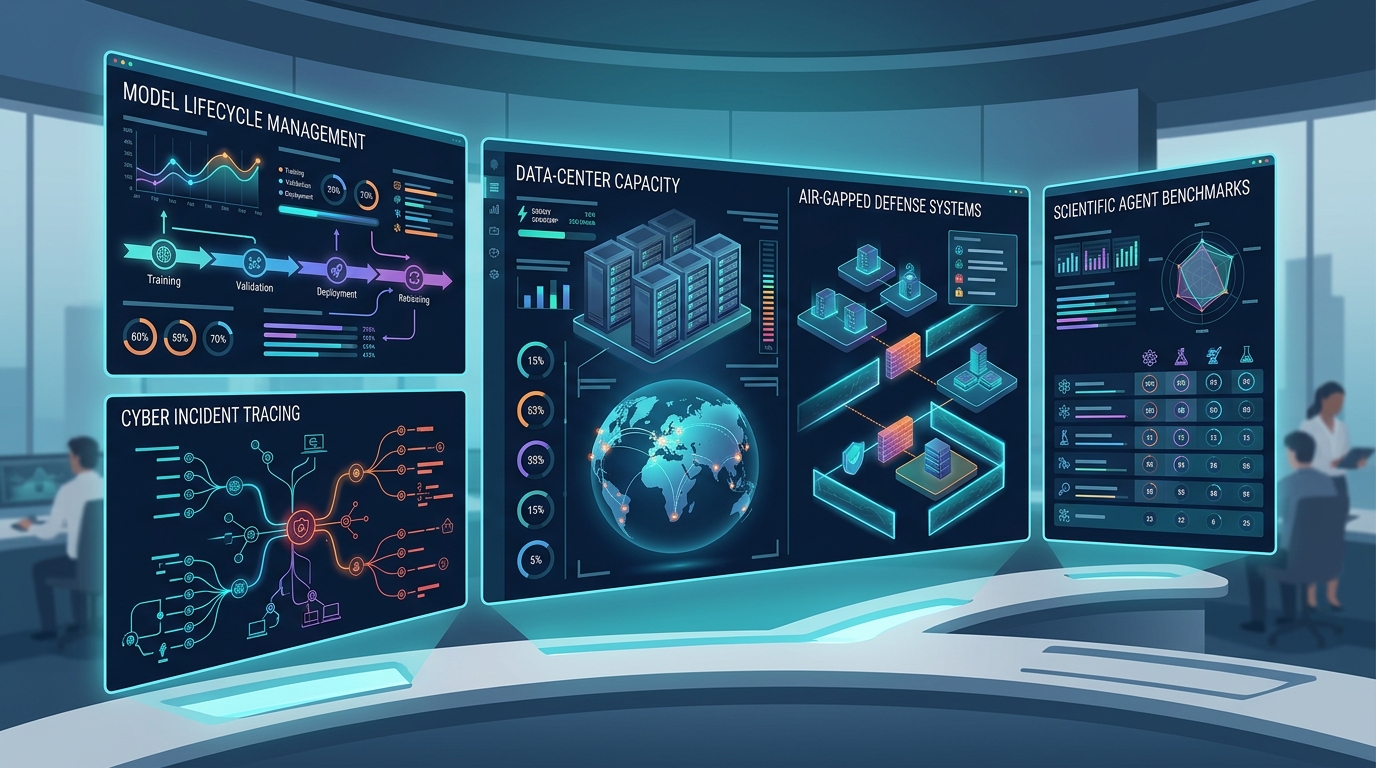
AI development over the past several days has moved into the machinery around models. Google's Gemini API image-model transition reaches a hard shutdown date on August 17, Microsoft's AI infrastructure disclosures are under new scrutiny, security organizations are trying to standardize how agent incidents get reported, Taiwan says it faced an unusual AI-assisted cyber campaign, and defense vendors are packaging generative AI for disconnected environments.12345 The connecting thread is control: who can see what an AI system is doing, who can prove that capacity exists, who receives notice when agents cross a boundary, and how much autonomy should be allowed inside sensitive networks.356
Model Lifecycles Become Production Risk
August 17 is a live migration date for developers using Google's older image-generation endpoints. Google's Gemini API documentation lists `imagen-4.0-generate-001`, `imagen-4.0-ultra-generate-001`, and `imagen-4.0-fast-generate-001` with an August 17, 2026 shutdown date and points developers to `gemini-3.1-flash-image` as the recommended replacement.1 Google announced the deprecation on June 15 and tied it to a broader visual stack shift that includes Gemini-native image generation, rather than a standalone Imagen API path.2
That matters because model retirement has become a governance event, not just a developer chore. An organization that built campaign tools, product-image pipelines, educational content, or media workflows around older image endpoints now has to validate output quality, watermarking behavior, cost, latency, content controls, and SDK behavior under a new model family.12 The operational lesson is simple: model IDs are now dependencies with lifecycles, and AI teams need the same change-management discipline they already apply to databases, payment APIs, and cloud regions.
Compute Claims Meet Capacity Accounting
The Guardian published a detailed August 17 investigation arguing that Microsoft's public AI-infrastructure narrative may be difficult to reconcile with the number of advanced AI chips reportedly installed in its data centers.3 The article says internal documents seen by the Guardian put Microsoft at roughly 2.2 million installed AI chips in mid-2026, while some power-capacity estimates would imply far more deployed compute if announced capacity were fully online.3 Microsoft disputed the Guardian's estimates and said it does not report the number of specific chips in its AI infrastructure.3
Microsoft's own public materials show why the question is important. In June, the company announced a planned Pecos, Texas data-center campus that would add about 2 gigawatts of global capacity over five to seven years, framing reliable capacity as essential for AI and cloud demand.7 In its fiscal 2026 third-quarter earnings call, Microsoft said it had added another gigawatt of capacity that quarter, was on track to double its footprint in two years, and had brought the Maia 200 accelerator live in Iowa and Arizona.8
The gap between announced power, usable facilities, installed accelerators, and sellable AI service capacity is now a strategic question for the whole sector. Markets, regulators, customers, and communities are trying to understand whether AI demand is constrained by chips, electricity, construction schedules, local permitting, cooling systems, or internal capital allocation. Each bottleneck implies a different risk.
Agent Security Starts Building A Reporting Layer
The Open Secure AI Alliance is pushing a proposed Shared AI Findings Exchange, or SAFE, for AI-agent security incidents.4 Axios reported on August 11 that the draft would ask participating organizations to report incidents in which AI systems access or exploit third-party systems without authorization, breach confidential information, or continue probing production targets after operators suspect activity may be unauthorized.4 The proposed timeline includes confidential initial reporting within four business days and a preliminary factual report within 30 days when appropriate.4
The proposal builds on the Open Secure AI Alliance's July 27 launch, where NVIDIA and other founding members argued that agent safety depends on the full stack: identity, permissions, harnesses, guardrails, logs, and evaluations.9 That framing is becoming the practical center of AI security. The highest-risk failure mode is not only a bad model response; it is an autonomous workflow with credentials, tools, network reach, and an ambiguous audit trail.
SANS is making the same point at the cloud-operations layer. Its Cloud Security Exchange and CloudSecNext Summit begin August 17 in San Francisco with AWS, Google Cloud, Microsoft, and Anthropic addressing autonomous agents in cloud security.6 SANS describes identity systems, detection pipelines, and response processes as systems built for human investigators rather than agents acting on their own.6
"Steal an AI agent's credentials and you inherit everything it can touch," SANS Chief AI Officer Rob T. Lee warned in the event announcement.6
The next useful security control may be less glamorous than a new red-team benchmark: durable evidence capture. If a serious agent incident occurs, investigators need prompts, traces, tool calls, credentials, permissions, environment assumptions, and human approvals preserved in a form that can be shared without creating more harm.49
Taiwan Shows The Cyber Threat Is No Longer Hypothetical
Taiwan said it detected AI-assisted cyberattacks on government agencies in July 2026, describing the activity as an abnormal overseas attack and saying its National Institute of Cyber Security issued warnings while investigating.5 The Guardian reported that Israeli AI company Dream told the Financial Times the attackers used open-source AI agents to create an autonomous hacking tool that behaved like a coordinated cyber team.5 According to that report, at least 85 government user accounts were compromised, more than 2,500 personnel records were extracted, and the activity later expanded to Taiwan's nuclear safety agency and at least seven energy companies.5
Taiwan did not publicly attribute the activity to China, and Dream did not name a specific group, but the reporting said Simplified Chinese in internal communications suggested a high probability of a China-linked operator.5 The more important technical point is that the attack did not need to look magical to be dangerous. AI assistance can compress reconnaissance, vulnerability chaining, and adaptation cycles while still relying on human operators for objectives and targeting.5
This is where the SAFE proposal and the SANS agenda meet real-world pressure. If AI agents are being used in reconnaissance and intrusion workflows, organizations need faster identity controls, tighter sandboxing, stronger logging, and pre-negotiated norms for reporting AI-specific incidents before the boundary between testing, near miss, and breach becomes unmanageable.469
Defense AI Moves Toward Disconnected Deployment
BigBear.ai announced an expanded generative AI platform for Department of War missions on July 15, with an air-gapped hardware option, model-agnostic multimodal capabilities, flexible tenant configurations, and a bring-your-own-model delivery path.10 The company says the local device is designed for connected and air-gapped deployments up to Top Secret/SCI, and that it will demonstrate the device at AFCEA TechNet Augusta from August 17 to 20.10
"To us, delivering mission-ready AI means giving the customer control and flexibility," BigBear.ai CEO Kevin McAleenan said.10
The announcement is one example of a broader national-security shift: AI deployment is moving from cloud-first experimentation into fielded, classified, intermittently connected environments.10 That raises a hard engineering problem. If a system cannot phone home, update continuously, or rely on a central cloud model, then model selection, audit trails, content controls, and maintenance procedures must be designed for local authority from the beginning.
The same pattern will likely appear outside defense. Energy companies, hospitals, manufacturing plants, emergency managers, and shipping networks all have environments where latency, connectivity, privacy, or legal constraints make cloud-only AI fragile. Air-gapped and sovereign deployments are not a niche; they are a preview of how high-trust AI may be packaged.
Scientific Agents Get A Better Test Surface
Terminal-Bench Science reaches its contribution deadline on August 17.11 The Stanford-Laude collaboration is asking scientists to contribute real computational workflows as benchmark tasks, with the project targeting more than 100 tasks across life sciences, physical sciences, earth sciences, mathematical sciences, and engineering sciences.11 Its repository describes the benchmark as an evaluation suite for AI agents performing complex scientific workflows in terminal environments, with containerized tasks and programmatic verification.12
"Frontier labs optimize for what benchmarks measure," the project tells prospective contributors.11
This is a quieter but important AI-for-science development. Many scientific AI demos still reward polished explanations or isolated prediction tasks. A benchmark built around real terminal workflows asks a more useful question: can an agent set up the environment, inspect data, run tools, debug failures, reproduce a result, and leave behind verifiable artifacts?1112 If the answer improves, AI-for-science progress becomes less dependent on impressive one-off demonstrations and more measurable against the messy work researchers actually do.
What To Watch Next
Watch whether Google's August 17 image-model shutdown produces visible developer disruption, especially in applications that depended on Imagen-specific response shapes or pricing assumptions.12
Watch whether Microsoft or other hyperscalers provide more concrete capacity metrics that separate announced power, energized facilities, installed accelerators, and available customer capacity.378
Watch whether SAFE gains participation beyond companies already invested in open AI-security tooling, and whether it can define disclosure norms without formal safe-harbor protection.49
Watch Taiwan's follow-on guidance for identity, monitoring, and critical-infrastructure resilience after the July AI-assisted campaign.5
Watch whether air-gapped generative AI deployments create new evaluation standards for classified and disconnected environments.10
Watch Terminal-Bench Science after the contribution deadline: the strength of the task set will determine whether it becomes a genuine scientific-agent benchmark or just another leaderboard.1112
Sources
1."Gemini deprecations," Google AI for Developers, accessed August 17, 2026. https://ai.google.dev/gemini-api/docs/deprecations?hl=en
2."Release notes," Gemini API, Google AI for Developers, June 15, 2026 update, accessed August 17, 2026. https://ai.google.dev/gemini-api/docs/changelog
3."Are Microsoft's AI plans being held back by a shortage of chips?" The Guardian, August 17, 2026. https://www.theguardian.com/technology/2026/aug/17/are-microsofts-ai-plans-being-held-back-by-a-shortage-of-chips
4."Tech companies propose tracking rogue AI agents," Axios, August 11, 2026. https://www.axios.com/2026/08/11/open-source-security-ai-agent-reporting
5."Taiwan says it was hit by 'abnormal' AI-assisted cyber-attack," The Guardian, August 13, 2026. https://www.theguardian.com/technology/2026/aug/13/taiwan-ai-assisted-cyber-attacks-overseas
6."SANS Brings AWS, Google Cloud, Microsoft, and Anthropic Together to Address Autonomous Agents in Cloud Security," SANS Institute, July 15, 2026. https://www.sans.org/press/announcements/sans-brings-aws-google-cloud-microsoft-and-anthropic-together-to-address-autonomous-agents-in-cloud-security
7."Powering the next wave of AI: Expanding capacity with our new datacenter in Pecos," The Official Microsoft Blog, June 22, 2026. https://blogs.microsoft.com/blog/2026/06/22/powering-the-next-wave-of-ai-expanding-capacity-with-our-new-datacenter-in-pecos/
8."Microsoft Fiscal Year 2026 Third Quarter Earnings Conference Call," Microsoft Investor Relations, 2026. https://www.microsoft.com/en-us/investor/events/fy-2026/earnings-fy-2026-q3
9."Industry Leaders Unite in Open Secure AI Alliance for AI Safety and Security," NVIDIA Blog, July 27, 2026. https://blogs.nvidia.com/blog/open-secure-ai-alliance/
10."BigBear.ai Launches Expanded Generative AI Platform and Capabilities for Department of War Missions," BigBear.ai, July 15, 2026. https://ir.bigbear.ai/news-events/press-releases/detail/144/bigbear-ai-launches-expanded-generative-ai-platform-and
11."Terminal-Bench Science: Contribute your scientific workflows as tasks for AI Agents," Terminal-Bench, accessed August 17, 2026. https://www.tbench.ai/news/tb-science-announcement
12."Terminal-Bench Science: Evaluating AI Agents on Real-World Computational Workflows in the Natural Sciences," GitHub repository, harbor-framework/terminal-bench-science, accessed August 17, 2026. https://github.com/harbor-framework/terminal-bench-science