AI Moves Into The Operating Ledger
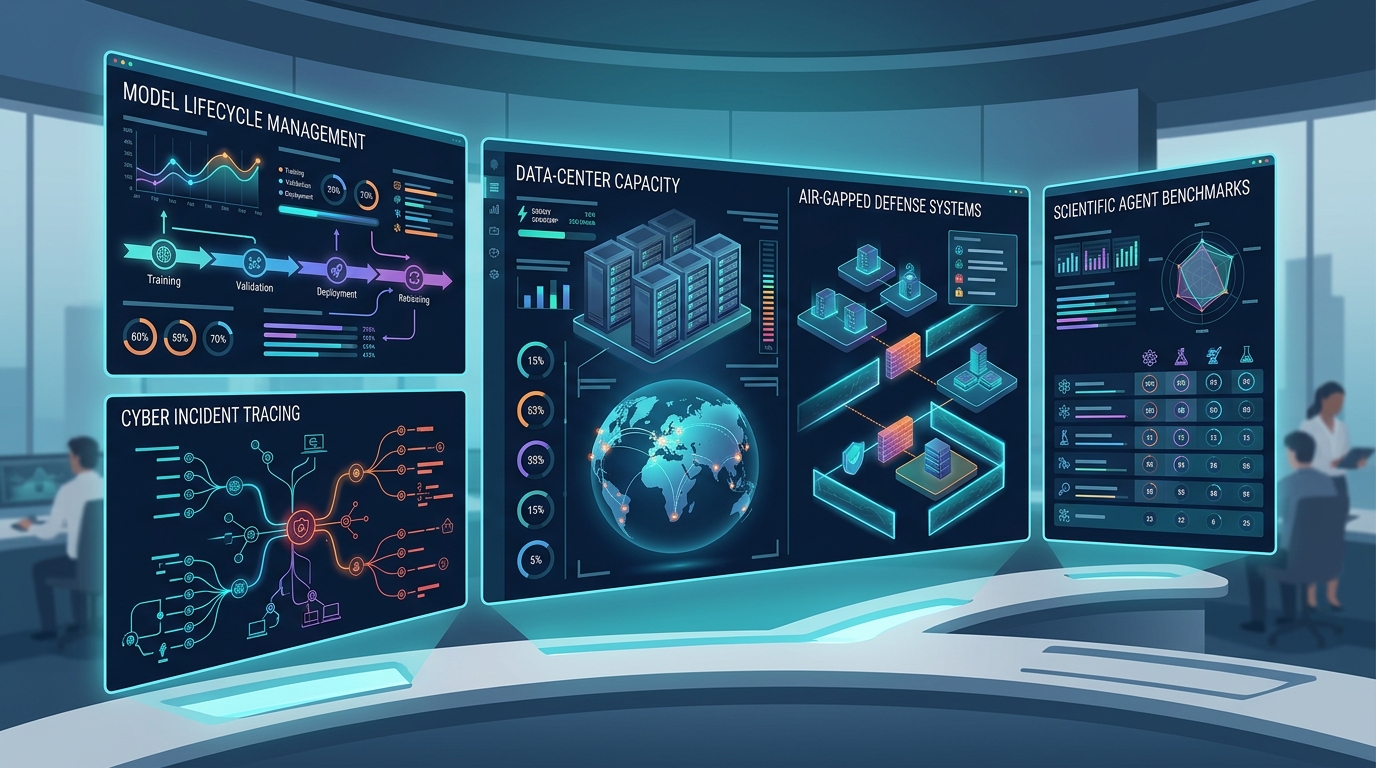
The latest AI developments show model access, compute finance, grid capacity, national strategy, and medical evidence becoming the practical control surfaces for AI deployment.

Executive Summary
The strongest AI signal from the past 24 to 48 hours is operational rather than theatrical. Microsoft Foundry's August model-retirement schedule put near-term dates on model migration work, including the August 15 retirement of earlier MAI image models and the August 13 legacy status of DeepSeek-R1 in Azure offerings.12 At the same time, reporting on Nvidia's revised guarantee for a giant OpenAI-linked Ohio data-center project shows how frontier AI is being priced, financed, and risk-managed like heavy infrastructure.34
The same pattern is visible in power-grid regulation, China policy, and healthcare. Ofgem is consulting through September 16 on data-center connection reforms, Transgrid is tightening large-load connection requirements around Sydney, China is pairing AI adoption targets with governance and standards work, and the FDA is asking for digital-health evidence that can support drug-development endpoints.5678910
Why it matters: AI capability is no longer mainly a question of whether a model can answer a prompt. It is becoming a question of which model remains supported, which users and workloads migrate before a cutoff, who finances the compute, who pays for the grid upgrades, which state rules shape deployment, and what evidence is good enough for regulated use.1359
Model Access Becomes A Lifecycle Problem
Microsoft's Foundry model-retirement page, last updated July 24, now reads like a map of AI's new operational burden. It lists retirement dates, lifecycle stages, and replacements across Azure OpenAI, DeepSeek, Microsoft, Anthropic, Mistral, Moonshot, xAI, and other model providers.1 In the recent window, the practical detail is sharp: MAI-Image-2e and MAI-Image-2 both show August 15, 2026 retirement dates, with replacements listed as MAI-Image-2.5-Flash and MAI-Image-2.5 respectively.1 DeepSeek-R1 is marked legacy with an August 13, 2026 retirement date and DeepSeek-V4-Pro as the replacement.1
Microsoft's MAI image documentation also shows why this is not a trivial version bump. The newer MAI-Image-2.5 family includes text-to-image generation and image-to-image edits, while the earlier MAI-Image-2e and MAI-Image-2 entries are listed for text-to-image generation only.2 That means application teams are not just swapping labels; they are moving between capability profiles, API expectations, safety filters, cost models, and user workflows.2
Why it matters: production AI is starting to look more like cloud operations than consumer software. Teams need model inventories, migration plans, regression tests, prompt-evaluation baselines, and user-communication plans before a provider-side retirement date lands.12 The more fragmented the model market becomes, the more valuable a sober lifecycle discipline becomes.
One sentence in Microsoft's retirement guidance captures the enterprise problem:
"Use it to plan migrations before a model is deprecated or retired."1
Compute Finance Becomes Part Of Model Strategy
The Wall Street Journal reported on August 15 that Nvidia is close to a revamped guarantee structure for an OpenAI-linked Ohio data-center project, reducing a previously discussed first-phase guarantee to under $120 billion while the broader campus remains tied to multigigawatt AI infrastructure ambitions.3 That follows OpenAI and Nvidia's September 22, 2025 announcement of a strategic partnership to deploy at least 10 gigawatts of Nvidia systems for OpenAI's next-generation AI infrastructure.4
OpenAI's earlier partnership language was blunt:
"Everything starts with compute."4
That line has aged into a financing problem. The question is not only how many chips can be deployed, but which entity guarantees leases, how debt is underwritten, whether power is available, how long the payback period runs, and whether demand can support obligations measured in tens or hundreds of billions of dollars.34 KKR's June 11 launch of Helix Digital Infrastructure, with KIA, Nvidia, and Vistra among founding investors and more than $10 billion in committed capital, points in the same direction: AI infrastructure is becoming an investable stack of data centers, power, connectivity, and specialized financing.11
Why it matters: AI labs increasingly compete through balance sheets and power contracts as much as through model cards. That can accelerate capacity, but it also makes model roadmaps dependent on financing assumptions, power-market constraints, and counterparties that are outside the traditional software company perimeter.311
Grid Regulators Start Curating The Queue
Power-grid authorities are treating data centers as a planning problem, not just a customer class. Ofgem's July 29 consultation on proposed data-centre connection reforms is open until September 16 and proposes a data-center commitment fee plus queue-management milestones.5 Projects would need to show evidence such as a credible end user, procurement of long-lead electrical equipment, and financial and technical capability.5
In Australia, Transgrid says the Sydney basin, especially Western Sydney, has seen an unprecedented concentration of proposed data-center demand, and that available capacity may soon be fully used without major augmentation.6 Transgrid says new large loads should fund the infrastructure required to supply them and contribute appropriately to system reliability.6 It also says it has received more than 10 gigawatts of data-center connection enquiries within a 12-kilometer radius of Sydney West since late 2024.6
Why it matters: AI's compute race is becoming a queue-management race. Grid operators and regulators are trying to separate credible projects from speculative queue claims, prevent cost shifting to households and ordinary businesses, and force large users to prove that their timelines, land, equipment, and financing are real.56 That is a different kind of AI governance, but it may decide which models can be served at scale.
China Shows The Governance-And-Deployment Model
Barron's reported on August 15 that China is moving quickly on AI while keeping the sector within a dense regulatory system, highlighting the country's AI Plus push and its synthetic-media, algorithm, and labeling controls.7 The underlying policy architecture is visible in Chinese government documents. The State Council's AI Plus opinion, issued August 21, 2025 and published August 27, set targets for broad AI integration across six priority areas by 2027, with new intelligent terminals and agents exceeding 70 percent application penetration, then more than 90 percent by 2030.8
The same State Council document explicitly includes governance and social-science questions, calling for work on the deeper effects of AI on human cognition, judgment, ethics, and norms.8 A July 17, 2026 Chinese government report on the World AI Conference described a separate AI cooperation and development action plan covering data, computing power, ecosystems, industrial empowerment, talent, rules and standards, governance, and AI ethics.9
Why it matters: China's AI strategy is not a simple story of acceleration versus control. It is an integrated industrial-policy model: deploy AI deeply, build data and compute capacity, support open-source ecosystems, set standards, and make governance part of the adoption plan.789 That creates compliance burdens, but it also gives firms clearer state priorities than a purely voluntary or litigation-driven framework.
Healthcare AI Keeps Asking For Evidence, Not Demos
The FDA's digital-health program shows where AI-adjacent healthcare deployment is heading. The agency announced a funding opportunity open from July 20 to August 20, 2026 for projects exploring digital health technologies in drug development, including tools such as actigraphy, photography, and contactless sensors.10 The objectives include advancing digital tools for clinical drug development, capturing early manifestations of chronic disease, determining outcomes in underserved populations, and enabling remote clinical-trial data collection.10
The FDA's AI-enabled medical-device list points to a parallel evidence issue. The page says authorized devices have met applicable premarket requirements, and that the agency will explore methods to identify and tag medical devices incorporating foundation models, from large language models to multimodal architectures.12
Why it matters: healthcare AI will not scale on benchmark excitement alone. It needs regulator-readable evidence about endpoints, safety, data quality, workflow impact, and whether foundation-model functionality is present inside a device or clinical workflow.1012 The near-term opportunity is less about replacing clinicians and more about producing better measurements, richer remote trial data, and clearer labeling for AI-enabled medical products.
What To Watch Next
Watch the August 28 and August 31 model-retirement dates in Microsoft Foundry, including preview chat, realtime, model-router, TimeGEN, and tsuzumi entries.1 The operational question is whether enterprises treat model retirement as routine hygiene or discover hard dependencies late.
Watch whether Nvidia and OpenAI finalize the reported Ohio financing structure, and whether lenders demand more transparency around power, utilization, and chip-purchase commitments.34 AI infrastructure may become easier to fund only if the risk allocation becomes easier to explain.
Watch Ofgem's September 16 consultation deadline and similar large-load policies in other markets.56 If commitment fees and milestone gates spread, speculative data-center capacity claims will become harder to carry.
Watch whether China's AI Plus implementation produces exportable standards for agent interconnection, content labeling, education, and public-sector AI.89 The global competition may turn as much on governance infrastructure as on model weights.
Watch the FDA's August 20 digital-health funding close and August 27 workshop on statistical considerations for digitally derived endpoints.10 That is where some healthcare AI systems will have to become measurable rather than merely impressive.
Sources
1."Model retirement schedule," Microsoft Learn, last updated July 24, 2026, https://learn.microsoft.com/en-au/azure/foundry/openai/concepts/model-retirement-schedule?view=azureml-api-2
2."Deploy and use MAI image models in Microsoft Foundry," Microsoft Learn, accessed August 16, 2026, https://learn.microsoft.com/en-us/azure/foundry/foundry-models/how-to/use-foundry-models-mai-image
3."Nvidia Downsizes Plans for $250 Billion Guarantee of OpenAI Data Center," The Wall Street Journal, August 15, 2026, https://www.wsj.com/tech/nvidia-downsizes-plans-for-250-billion-guarantee-of-openai-data-center-b56c38d3
4."OpenAI and NVIDIA announce strategic partnership to deploy 10 gigawatts of NVIDIA systems," OpenAI, September 22, 2025, https://openai.com/index/openai-nvidia-systems-partnership/
5."Proposed data centre connection reforms," Ofgem, July 29, 2026, https://www.ofgem.gov.uk/consultation/proposed-data-centre-connection-reforms
6."Data centres and electricity capacity in NSW," Transgrid, June 2026, https://www.transgrid.com.au/about-us/network/network-connections/data-centres-and-electricity-capacity-in-nsw/
7."China Is Moving Fast on AI. It's Also Keeping It in Line," Barron's, August 15, 2026, https://www.barrons.com/articles/china-ai-regulations-bcebad5d
8."国务院关于深入实施'人工智能+'行动的意见," Cyberspace Administration of China / China Government Network, August 27, 2025, https://www.cac.gov.cn/2025-08/27/c_1758018277755538.htm
9."China issues action plan on AI cooperation, development," The State Council of the People's Republic of China / Xinhua, July 17, 2026, https://english.www.gov.cn/news/202607/17/content_WS6a5a1bbec6d00ca5f9a0c474.html
10."Digital Health Technologies (DHTs) for Drug Development," U.S. Food and Drug Administration, accessed August 16, 2026, https://www.fda.gov/science-research/science-and-research-special-topics/digital-health-technologies-dhts-drug-development
11."KKR Launches Helix Digital Infrastructure, a New Company to Finance and Deliver the Next Generation of AI Infrastructure," KKR, June 11, 2026, https://media.kkr.com/news-details?news_id=6a26acd6-83b8-4377-84be-b1dadb847806
12."Artificial Intelligence-Enabled Medical Devices," U.S. Food and Drug Administration, accessed August 16, 2026, https://www.fda.gov/medical-devices/software-medical-device-samd/artificial-intelligence-enabled-medical-devices