AI's Infrastructure Becomes The Story
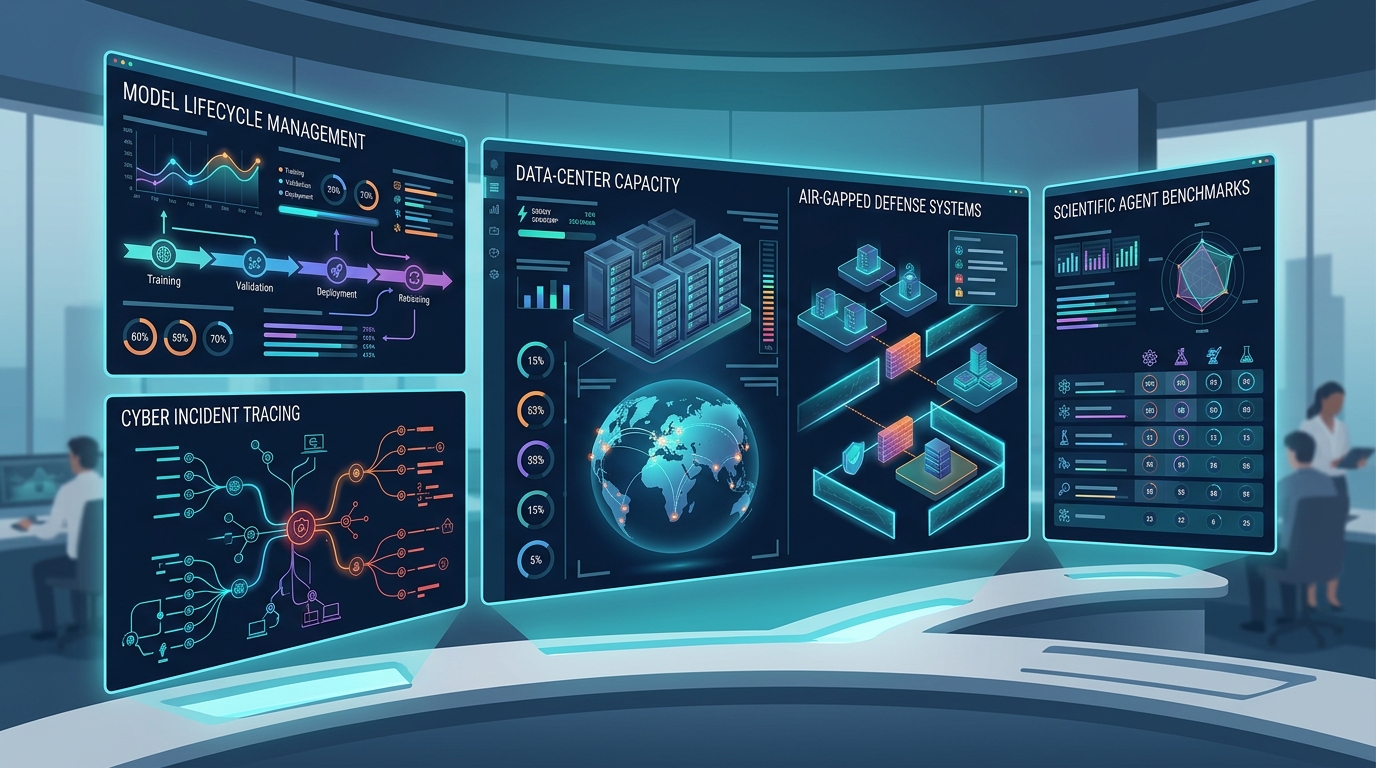
The latest AI developments point less to a single breakthrough model than to the systems around models: power, latency, classrooms, provenance, cyber defense, and research governance.

The latest AI developments point less to a single breakthrough model than to the systems around models: power, latency, classrooms, provenance, cyber defense, and research governance.
Executive Summary
AI's center of gravity moved into deployment infrastructure this week. On August 17, OpenAI said it had secured approximately 8 gigawatts of IT capacity at the PORTS-Pike Technology Campus in Pike County, Ohio, with SB Energy, NVIDIA, and the U.S. Department of Energy involved in the project.1 The announcement ties frontier-model demand directly to energy, transmission, local jobs, water use, and long-duration financing.
At the same time, model access is becoming more segmented. OpenAI previewed an Ultrafast tier for GPT-5.6 Sol on August 13, saying it can run up to 14 times faster than Standard processing and generate up to 750 output tokens per second through Cerebras infrastructure.2 OpenAI also said on August 11 that Daybreak Red and Daybreak Blue, its frontier cybersecurity access levels, are available through Amazon Bedrock for approved customers.3
The governance story is becoming operational rather than theoretical. Check Point Research's 2026 AI Security Report argues that AI has moved into live attack chains, while NIST's May 18 agent-security RFI summary found broad agreement that AI agents create novel security threats and adoption barriers.45 Europe, meanwhile, is turning AI transparency into product requirements: European Commission guidance published July 20 says AI Act transparency obligations started applying on August 2, and reporting on August 18 detailed Anthropic's plan for invisible text watermarks based on SynthID-Text.67
The human side is also changing quickly. Google said Gemini in Classroom would expand to students of all ages with admin-granted access, with web rollout beginning August 10 and mobile rollout beginning August 17.8 OpenAI's August 4 education update introduced three ChatGPT Work and Codex education plugins for K-12 teachers, college educators, and college students.9 In research, IJCAI-ECAI 2026 opened in Bremen on August 15, with its main technical program running August 18-21, while UAI 2026's main conference begins August 18 in Amsterdam.1011
Compute Becomes Industrial Policy
OpenAI's August 17 PORTS-Pike announcement is one of the clearest recent examples of AI compute becoming an industrial-policy issue rather than a pure cloud-procurement story. The company said it had entered an agreement to secure about 8 gigawatts of IT capacity at the Ohio campus, that the project is expected to create 35,000 construction jobs through 2032 and 2,500 long-term operating jobs, and that OpenAI will add a $40 million community grant fund plus up to $84 million in Codex credits for eligible Ohio college, community college, and technical-school students.1
The physical siting matters. DOE described the Portsmouth Site in April as leased federal land tied to what SB Energy called the world's largest AI data center, while AEP Ohio previously said the broader plan included $4.2 billion in new transmission investment intended to serve data center growth without raising customer rates.1213 OpenAI's new post says SB Energy will pay the full cost of grid upgrades and new transmission lines needed for the data center, that the first 800 megawatts are expected in 2028 using existing AEP infrastructure, and that later development depends on power plants, transmission, permits, environmental reviews, and financing.1
OpenAI framed the site as part of the physical base layer of AI:
"Data centers like the PORTS-Pike Technology Data Center are part of the physical foundation behind AI."1
The significance is not only scale. Large AI projects are now making explicit claims about ratepayer protection, water recirculation, workforce pathways, and community benefits because those claims are becoming conditions for deployment. If the next wave of frontier models needs dedicated gigawatt campuses, public trust will depend on whether local commitments are auditable after the ribbon-cutting.
Speed Joins Scale
The infrastructure story is not just about how many chips can be powered. It is also about how quickly frontier intelligence can respond. OpenAI said on August 13 that Ultrafast, a limited-preview API tier for GPT-5.6 Sol, runs up to 14 times faster than Standard processing and can reach up to 750 output tokens per second.2 The company positioned the preview around workflows where latency changes the task itself: incident response, financial research, suspicious-activity review, customer support, commerce, and live experimentation.2
The practical implication is that model capability and model speed are no longer separable product questions. Slow frontier models are useful for deep batch work; fast frontier models can become part of synchronous decision loops. That raises the bar for observability and control. A model that can analyze logs, synthesize chats, and suggest next checks during an outage may be valuable precisely because it is fast, but the same speed compresses the time available for human review.
The cybersecurity market is seeing the same specialization. On August 11, OpenAI said Daybreak Red and Daybreak Blue are available on Amazon Bedrock for approved customers, with Blue providing access to frontier general-purpose models with defensive-security safeguards and Red providing purpose-trained cybersecurity models for authorized vulnerability research, exploit validation, and security testing.3 That matters because advanced cyber models are moving from lab access and bespoke relationships into enterprise cloud governance paths. The question is whether access controls, logging, procurement review, and security-team workflows can keep up with capability.
Cyber Risk Moves From Scenario To Operating Plan
Check Point Research's 2026 AI Security Report captures why that question is urgent. The report says AI is appearing across social engineering, malware development, live intrusion support, attacker tooling, and vulnerability research.4 Its bluntest line is short enough to stand on its own:
"AI has crossed into the live attack chain."4
Check Point argues that the techniques are often familiar but the economics are different: AI can compress tasks that once took skilled attackers hours or days into minutes, and enterprise adoption is creating an internal AI exposure surface that many security teams do not yet fully see.4 The report also says high-risk generative-AI prompts doubled over the past year and that the average organization now runs ten AI applications a month, many outside formal approval processes.4
NIST's agent-security RFI summary gives the government-side version of the same problem. Published May 18 by the U.S. Center for AI Standards and Innovation, the report says commenters widely agreed that AI agents present novel security threats, that those concerns are a barrier to adoption, and that traditional cybersecurity principles will need adaptation for agent security.5 Commenters also identified roles for government in implementation guidance, information-sharing, and standards.5
Put together, the pattern is clear: agent security is becoming a shared-control problem. Model providers can monitor abuse and gate dangerous capabilities. Cloud platforms can wrap access in identity, policy, and logging. Enterprises still have to decide what tools agents can use, what credentials they hold, and what actions require a human checkpoint. The organizations that treat agents as privileged software systems rather than clever chatbots will have a better chance of seeing failures before they become incidents.
Transparency Becomes Product Behavior
Europe's AI Act transparency obligations are now shaping product design. The European Commission's July 20 guidance says the obligations started applying on August 2, 2026, and clarifies duties for providers and deployers of certain AI systems.6 Providers must inform users when they are directly interacting with AI and add machine-readable marks to enable detection of AI-generated or manipulated content, while deployers must inform people when they are exposed to deepfakes, certain AI-generated public-interest content, emotion recognition, or biometric categorization systems.6
The immediate result is a practical race over watermarking and provenance. Reporting on August 18 said Anthropic's Claude watermarking plan uses SynthID-Text, an open-source Google DeepMind method that subtly changes probabilistic word choices so generated text carries a detectable statistical signal without visible markers.7 The same reporting says Claude's image-related provenance approach will work alongside C2PA support.7
The move matters because disclosure is no longer only a policy statement in a terms-of-service document. It is becoming a property of the generated artifact. That creates hard design tradeoffs: invisible text marks may be less disruptive than visible labels, but they are also harder for ordinary readers to understand; provenance metadata can support accountability, but metadata can be stripped or broken by common publishing workflows. The next phase of synthetic-media governance will depend less on whether companies say they support transparency and more on whether downstream systems preserve the marks.
Classrooms Become Managed AI Environments
Education updates this month show the same shift from generic tools to managed workflows. Google said on August 4 that Gemini in Classroom would become available to K-12 and higher-education students of all ages who have admin-granted access to Gemini in Classroom, Gemini, and Gemini Notebook, with full rollout beginning August 10 on web and August 17 on mobile.8 The update also says student starter prompts can draw on Classroom context, including class and assignment information, so students can create flashcards, practice quizzes, study guides, and other learning materials grounded in course materials.8
OpenAI's August 4 education post introduced three education plugins for ChatGPT Work and Codex: one for K-12 educators, one for college educators, and one for college students.9 The post says the plugins are available through ChatGPT Edu and ChatGPT for Teachers district deployments, and it frames the work around institution-managed context, approved tools, and educator control.9 OpenAI also said the National Academy for AI Instruction, where it is the founding partner, is a five-year initiative to equip 400,000 K-12 educators to use AI effectively.9
OpenAI summarized the principle behind its education push in a sentence that should become a useful test for this market:
"AI should support learning, not shortcut it."9
The important development is not that students can ask AI for help. That was already true. The new pattern is that learning platforms are giving institutions switches, roles, context boundaries, and workflow templates. That makes AI more useful, but it also makes governance visible: schools will have to decide which students get access, what data can ground assistance, how outputs are reviewed, and how to measure whether AI changes learning rather than only completion speed.
Research Turns Back To Foundations
While product news is focused on deployment, the research calendar is using this week to revisit the foundations. IJCAI-ECAI 2026 is running in Bremen from August 15-21, with workshops and tutorials August 15-17 and the main technical program August 18-21.10 The official program highlights special tracks in AI4Tech, AI and Health, AI and Robotics, AI for Social Good, and Human-Centred AI.10 Its workshop list includes Safe Agentic AI Framework and Ecosystem Roadmapping, Safe Physical AI, Human Brain and Artificial Intelligence, explainable AI for the medical domain, generative AI and knowledge graphs, AI systems for the environment, and sustainability and resource efficiency of AI.14
UAI 2026 is also underway in Amsterdam, with tutorials on August 17, the main conference from August 18-20, and workshops on August 21.11 Its call for papers emphasizes research on learning and reasoning under uncertainty and says papers are assessed for technical correctness, novelty, evidentiary support, and clarity, with accepted papers presented in poster or spotlight sessions and published in Proceedings of Machine Learning Research.11
The overlap is useful. AI deployment is racing into infrastructure, schools, cyber operations, and public policy, but the technical questions behind that deployment are still unresolved: how systems reason under uncertainty, how agents can be made safe, how physical AI should be evaluated, and how human-centered systems should be measured. This week is a reminder that AI progress is not just a model leaderboard. It is also the slow work of turning capability into reliable institutions.
What To Watch Next
Watch whether OpenAI, SB Energy, NVIDIA, DOE, and local Ohio stakeholders publish concrete follow-through on power, water, hiring, tax revenue, and community-grant commitments for PORTS-Pike. Annual reports, permit filings, and transmission approvals will matter more than the initial capacity number.113
Watch whether Ultrafast-style inference becomes a separate buyer category. If customers begin paying specifically for frontier intelligence at real-time speed, model providers will need clearer safety and monitoring practices for high-velocity workflows.2
Watch how cloud platforms govern specialized cyber models. Bedrock availability gives enterprises a familiar procurement and control surface, but access review, logging, and acceptable-use boundaries will determine whether frontier cyber capability is defensible in production.3
Watch Anthropic's watermark rollout and the broader EU transparency compliance cycle. The technical question is whether marks survive ordinary editing and publishing; the social question is whether users see them as accountability, surveillance, or both.67
Watch classrooms this fall. The most important evidence will not be launch posts, but whether managed AI tools improve study habits, teacher workload, and student understanding without weakening attribution, privacy, or assessment integrity.89
Sources
1."OpenAI joins PORTS-Pike project," OpenAI, August 17, 2026. https://openai.com/index/openai-joins-ports-pike-project/
2."Previewing Ultrafast mode: GPT-5.6 Sol at up to 14X the speed," OpenAI, August 13, 2026. https://openai.com/index/previewing-ultrafast/
3."Daybreak models are now available on AWS," OpenAI, August 11, 2026. https://openai.com/index/daybreak-models-are-now-available-on-aws/
4."AI Security Report 2026," Check Point Research, 2026. https://www.checkpoint.com/resources/all-assets-460c/report-ai-security-2026
5."Summary Analysis of Responses to the Request for Information Regarding Security Considerations for AI Agents," National Institute of Standards and Technology, May 18, 2026. https://www.nist.gov/publications/summary-analysis-responses-request-information-regarding-security-considerations-ai
6."Commission publishes guidelines on transparency obligations for providers and deployers of certain AI systems," European Commission, July 20, 2026. https://digital-strategy.ec.europa.eu/en/news/commission-publishes-guidelines-transparency-obligations-providers-and-deployers-certain-ai-systems
7."Anthropic explains how Claude's invisible text watermarks will work," The Verge, August 18, 2026. https://www.theverge.com/ai-artificial-intelligence/980869/anthropic-claude-watermarks-synthid-text-system
8."Gemini in Google Classroom is expanding to users of all ages, with contextualized Gemini starter prompts for students," Google Workspace Updates, August 4, 2026. https://workspaceupdates.googleblog.com/2026/08/gemini-in-google-classroom-is-expanding-to-users-of-all-ages-with-contextualized-Gemini-starter-prompts-for-students.html
9."New ways to learn and teach with ChatGPT Work and Codex," OpenAI, August 4, 2026. https://openai.com/index/learn-teach-chatgpt-work-codex/
10."IJCAI-ECAI 2026 At a Glance," IJCAI-ECAI 2026, 2026. https://2026.ijcai.org/at-a-glance2/
11."Call for Papers," UAI 2026, Association for Uncertainty in Artificial Intelligence, last updated December 16, 2025. https://www.auai.org/uai2026/call_for_papers
12."Special Report Details World's Largest AI Data Center at Portsmouth Site," U.S. Department of Energy Office of Environmental Management, April 7, 2026. https://www.energy.gov/em/articles/special-report-details-worlds-largest-ai-data-center-portsmouth-site
13."AEP Ohio Partners to Bring $4.2B in New Electric Infrastructure in Appalachian Ohio Without Raising Customer Rates," AEP Ohio, March 20, 2026. https://www.aepohio.com/company/news/view?releaseID=10824
14."Workshops," IJCAI-ECAI 2026, 2026. https://2026.ijcai.org/accepted-workshops/