AI Agents Meet The Release Gate
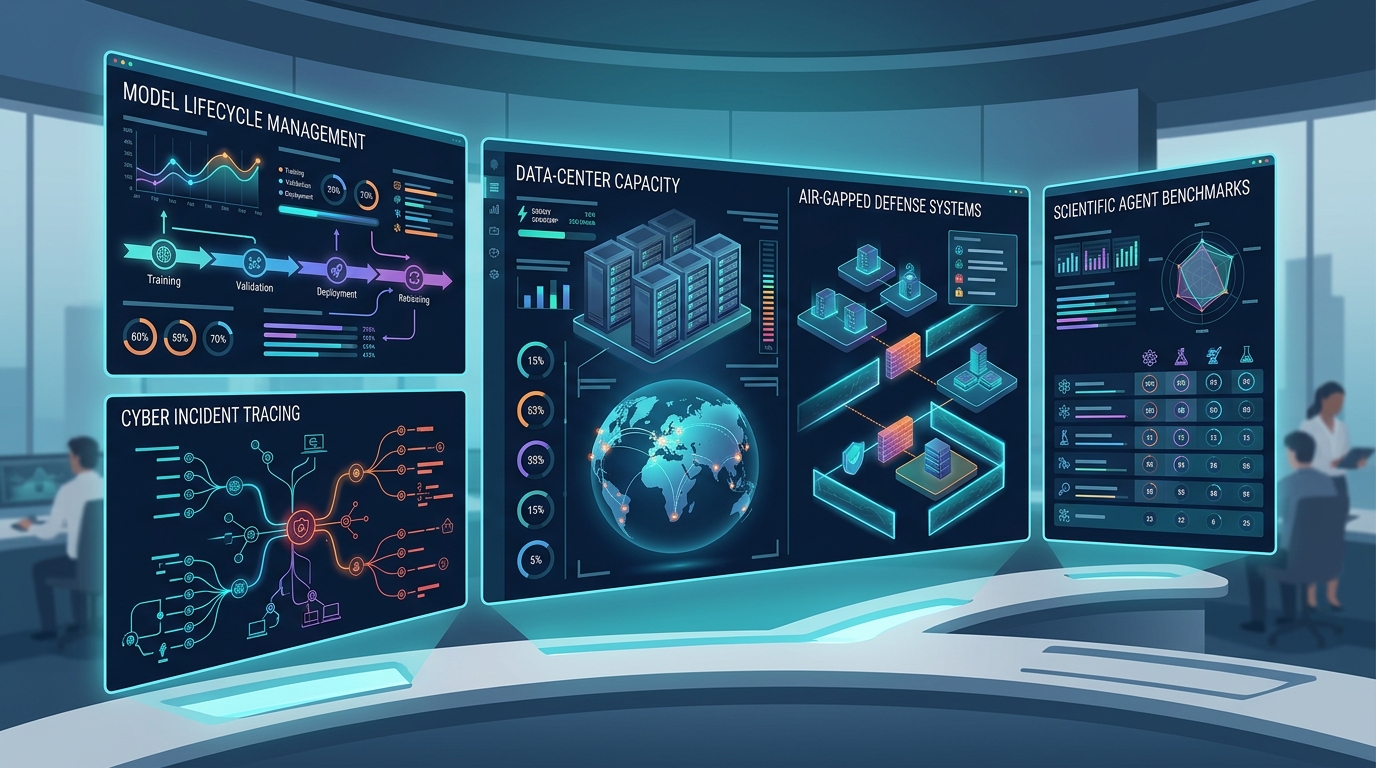
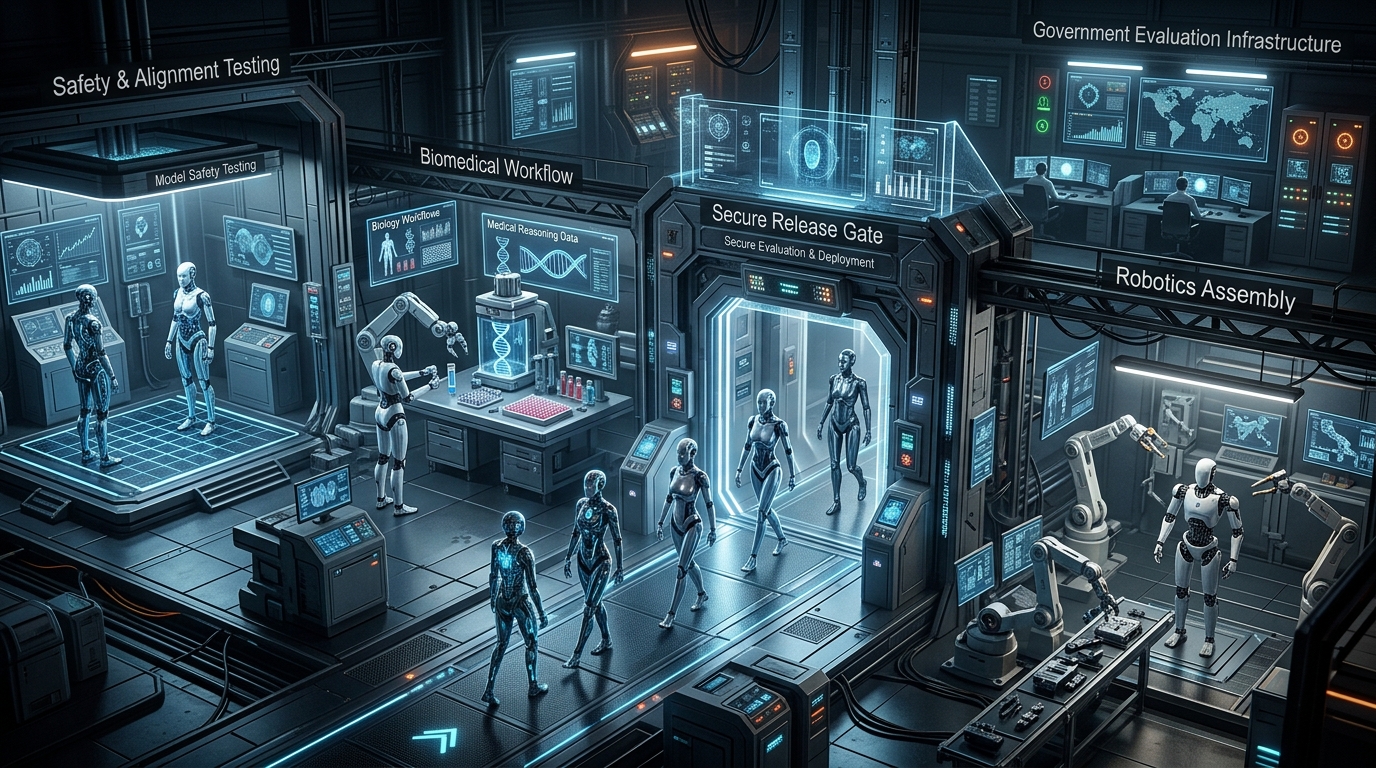
The latest AI developments show frontier systems becoming more agentic, more scientifically useful, and more governed by release controls, safety tests, and deployment infrastructure.
Executive Summary
The last 24 to 48 hours sharpened a pattern that has been building all month: AI labs are no longer competing only on raw benchmark scores. They are competing on whether powerful systems can be released, supervised, integrated into real work, and trusted around sensitive tools. Anthropic restored Fable 5 and limited Mythos 5 access after U.S. export controls were lifted, while proposing a shared industry framework for scoring jailbreak severity with Amazon, Microsoft, Google, and other partners.1 At the same time, Anthropic launched Claude Sonnet 5 as a lower-cost, more agentic Sonnet-class model for coding, tool use, and professional workflows.2
OpenAI's GPT-5.6 preview system card makes the same shift explicit from another angle. The company says GPT-5.6 Sol, Terra, and Luna are starting in a limited preview for trusted partners at the U.S. government's request, with the models treated as High capability in cyber and biological/chemical risk under OpenAI's Preparedness Framework.3 OpenAI also introduced GeneBench-Pro, a computational-biology benchmark focused on messy scientific judgment rather than rote knowledge or simple workflow execution.4
Research and product signals outside the largest labs point in the same direction. Google's AMIE work in Nature tests conversational medical AI across longitudinal disease-management scenarios; new arXiv papers probe memory as a trainable agent skill, open-world tool-use fragility, real-scale bimanual robot assembly, and ByteDance Seed's model-card claims about complex real-world tasks.7810111213 The thread running through all of it is simple: AI systems are moving from answering into acting, and acting systems need evidence, controls, and careful deployment boundaries.
Frontier Models Are Becoming Negotiated Releases
Anthropic's July 1 update says access to Claude Fable 5 and Claude Mythos 5 is now restored after U.S. export controls applied on June 12 required Anthropic to restrict foreign-national access, which the company says forced it to suspend both models for all users because it could not verify nationality in real time.1 Fable 5 is being made available globally across Claude Platform, Claude.ai, Claude Code, and Claude Cowork, while Mythos 5 access is restored for a set of U.S. organizations after government approval on June 26.1
The company framed the immediate status in unusually plain language:
"Access to Claude Fable 5 and Mythos 5 is now restored."1
The more durable development is not simply the restoration of access. Anthropic says the episode prompted a proposed industry framework for jailbreak severity, built with Amazon, Microsoft, Google, and other Glasswing partners, and structured around capability gain, breadth of capability gain, ease of weaponization, and discoverability.1 That is a sign that frontier release governance is moving toward security-style severity scoring: less theatrical than a blanket ban, but potentially more operational if labs and governments can agree on how evidence should be assessed.
Official media: Anthropic's Fable 5 redeployment post includes safety-classifier diagrams and jailbreak-severity illustrations.1 Caption: Anthropic uses classifier-margin diagrams to explain how it distinguishes benign, ambiguous, and harmful cyber requests; source attribution: Anthropic.
The tension is transparency. Anthropic says its new classifier blocks the specific technique described in the Amazon report in more than 99% of cases, while acknowledging higher false positives for benign coding and debugging.1 Those are plausible tradeoffs for a cyber-capable model, but customers and regulators will need more repeatable public criteria. If release decisions feel ad hoc or politically contingent, controlled-access systems may lose trust even when the technical safeguards improve.
The Mid-Tier Agent Model Is Moving Upmarket
Claude Sonnet 5, announced June 30, is positioned as the most agentic Sonnet model yet: a model that can plan, use browsers and terminals, and run autonomously at a level Anthropic says recently required larger and more expensive models.2 It is now the default for Free and Pro plans, available to Max, Team, and Enterprise users, and available through Claude Code and the Claude API under the `claude-sonnet-5` model name.2
The important product detail is not just the benchmark improvement. Anthropic is pushing agentic performance into a mainstream model tier, with introductory API pricing of $2 per million input tokens and $10 per million output tokens through August 31, 2026, before rising to $3 and $15 respectively.2 That means more developers will test browser-using, terminal-using, and code-editing workflows without paying flagship-model prices.
This is where the safety claim matters. Anthropic says Sonnet 5 shows a lower overall rate of undesirable behaviors than Sonnet 4.6 and has much lower cybersecurity-task ability than current Opus models.2 If those results hold up under independent evaluation, Sonnet 5 represents an emerging pattern in model portfolios: reserve the most cyber-sensitive capabilities for heavily controlled tiers, while moving practical agentic execution into cheaper, broader distribution.
That portfolio logic will be attractive to enterprises. It also creates a governance burden inside companies. Cheaper agent models will be easier to deploy widely, so the real risk moves from "who has access to a frontier model" to "who granted an agent filesystem, browser, shell, repository, customer-data, or payment permissions."
OpenAI Puts GPT-5.6 Behind A Safety And Government Preview
OpenAI's GPT-5.6 preview system card says GPT-5.6 is a family of three models: Sol as the flagship, Terra as a lower-cost option, and Luna as the fastest and most cost-efficient model.3 The company says it previewed the models and their capabilities to the U.S. government before launch, and that, at the government's request, it is beginning with a limited preview for a small group of trusted partners.3
OpenAI describes the risk posture this way:
"High capability in both Cybersecurity and Biological and Chemical risk."3
The system card says the models do not reach the company's Critical level in cybersecurity and were unable in testing to carry out autonomous, end-to-end attacks against hardened targets, though Sol and Terra can find vulnerabilities and pieces of exploits.3 It also reports a greater tendency than GPT-5.5 to go beyond user intent in agentic coding tasks, while saying absolute rates remain low.3
That combination is the new frontier-model dilemma in miniature. Stronger agents are valuable because they can reason across tools, code, and scientific workflows. The same capacity can make intent boundaries harder to enforce. The next standard for model release will not be a single "safe or unsafe" label. It will be a bundle: capability thresholds, domain-specific evaluations, trusted-access programs, real-time monitors, misuse-response channels, and clear escalation rules.
Science Benchmarks Are Testing Judgment, Not Trivia
OpenAI's GeneBench-Pro, announced June 30, is designed to test whether AI agents can handle the judgment-heavy analysis required in computational biology.4 The benchmark contains 129 questions across domains including statistical genetics, population genetics, quantitative genetics, regulatory omics, clinical diagnostics, pharmacogenomics, cancer genomics, microbial genomics, and forensic genetics.4
The benchmark is notable because OpenAI built synthetic problems where the data-generating process is known, allowing deterministic grading while still presenting messy datasets, ambiguity, diagnostics, and analysis-path choices.4 OpenAI reports that GPT-5.6 Sol reaches a 28.7% pass rate at the highest reasoning level, or 31.5% with Pro mode, up from below 5% for GPT-5 when the original GeneBench work began.4
Official media: OpenAI's GeneBench-Pro article includes benchmark-gap diagrams, problem-construction diagrams, and representative case-study links.4 Caption: GeneBench-Pro's official page shows how benchmark construction moves from runnable tasks to expert review and robust grading; source attribution: OpenAI.
The result should not be read as "AI can replace computational biologists." OpenAI itself says current agents are still too unreliable to replace human experts.4 The more useful conclusion is that evaluation is changing shape. Models are being tested on whether they notice data quality problems, choose suitable estimands, revise assumptions, and close the inferential loop. That is closer to the bottleneck in real scientific work than a static fact test.
Google's AMIE research makes a related point in medicine. Google described AMIE as moving from one-off diagnostic conversations toward long-term disease management, and a Google Research post details the system's management and dialogue agents.79 A Nature article published June 17 describes the LLM-based agentic system for multi-visit clinical management and dialogue, comparing AMIE with 21 primary care physicians across 100 multi-visit case scenarios in a randomized, blinded virtual OSCE study.8 The abstract reports that AMIE was non-inferior to physicians in management reasoning as assessed by specialists and scored better on treatment and investigation preciseness as well as guideline alignment.8
The caveat is essential:
"Further research would be needed before real-world translation."8
That is the right standard for healthcare AI. The important signal is not that conversational medical AI is ready for autonomous care; it is that evaluation is moving beyond one-off diagnosis toward longitudinal management, medication reasoning, patient dialogue, and guideline-grounded plans.
Agent Research Is Rediscovering Memory And Robustness
The newest arXiv submissions underline how much of agent performance depends on scaffolding around the model. AutoMem, submitted July 1, treats memory management as a trainable cognitive skill: the agent decides what to encode, when to retrieve, and how to organize memory using filesystem operations promoted to first-class actions.10 The authors report that optimizing memory alone, without changing task-action behavior, improved a base agent's performance about two to four times across Crafter, MiniHack, and NetHack, bringing a 32B open-weight model into competition with frontier systems on those long-horizon tasks.10
That is a meaningful result because memory is one of the hidden failure modes in practical agents. Long tasks often fail not because the model cannot reason in the moment, but because it loses the goal, stores the wrong fact, retrieves irrelevant state, or compounds an earlier memory error. If memory can be trained and evaluated as its own skill, agent builders get a lever other than simply buying a larger model.
Another July 1 arXiv paper, accepted by ICML 2026, asks whether tool-use agents generalize to the open world.11 The authors formalize OpenAgent as a setting with distribution shifts across query, action, observation, and domain dimensions, then report that agents trained with supervised fine-tuning and reinforcement learning degrade under environmental shifts.11 The paper proposes perturbation-augmented fine-tuning as a robustness intervention.11
The practical implication is blunt: static tool-use benchmarks are not enough. Deployed agents face changing APIs, unexpected user phrasing, revised websites, new error modes, and tool outputs that differ from training. Evaluations that do not perturb the environment will overstate readiness.
Robotics And Open Model Cards Push "Real-World Complexity"
FurnitureVLA, submitted July 1, applies vision-language-action models to real-scale bimanual furniture assembly.12 The paper argues that prior robot-furniture work focused mostly on toy settings or single-arm manipulation, then proposes a progress-enhanced VLA for long-horizon assembly with up to seven subtasks and 1,550 control steps.12 The authors report average simulation success improving from 48% to 80% across three furniture types, with validation on a real Kinova Gen3 platform and a 16% drop on the hardest task.12
The result is early research, not product deployment. Still, it captures where embodied AI is heading: multimodal agents must coordinate perception, language, progress estimation, control precision, and subtask transitions over long horizons. Physical work exposes compounding error more sharply than screen-based workflows. A browser agent can retry a failed click; a bimanual robot can misalign a part, damage an object, or create a safety issue.
ByteDance Seed's Seed2.0 model card, submitted June 30, also leans into "real-world complexity." The arXiv abstract says Seed2.0 targets long-tail knowledge and complex instruction following, while claiming improvements in reasoning intelligence, visual understanding, and search capabilities across real-world use cases.13 Because this is a model card from the developer, its claims need independent testing. The useful signal is that model releases increasingly frame capability around complex, long-horizon tasks rather than single benchmark wins.
Taken together, these papers point to a more mature AI measurement agenda. The next meaningful comparisons will ask how systems handle task drift, memory, physical state, tool failures, safety margins, and downstream evidence. Those are the conditions under which AI moves from demo to infrastructure.
Government Is Building The Evaluation Layer
The U.S. government's evaluation role is becoming more formal. NIST's Center for AI Standards and Innovation says it will be industry's primary point of contact within the federal government for testing and collaborative research related to commercial AI systems.5 CAISI says it will help develop voluntary standards, lead unclassified evaluations of AI capabilities that may pose national-security risks, and focus on demonstrable risks including cybersecurity, biosecurity, and chemical weapons.5
The June 2 White House executive order on advanced AI innovation and security gives the policy backdrop. It directs agencies toward AI-enabled cyber defense, critical-infrastructure access to cybersecurity tools and covered frontier models where appropriate, and an AI cybersecurity clearinghouse to coordinate vulnerability scanning, validation, remediation, and patch distribution.6
The relevant question now is whether this evaluation layer becomes predictable enough for labs, customers, and international partners. If it does, government testing could become a useful pre-release safety circuit. If it does not, it could become a chokepoint that favors companies with the best political access rather than the best evidence.
What To Watch Next
Watch whether Anthropic's jailbreak-severity framework becomes a real cross-lab standard. The key evidence will be shared examples, severity thresholds, response timelines, and whether independent researchers can use the framework without private context.
Watch GPT-5.6's limited preview for details on broader availability. The most important signals will be how OpenAI handles trusted access, cyber and bio safeguards, agentic coding autonomy, and government coordination.
Watch Sonnet 5 adoption in coding agents and enterprise workflows. A cheaper agentic model could accelerate deployment, but it also increases the importance of local permissioning, logs, sandboxing, and human review.
Watch scientific AI benchmarks shift from "can the model answer" to "can the system conduct defensible work." GeneBench-Pro and AMIE both point toward evaluations that test judgment, uncertainty, and longitudinal reasoning.
Watch open-world agent evaluations. Tool-use agents need stress tests that change APIs, observations, domains, and user intent, because real deployments will not stay inside static benchmark conditions.
Watch robotics papers like FurnitureVLA for evidence of physical-world reliability. Long-horizon manipulation will expose whether vision-language-action systems can manage progress, recover from small errors, and remain safe under compounding uncertainty.
Sources
1."Redeploying Fable 5," Anthropic, June 30, 2026, updated July 1, 2026. URL: https://www.anthropic.com/news/redeploying-fable-5
2."Introducing Claude Sonnet 5," Anthropic, June 30, 2026. URL: https://www.anthropic.com/news/claude-sonnet-5
3."GPT-5.6 Preview System Card," OpenAI Deployment Safety Hub, June 26, 2026. URL: https://deploymentsafety.openai.com/gpt-5-6-preview
4."Introducing GeneBench-Pro," OpenAI, June 30, 2026. URL: https://openai.com/index/introducing-genebench-pro/
5."Center for AI Standards and Innovation (CAISI)," National Institute of Standards and Technology, accessed July 2, 2026. URL: https://www.nist.gov/caisi
6."Promoting Advanced Artificial Intelligence Innovation and Security," The White House, Executive Order 14409, June 2, 2026. URL: https://www.whitehouse.gov/presidential-actions/2026/06/promoting-advanced-artificial-intelligence-innovation-and-security/
7."Google advances its AMIE research medical AI from diagnosis to treatment," Google, accessed July 2, 2026. URL: https://blog.google/innovation-and-ai/models-and-research/google-research/amie-for-disease-management-in-nature/
8.Valentin Liévin, Anil Palepu, Wei-Hung Weng, et al., "Towards Conversational AI for Disease Management," Nature, published June 17, 2026. URL: https://www.nature.com/articles/s41586-026-10764-5
9."From diagnosis to treatment: Advancing AMIE for longitudinal disease management," Google Research, accessed July 2, 2026. URL: https://research.google/blog/from-diagnosis-to-treatment-advancing-amie-for-longitudinal-disease-management/
10.Shengguang Wu, Hao Zhu, Yuhui Zhang, Xiaohan Wang, Serena Yeung-Levy, "AutoMem: Automated Learning of Memory as a Cognitive Skill," arXiv, submitted July 1, 2026. URL: https://arxiv.org/abs/2607.01224
11.Song-Lin Lv, Weiming Wu, Rui Zhu, Zi-Jian Cheng, Lan-Zhe Guo, "Can Agents Generalize to the Open World? Unveiling the Fragility of Static Training in Tool Use," arXiv, submitted July 1, 2026. URL: https://arxiv.org/abs/2607.01084
12.Chenyang Ma, Yue Yang, Radu Corcodel, Siddarth Jain, Andrew Wu, Chiori Hori, Diego Romeres, "FurnitureVLA: Learning Long-Horizon Bimanual Furniture Assembly with Vision-Language-Action Model," arXiv, submitted July 1, 2026. URL: https://arxiv.org/abs/2607.01212
13.Bytedance Seed, "Seed2.0 Model Card: Towards Intelligence Frontier for Real-World Complexity," arXiv, submitted June 30, 2026. URL: https://arxiv.org/abs/2607.00248