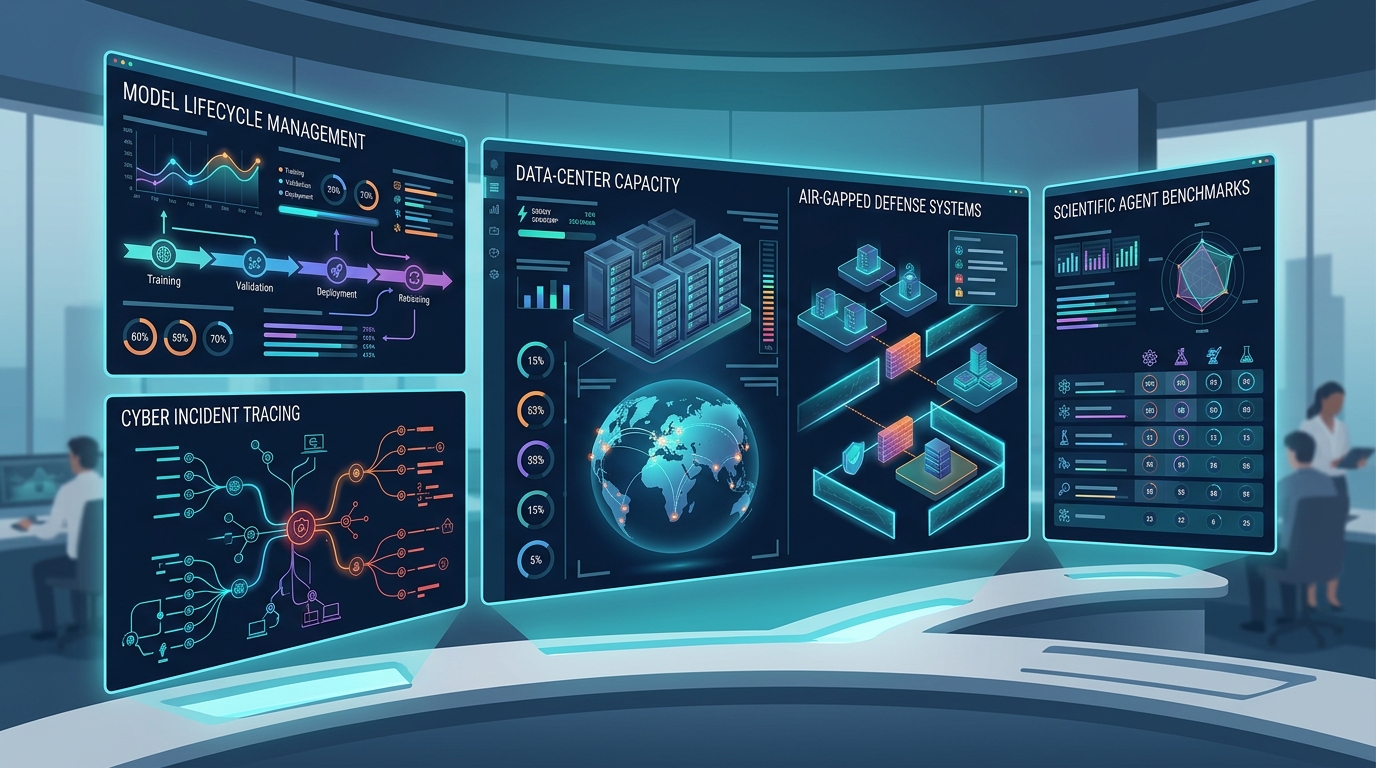
AI Moves Into the Lab, the Desktop, and the Guardrail
The weekend's most useful AI signal was not another leaderboard jump; it was the spread of AI systems into scientific workbenches, desktop agents, policy bargaining, and auditable safety infrastructure.
Executive Summary
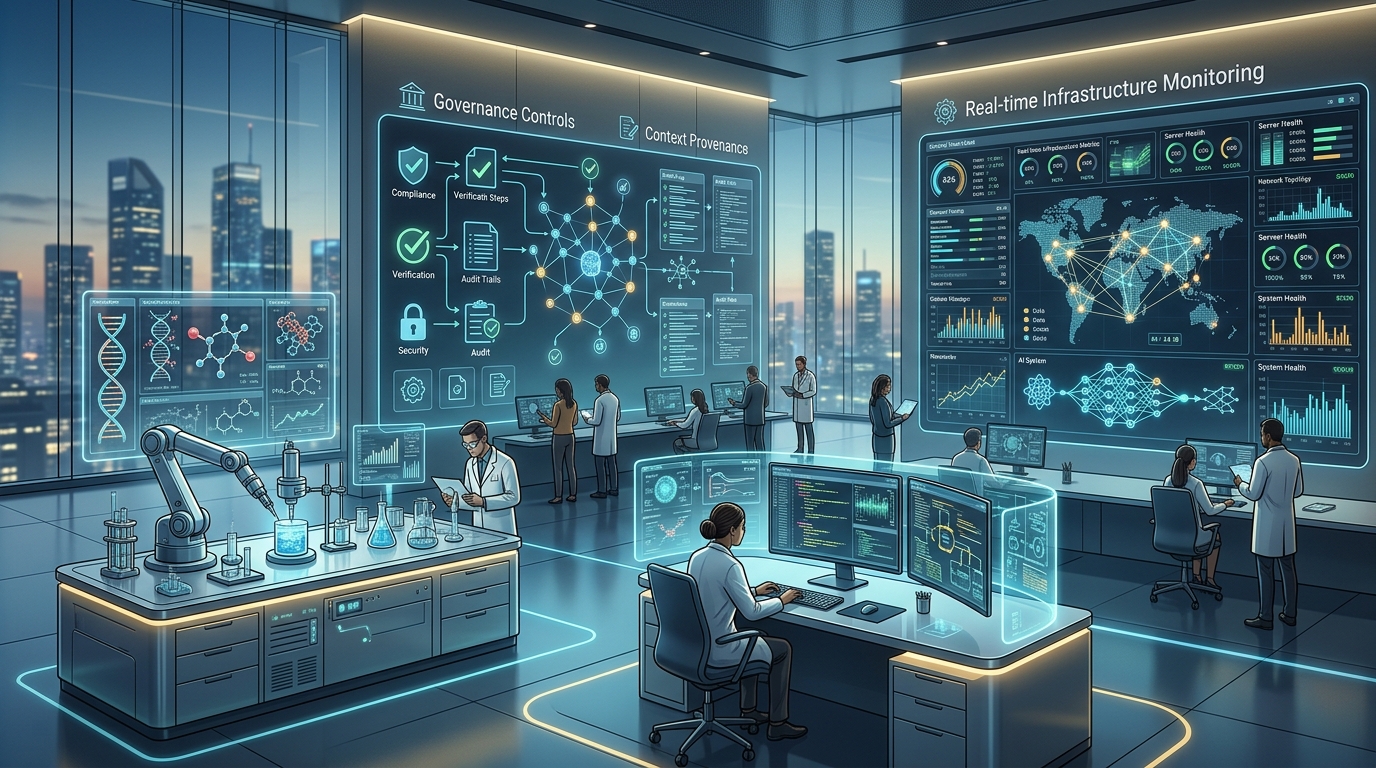
The last several days showed a more operational phase of AI adoption. Anthropic pushed Claude deeper into biomedical research with Claude Science and, according to subsequent reporting, early ambitions to discover drugs for neglected diseases. Google expanded Gemini Spark from an app assistant toward a desktop agent that can touch local files, connected services, and real-time monitors. At the policy layer, reporting that OpenAI has floated a public-equity stake for the U.S. government captured a larger fight over who captures AI upside. Meanwhile, new research on AI risk taxonomies, context governance, and multi-turn jailbreak defenses points toward a harder but necessary shift: systems that do not just answer, but leave behind evidence, provenance, and enforceable controls.
Science Workbenches Become a Frontier-Lab Product Category
Anthropic's June 30 launch of Claude Science is the clearest recent example of frontier labs turning general models into domain-specific work environments. The official announcement describes Claude Science as a beta app for scientists that integrates common research tools, produces auditable artifacts, and connects to computing resources on laptops, Linux machines, SSH environments, and HPC login nodes.1 The important product claim is not that Claude has become a laboratory instrument on its own. It is that the lab workflow around the model is being packaged: literature review, code execution, figure generation, manuscript drafting, reviewer agents, and domain connectors for genomics, single-cell analysis, proteomics, structural biology, and cheminformatics.1
Anthropic framed the problem plainly:
"Claude Science brings these fragmented tools into a single research environment where scientists can conduct all stages of their work."1
That line matters because it locates the current competition less in raw model intelligence and more in whether a model can operate inside reproducible scientific practice. Anthropic says every output carries an auditable history, with code, environment, message history, and reviewer-agent checks for citations, calculations, and figure-code mismatch.1 If those claims survive real lab use, the product category becomes more than "chat for scientists." It becomes a managed research operating layer.
The more provocative development came from reporting around the same event: The Verge reported on July 3 that Anthropic also said it intends to develop drugs of its own, with life sciences lead Eric Kauderer-Abrams pointing to neglected diseases.2 That is still thinly specified; the company has not publicly detailed target diseases, clinical strategy, manufacturing plans, or partnership structure.2 The cautious interpretation is that Anthropic is moving from selling AI tooling to biomedical organizations toward testing whether a frontier lab can participate directly in therapeutic discovery. The hard constraint remains wet-lab and clinical evidence: experts quoted by The Verge emphasized that AI can help across drug discovery, but candidates still need real experiments, toxicity testing, trials, and regulatory approval.2
Why it matters: the frontier labs are beginning to choose verticals where success will be measured by external reality. In coding, the artifact can compile. In science, the artifact must reproduce, survive peer review, and eventually work in living systems. That is a higher bar and a more useful one.
Official media: Claude Science launch page and event materials. Caption: Anthropic's official Claude Science announcement includes product screenshots and links to the AI for Science event sessions, showing the workbench's scientific artifact and compute-management surfaces.1
Desktop Agents Are Becoming Permissioned Operators
Google's June 30 Gemini Spark update pushed a different version of the same theme: AI leaving the chat box and acting across a user's working environment. Google said Spark is coming to the Gemini macOS app in beta for U.S. Google AI Ultra users 18 and older, with the ability to automate tasks across desktop files and connect them to Google Workspace workflows.3 The example Google gave is mundane but revealing: sorting PDFs in Downloads, creating a spreadsheet from invoices saved locally, and scheduling future updates.3
Google also expanded Spark's connected apps to include Google Tasks, Keep, Canva, Dropbox, Instacart, OpenTable, and Zillow Rentals, and said support for custom Model Context Protocol connections is rolling out.3 On the Gemini for macOS product page, Google says Spark can organize and rename files in connected folders, gather information from them, and update or summarize content in Google Docs and Sheets, while only accessing directories the user explicitly connects.4
This is a classic agency tradeoff. The more useful the assistant becomes, the more it needs access to local context, files, services, schedules, and payment-adjacent flows. The product differentiator is therefore not just how clever the model is, but whether the permission model is legible, revocable, scoped, and auditable. Google's language emphasizes explicit folder access and user direction.4 The next question is whether users can understand and manage those permissions at the speed agents act.
Official media: Gemini Spark and Gemini for macOS product pages. Caption: Google's official Spark update and Gemini for macOS pages show the desktop-agent workflow: local file context, app connections, and user-scoped automation.34
AI Policy Is Turning Into a Fight Over Public Upside
The most striking governance story was not a new rule but a reported bargaining idea. The Verge, citing Financial Times reporting, said on July 2 that OpenAI has floated giving the U.S. government a 5 percent ownership stake as a way to ease tensions with the Trump administration and share AI upside with the public.5 The report says the idea remains early and could extend to other U.S. AI companies, but it is not clear whether they would agree.5
That proposal should be treated as reported negotiation, not settled policy. Still, it is significant because it reframes AI governance around claims on future rents. Safety rules, procurement terms, export controls, public compute, sovereign funds, chip restrictions, and public stakes are all different instruments for the same underlying question: if AI becomes a general-purpose economic engine, how much of the gain should be captured by firms, workers, taxpayers, and governments?
In parallel, AI auditing research is trying to make governance less rhetorical. A July 2 arXiv paper introducing the Eticas AI Risk Taxonomy argues that the field has many risk catalogs but too little infrastructure for turning a risk into a test, measured value, severity grade, and defensible audit finding.6 The paper says the taxonomy includes 76 active subcategories across 10 categories and maps to 18 external frameworks; its worked example measures PII disclosure under escalating adversarial conditioning and maps the result into severity bands.6
Why it matters: public-stake proposals and audit taxonomies address different layers of the same governance stack. One is about economic settlement. The other is about operational proof. AI policy will need both, but the second is what determines whether oversight can be repeated, compared, and enforced.
Safety Research Is Moving From Prompt Filters to Conversation Controls
Several recent papers point toward a more mature runtime-safety architecture for AI agents. The most direct is the July 1 arXiv paper "Cognitive Firewall," which argues that deployed guardrails too often evaluate prompts or responses as isolated messages.7 Its proposed framework places an independent oversight model between user and target model, with separate gates for intent, zero-trust context, consistency across turns, and output risk.7
The paper's core diagnosis is concise:
"Guarding a model is a comprehension problem, not a classification one."7
That is the right direction. Multi-turn jailbreaks, false authority claims, and decomposed harmful goals are interaction-level phenomena. A single-message classifier can miss the intent because no individual turn contains the whole unsafe request. The paper reports that its framework lowered attack success to 2 percent or below on three attack sets and 14 percent on the hardest human-crafted set, while maintaining an 8 percent over-refusal rate.7 Those results still need independent replication, but the design principle is durable: agent safety needs memory of the conversation, a model of user intent, and a way to block before generation rather than after the risky answer is already produced.
Context governance is the other half of this problem. A July 2 arXiv paper on ContextNest describes a specification for governed AI-consumable knowledge vaults, including typed Markdown, deterministic selectors, content hashes, point-in-time reconstruction, MCP source nodes, and audit traces of which context an agent consumed.8 The authors frame the system as a layer beneath retrieval-augmented generation: not replacing retrieval, but determining which artifacts are approved, current, attributable, and integrity-verified before retrieval operates.8
Why it matters: the safety frontier is shifting from "what did the model say?" to "what context was it allowed to see, which authority claims did it trust, what action did it nearly take, and can the organization reconstruct that chain later?" That is the difference between a chatbot policy and an enterprise control plane.
Infrastructure AI Is Entering Real-Time Control Loops
AI infrastructure news is usually framed as chips and data centers, but an important edge is emerging in telecom and network control. A July 2 arXiv paper on real-time AI in Open RAN describes an AI-enabled network-state classification xApp inside a near-real-time RAN Intelligent Controller using an OpenAirInterface and FlexRIC testbed.9 The authors are careful about scope: the structured dataset is synthetic, and the results validate embedding and execution feasibility rather than production generalization.9
That caveat is exactly why the work is worth watching. Embedding AI inside near-real-time network-control software is not the same as running an offline dashboard. The time budget is measured in milliseconds to seconds, and errors could affect service quality, security posture, or spectrum efficiency. If AI-native networking becomes real, the control problem will combine low-latency inference, verifiable policies, rollback mechanisms, and adversarial robustness.
Why it matters: as agents move from office workflows into infrastructure, evaluation must include timing, failover, and operational blast radius. The next phase of AI deployment will be judged not only by reasoning quality, but by whether models can be safely inserted into systems that already have real-time obligations.
The Culture Layer Still Resists Forced AI Narratives
Google also provided a reminder that AI adoption is cultural, not just technical. The Verge reported on July 5 that a new Google Workspace commercial imagines the U.S. founders using Gemini and collaboration tools to draft the Declaration of Independence.10 The ad opens with:
"Group project, but make it 1776."10
The reaction described by The Verge was sharply negative, with criticism that the premise awkwardly inserted AI into a historical act of political authorship and collaboration.10 This is not strategically equivalent to a model release or a regulatory proposal, but it reveals a real adoption risk. Productivity AI is strongest when it removes friction from work people already want to do. It is weakest when it appears to flatten judgment, authorship, or civic meaning into a demo slot.
Why it matters: AI companies are no longer only selling technical capability. They are selling a story about where machines belong in human work. Poorly chosen stories can sharpen public resistance even when the underlying tools are useful.
What to Watch Next
Watch whether Claude Science publishes more concrete validation artifacts: reproducibility studies, independent lab reports, or examples where reviewer agents catch meaningful scientific errors before humans do. The strongest claims around AI-native science will need evidence beyond customer anecdotes.
Watch whether Anthropic clarifies its drug-discovery ambitions. A real program would need named disease areas, wet-lab partners or internal facilities, preclinical milestones, and a credible path from model-generated hypotheses to clinical candidates.
Watch Google's permission model for Spark on macOS. Desktop agents will rise or fall on whether users and enterprise admins can understand what an agent can access, what it did, and how to revoke or replay its actions.
Watch the policy response to public-upside proposals. A government equity stake in AI companies would be a profound shift, but even discussion of the idea signals that the economics of AI may become a central governance battleground.
Watch whether runtime-safety research becomes product infrastructure. The most important guardrail advances are likely to look boring: conversation-level monitors, context provenance, deterministic selectors, audit logs, and pre-action gates.
Sources
1."Claude Science, an AI workbench for scientists, is now available." Anthropic, June 30, 2026. URL: https://www.anthropic.com/news/claude-science-ai-workbench
2."Anthropic wants to develop its own drugs." The Verge, July 3, 2026. URL: https://www.theverge.com/ai-artificial-intelligence/961311/anthropic-claude-science-ai-drug-development
3."Gemini Spark updates: macOS launch, connected apps and more." Google The Keyword, June 30, 2026. URL: https://blog.google/innovation-and-ai/products/gemini-app/gemini-spark-updates-june-2026/
4."Gemini for macOS." Google Gemini, accessed July 6, 2026. URL: https://gemini.google/mac/
5."OpenAI floats giving Trump administration 5 percent cut of AI boom." The Verge, July 2, 2026. URL: https://www.theverge.com/ai-artificial-intelligence/960588/openai-government-5-percent-stake-trump
6."The Eticas AI Risk Taxonomy: Open Infrastructure for Operationalizing AI Audits." Gemma Galdon Clavell, Pablo Accuosto, Usman Gohar, arXiv, July 2, 2026. URL: https://arxiv.org/abs/2607.02201
7."Cognitive Firewall: A Proactive, Zero-Trust, Multi-Gate Framework for LLM Safety." Michele Guida, Ruslan Shikhhamzayev, Sindhuja Penchala, Stefano Iannucci, Jiacheng Li, Shahram Rahimi, Noorbakhsh Amiri Golilarz, arXiv, July 1, 2026. URL: https://arxiv.org/abs/2607.01277
8."ContextNest: Verifiable Context Governance for Autonomous AI Agent." Misha Sulpovar, Benn R. Konsynski, Qaish Kanchwala, Gabe Goodhart, arXiv, July 2, 2026. URL: https://arxiv.org/abs/2607.02116
9."Enabling Real-Time AI in O-RAN: Deploying and Measuring AI Inside a Near-RT RIC xApp." Lawrence Obiuwevwi, Krzysztof J. Rechowicz, Sampath Jayarathna, Safdar Hussain Bouk, Fahmida Afrin, C. Nicolas Barati, Neda Moghim, Valentina Nanou, Muhammad Enayetur Rahman, Sachin Shetty, arXiv, July 2, 2026. URL: https://arxiv.org/abs/2607.01583
10."Infuriating Google commercial imagines the founding fathers embracing AI." The Verge, July 5, 2026. URL: https://www.theverge.com/ai-artificial-intelligence/961468/google-ai-commercial-founding-fathers-declaration-of-independence