AI Moves From Demo to Deployment
The latest AI developments show frontier systems being judged less by novelty than by whether they can navigate real environments, secure public infrastructure, survive geopolitical scrutiny, and fit inside human creative work.
Executive Summary
The last 48 hours were not defined by one giant general-purpose model launch. They were defined by a more practical shift: AI systems are being pushed into domains where failures have institutional consequences. Mistral introduced Robostral Navigate, an 8B embodied-navigation model that uses only a single RGB camera while claiming state-of-the-art results on unseen R2R-CE environments.1 The European Commission published an Action Plan on Cybersecurity and Artificial Intelligence on July 7, then escalated separate NIS2 cybersecurity enforcement against four member states on July 8.23 China said it had found security vulnerabilities in Anthropic's Claude Code, a claim that remains contested and politically loaded but still signals that coding agents are becoming objects of national security review.4 In media, the AI-generated performer Tilly Norwood was announced for a feature film, keeping labor, likeness, and synthetic-performance rights in the center of the AI debate.5
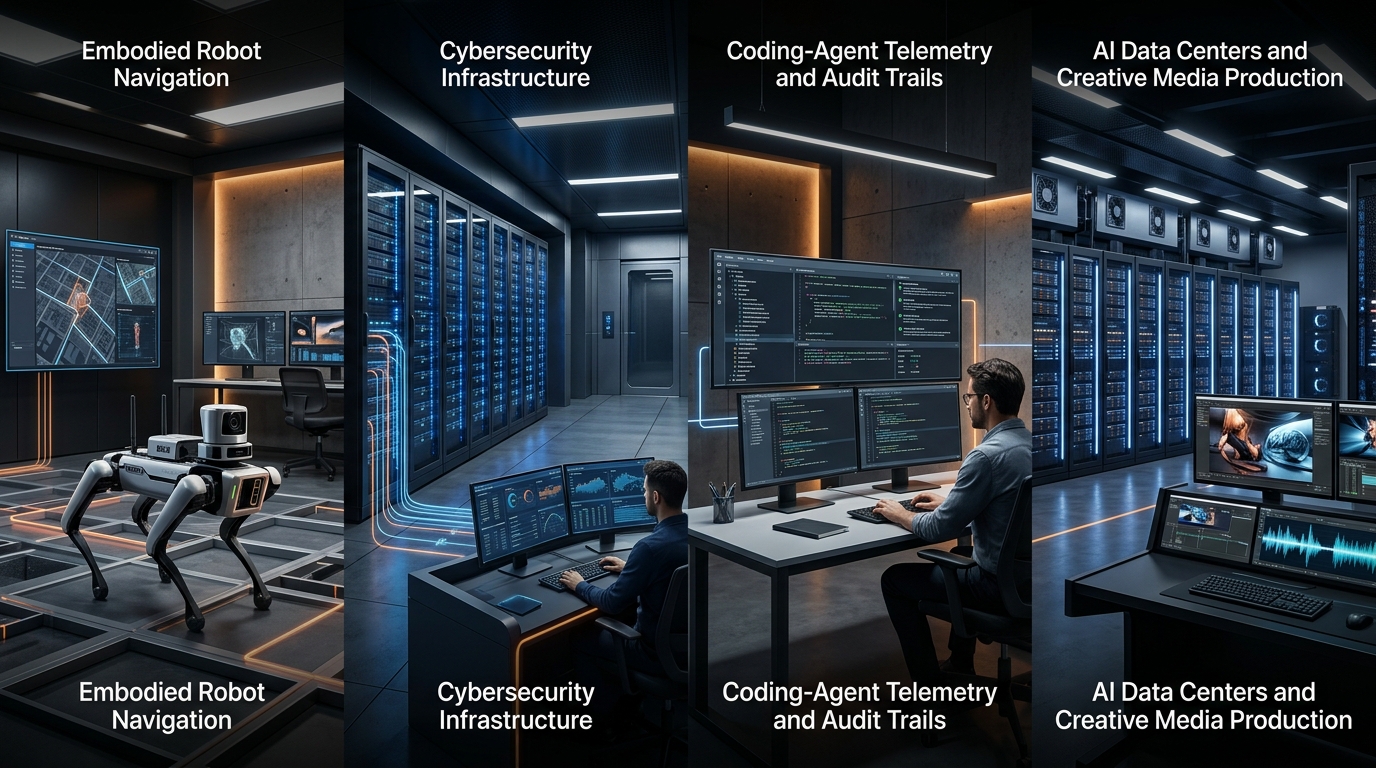
The connective tissue is accountability. AI is moving into robots, codebases, state cybersecurity planning, film production, and data-center standards. That makes evaluation, provenance, contractual rights, and operational transparency more important than leaderboard movement alone.
Robotics: Navigation Gets Smaller and More Embodied
Mistral's July 7 Robostral Navigate release is a notable robotics marker because it attacks a practical bottleneck: getting robots to follow natural-language route instructions without a heavy sensor stack. Mistral says the model has 8 billion parameters, takes RGB images plus plain-language instructions, and can navigate using a single ordinary camera rather than LiDAR, depth sensors, or multi-camera rigs.1
The headline metric is the company's claimed 76.6 percent success rate on R2R-CE validation unseen, with Mistral saying the model beats the best single-camera approach by 9.7 points and the best depth-or-multi-camera system by 4.5 points.1 The company also says Robostral Navigate was built in-house, trained entirely in simulation, and learned from about 400,000 trajectories across 6,000 scenes.1
Mistral framed the task in ordinary language:
"Leave the lobby, walk through the corridor, enter the supply room, and stop to face the second shelf."1
Why it matters: if these claims hold up under independent replication, embodied AI can become less dependent on expensive hardware configuration and more portable across robot types. The strategically important part is not simply that a robot can move. It is that navigation begins to look like a foundation capability for general-purpose robotics, closer to an interface layer that can connect perception, instruction-following, and task execution.
Media note: Mistral's official Robostral Navigate release page includes benchmark imagery and product visuals for the model.1
Cybersecurity: Europe Treats AI as Both Tool and Threat
The European Commission's July 7 Action Plan on Cybersecurity and Artificial Intelligence is another sign that governments are reorganizing cyber policy around advanced models. The Commission says AI can be misused to identify vulnerabilities, automate attacks, and increase the scale and speed of cyber incidents; it also says the plan will coordinate member states, industry, and EU-level organizations around AI-related cyber risks.2
Executive Vice-President Henna Virkkunen put the policy problem plainly:
"AI is transforming the meaning of cybersecurity. And we must keep pace."2
The next day, July 8, the Commission separately referred Ireland, Spain, France, and the Netherlands to the Court of Justice of the European Union for failing to notify full transposition of the NIS2 Directive, which covers cybersecurity standards for 18 critical sectors including health, energy, transport, and the public sector.3 The referral includes a request for financial sanctions until complete transposition is notified.3
Why it matters: AI cybersecurity is no longer just a product-security niche. It is becoming a governance layer for critical infrastructure. The EU is pairing AI-specific planning with old-fashioned enforcement of baseline cyber law. That combination matters because model-enabled attack automation only becomes manageable if hospitals, energy systems, transport networks, and public agencies have minimum cyber hygiene in place before the model layer is added.
Coding Agents: Claude Code Enters a Geopolitical Security Dispute
China said on July 8 that its National Vulnerability DataBase had found "security backdoor vulnerabilities" in Anthropic's Claude Code, according to The Wall Street Journal.4 The report says several Claude Code versions released between April and June could transmit sensitive information such as user location and identity to remote servers through a built-in monitoring mechanism, and that the agency advised users to uninstall or update the software.4 The same report says Anthropic did not immediately respond to a request for comment.4
This should be read carefully. The public record available today is not enough to treat China's characterization as independently proven. It arrives amid broader U.S.-China AI tensions, restrictions on access to frontier models, and disputes over model distillation. But the story still matters because agentic coding tools now sit directly on developer machines, inside repositories, and near secrets. Even when monitoring is intended for anti-abuse, export-control, or anti-resale reasons, hidden or poorly explained telemetry can become a trust failure.
Why it matters: coding agents combine model access, local execution, repository context, and network calls. That makes them harder to classify than ordinary SaaS tools. Expect more governments and large enterprises to demand software bills of materials, telemetry disclosure, local-mode guarantees, and audit logs before allowing coding agents into sensitive engineering environments.
Media and Labor: Synthetic Performers Move From Stunt to Production
The synthetic performer Tilly Norwood is now attached to a feature film. People reported on July 6 that Particle 6 announced Norwood would star in Misaligned, described by the studio as a comedy-drama about an AI being inside a digital world called the "Tillyverse."5 People also reported that Particle 6 said the project is a hybrid production involving directors, writers, editors, and AI specialists.5
The labor tension is not abstract. SAG-AFTRA previously said, in a statement quoted by People, that Norwood is "not an actor" but a computer-generated character trained on professional performers' work without permission or compensation.5 Particle 6's creator-side argument is different: Eline van der Velden said the studio's work showed that AI can support premium narrative filmmaking only with substantial human craft, judgment, and time.5
Why it matters: the Norwood project is less important as a single film than as a test case. If synthetic performers can be packaged, branded, and cast, then entertainment contracts will need sharper rules around training consent, performer likeness, credits, residuals, union coverage, and disclosure to audiences. The industry is moving from "can AI make a clip?" to "who gets paid, credited, protected, and held responsible when AI becomes a cast member?"
Infrastructure and Standards: The Data Center Becomes an AI Policy Object
NIST's AI program page now highlights a July 22-23 virtual workshop with the High Performance Computing Modernization Program on securing AI data centers, including architecture, security posture, and emerging standards.6 NIST frames data centers as the computing infrastructure behind AI training and inference, and says they have become important to national security, economic strength, and technological dominance.6
The same NIST page emphasizes that its AI work includes measurement science, benchmarks, evaluations, risk management, and voluntary technical standards, including the AI Risk Management Framework and the NIST GenAI evaluations program.6 Separately, NIST recently described ManipulationNet, an online robot-skills competition where AI scores physical robot manipulation tasks and experts double-check the scoring.7
Why it matters: AI governance is often discussed as model behavior, content policy, or copyright. But the operational layer is just as consequential. Power, cooling, chips, data-center security, physical access, robotics testbeds, and evaluation infrastructure are becoming part of the AI control surface.
What to Watch Next
Watch whether Mistral releases enough technical detail for Robostral Navigate to be independently tested beyond its own benchmark claims, especially on real-world long-horizon routes and cross-embodiment transfer.1
Watch whether the European Commission's AI-cybersecurity plan produces concrete procurement rules, incident-reporting playbooks, or cross-border evaluation programs, rather than remaining a coordination document.2
Watch whether Anthropic responds publicly to the Claude Code allegations, and whether enterprises begin asking coding-agent vendors for explicit telemetry disclosures, local execution controls, and model-access audit trails.4
Watch whether studios, unions, and insurers treat Tilly Norwood-style synthetic performers as characters, software assets, performers, or something contractually new.5
Watch the July 22-23 NIST AI data-center security workshop for signs of U.S. standards work around AI infrastructure, especially where cyber, export controls, critical energy systems, and high-performance computing overlap.6
Topics Intentionally Skipped
Several market-only AI chip stories were skipped because they were driven by short-term stock movement rather than primary technical or policy disclosures. Pre-release reporting about OpenAI's GPT-5.6 rollout was treated as a watch-list item rather than a confirmed public launch because the available July 8 coverage described an imminent release, not a completed official release.8 Broad NATO-and-AI geopolitical commentary was also skipped because the strongest available sources were interpretive journalism, not primary summit documents. Older model launches from late June were not repeated unless they directly shaped today's deployment-and-governance theme.
Sources
1."Robostral Navigate: single-camera AI navigation," Mistral AI, July 7, 2026. https://mistral.ai/news/robostral-navigate/
2."Commission presents EU Action Plan on Cybersecurity and Artificial Intelligence," European Commission, July 7, 2026. https://digital-strategy.ec.europa.eu/en/news/commission-presents-eu-action-plan-cybersecurity-and-artificial-intelligence
3."Commission refers Ireland, Spain, France and the Netherlands to the Court of Justice for failing to transpose the rules on cybersecurity," European Commission, July 8, 2026. https://digital-strategy.ec.europa.eu/en/news/commission-refers-ireland-spain-france-and-netherlands-court-justice-failing-transpose-rules
4."China Says It Has Found Security Vulnerabilities in Anthropic's Claude Code," The Wall Street Journal, July 8, 2026. https://www.wsj.com/tech/ai/china-says-it-has-found-security-vulnerabilities-in-anthropics-claude-code-5ecf05dc
5."AI Actress Tilly Norwood to Make Feature Film Debut in Comedy-Drama from Its Creator," People, July 6, 2026. https://people.com/ai-actress-tilly-norwood-to-make-feature-film-debut-12012414
6."Artificial intelligence," National Institute of Standards and Technology, accessed July 8, 2026. https://www.nist.gov/artificial-intelligence
7."Spotlight: Test Your Robot's Skills in NIST's Global Online Competition," National Institute of Standards and Technology, released June 24, 2026, updated July 1, 2026. https://www.nist.gov/news-events/news/2026/06/spotlight-test-your-robots-skills-nists-global-online-competition
8."GPT-5.6 buzz builds with launch imminent," Axios, July 8, 2026. https://www.axios.com/2026/07/08/gpt-sol-ultra-openai-anthropic-grok