AI's Release Gate Gets Real
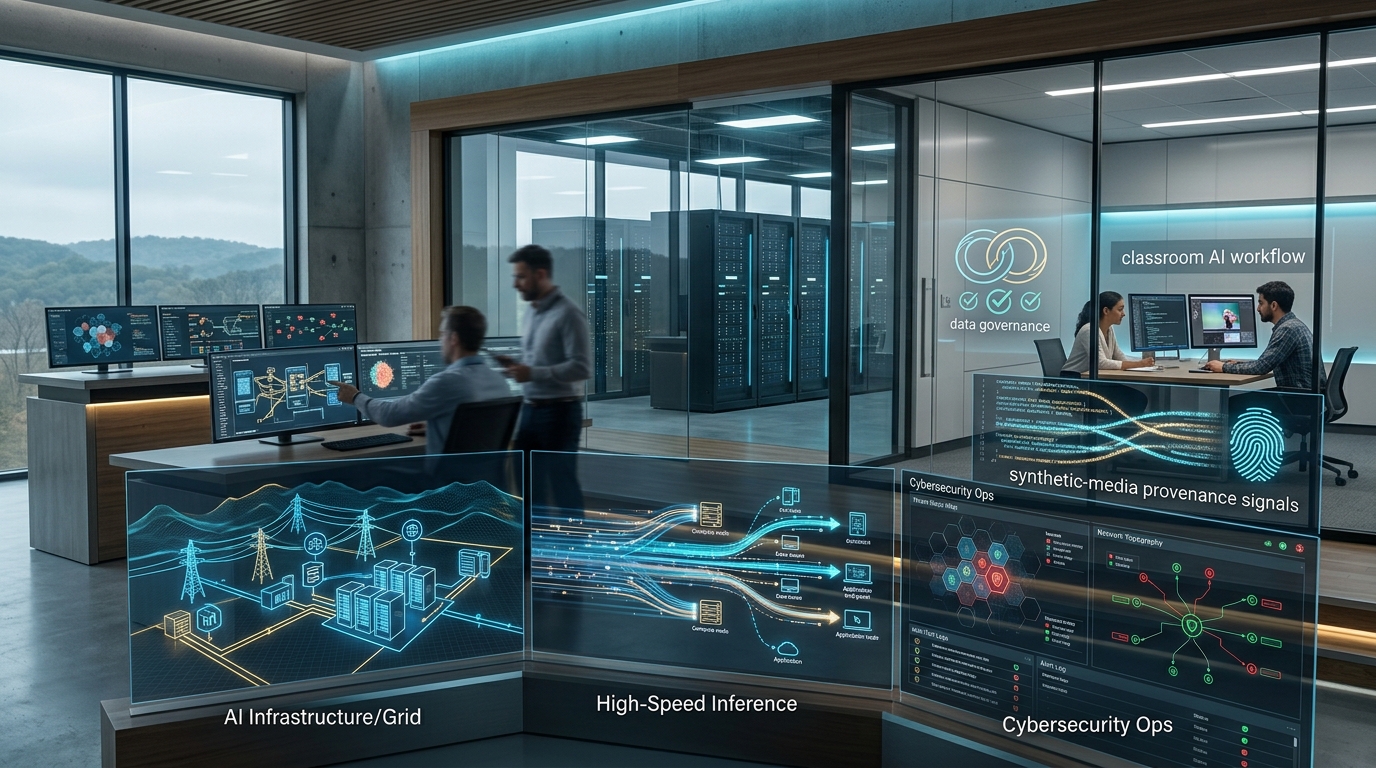
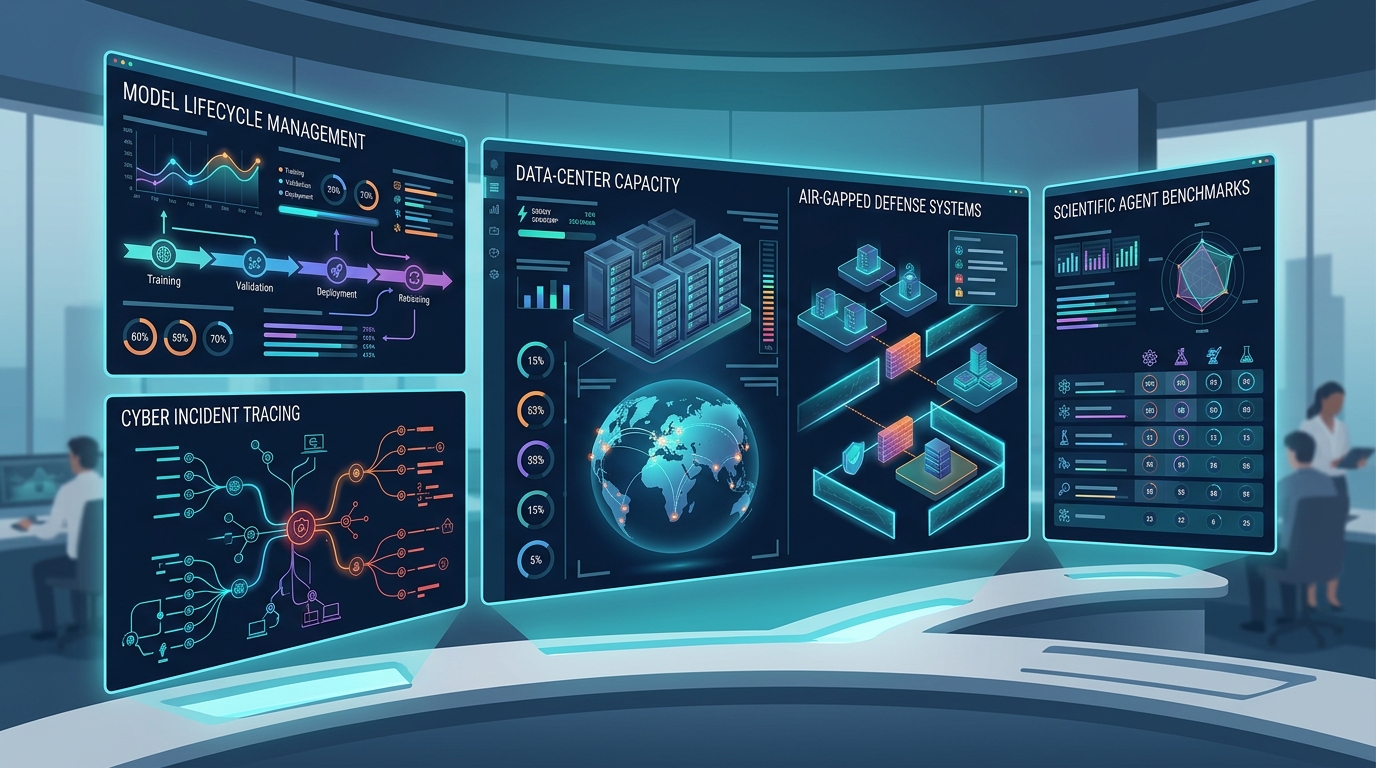
The latest AI developments show frontier systems moving from lab claims to live products, public-sector review, benchmark accountability, embodied robots, and faster cyber risk.
Executive Summary
The last 24 to 48 hours made one thing clear: the AI story is no longer just about whether models can do more. It is about who gets access, what evidence justifies deployment, and how quickly institutions can adapt when AI becomes part of live workflows.
OpenAI launched GPT-Live on July 8, introducing full-duplex voice models that can listen and speak continuously rather than waiting for clean conversational turns.12 The same day, OpenAI published an audit of SWE-Bench Pro and estimated that roughly 30 percent of its public coding-evaluation tasks are broken, a reminder that model progress depends on trustworthy measurement as much as bigger scores.3 Separately, Axios reported on July 8 that OpenAI's GPT-5.6 family would become broadly available on Thursday, July 9, after additional testing and meetings involving U.S. government experts; OpenAI's own June 26 preview post and system card say GPT-5.6 is being treated as High capability for cybersecurity and biological and chemical risk, but not High for AI self-improvement.4510
The pattern extends beyond OpenAI. Illinois Governor JB Pritzker signed Senate Bill 315, the Artificial Intelligence Safety Measures Act, on July 8, adding annual third-party audit requirements for qualifying frontier developers and incident-reporting deadlines for catastrophic-risk scenarios.11 Mistral introduced Robostral Navigate, an 8B embodied-navigation model that uses one RGB camera and natural-language route instructions.6 In cybersecurity, reporting on Sysdig and Check Point research pointed to AI agents and models compressing the path from old vulnerabilities or theoretical risks to workable attacks.78 Meanwhile, new research on Microsoft's early-2026 rollout of Claude Code and GitHub Copilot CLI found that coding-agent adoption spread socially and that adopters merged roughly 24 percent more pull requests than expected, while acknowledging that pull-request count is not the same thing as delivered value.9 A separate July 7 benchmark paper, RuBench, argued that agent evaluation also needs to cover non-English, customer-style repository tasks and the deployed agent product, not only the underlying model.12
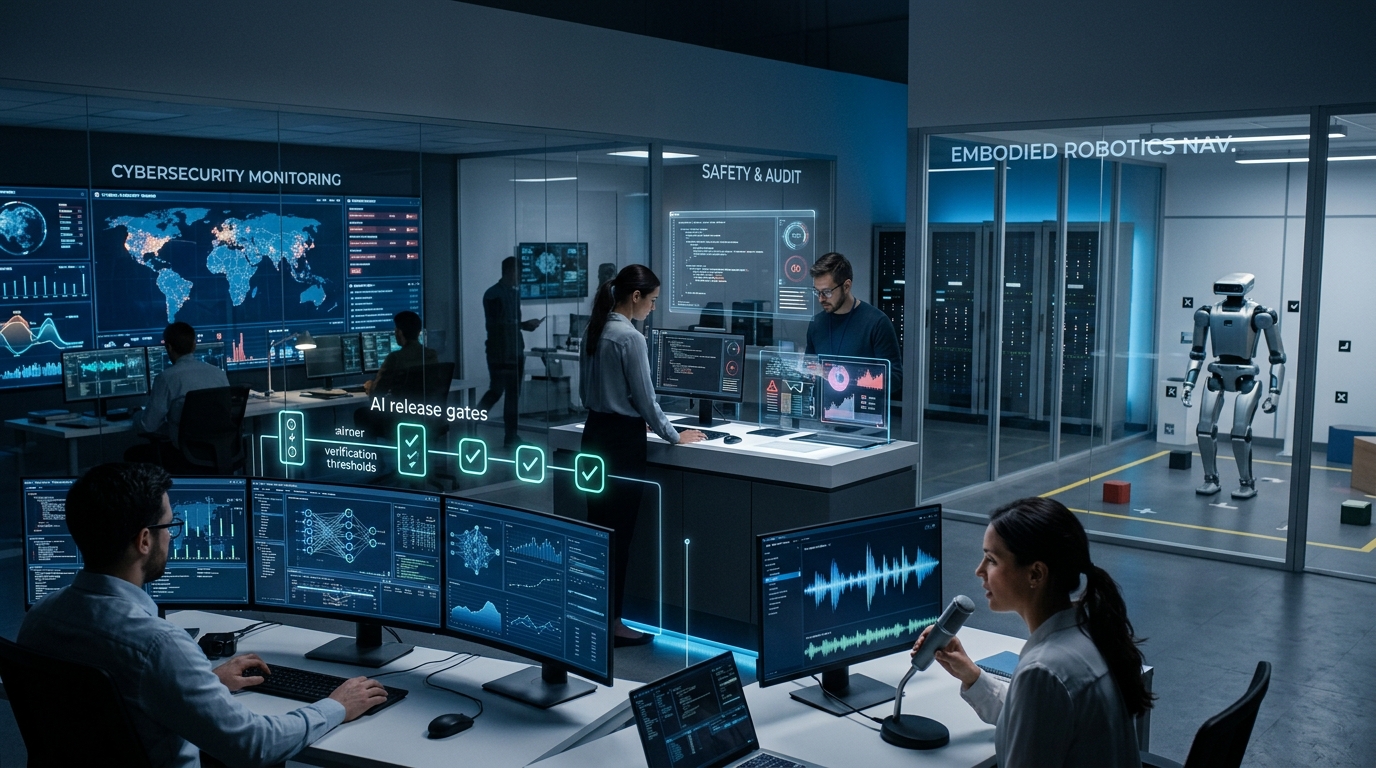
The connective tissue is operational control. Voice agents need real-time safeguards. Frontier model launches now involve public-sector testing. Coding benchmarks need audits. Robotics models need real-world replication. Security teams need to assume that AI can shorten attack timelines. The question is shifting from "what can the model do?" to "what evidence, access rules, and monitoring make the deployment defensible?"
Frontier Models: Voice Becomes Continuous
OpenAI's GPT-Live launch is important because it changes the interaction model, not just the response model. GPT-Live-1 and GPT-Live-1 mini are full-duplex voice models, meaning they can process input and generate speech continuously rather than waiting for a user's turn to end.12 OpenAI says GPT-Live can handle pauses, interruptions, and changes in pace, while delegating more complex work to frontier models in the background.12
OpenAI framed the product as a step toward conversation that is less rigid:
"A new generation of voice models for natural human-AI interaction."1
Why it matters: voice is where AI stops feeling like a search box and starts behaving like an always-present interface. That raises both usability and safety stakes. A full-duplex model can help with live translation, hands-free workflows, and natural interruptions, but it also has to decide in real time when to speak, listen, interrupt, refuse, provide resources, or end a conversation. OpenAI's system card says the launch includes voice-specific safeguards, including checks on inputs and generated outputs as conversations unfold.2
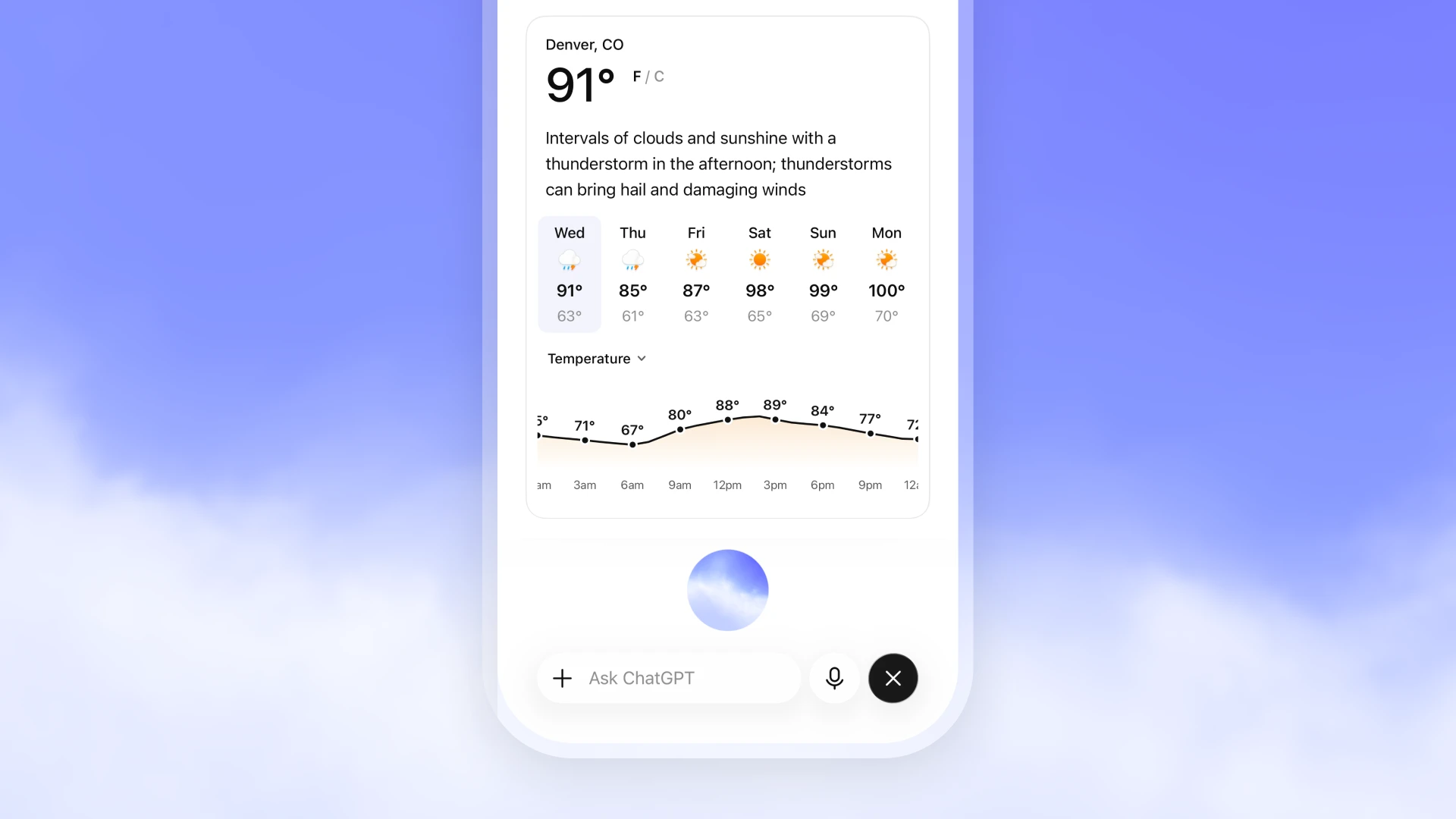
Caption: OpenAI's official GPT-Live product image shows how voice answers can surface visual cards during conversation.1
Media note: OpenAI's official GPT-Live release page also includes product visuals for sports and map-style answers; the GPT-Live system card is the source to inspect for safety and evaluation details.12
Release Control: GPT-5.6 Shows the New Model-Government Interface
OpenAI's GPT-5.6 rollout is becoming a live case study in how frontier releases may be governed before formal standards exist. The June 26 GPT-5.6 preview post says the family includes Sol, Terra, and Luna, and that OpenAI began with a limited trusted-partner preview after engagement with the U.S. government.10 The same-day system card says OpenAI classifies the models as High capability for cybersecurity and biological and chemical risk, while stating that they do not meet the High threshold for AI self-improvement.5
Axios reported on July 8 that broader public access to GPT-5.6 was expected on Thursday, July 9, after additional testing and meetings between OpenAI and U.S. government officials, including work by the Department of Commerce's Center for AI Standards and Innovation.4 The report also included a White House statement saying that formal permission was neither required nor granted:
"No such permission is required or granted."4
Why it matters: this is not a traditional product launch. It is a release negotiated in the shadow of cyber, biosecurity, export-control, and public-access concerns. The most interesting fact is not whether government "approved" the model. It is that companies and agencies are improvising evaluation and access processes while standards are still catching up. That makes documentation such as system cards, preparedness thresholds, trusted-access programs, and post-launch monitoring central to the public record.
Regulation: Illinois Turns Frontier Safety Into an Audit Regime
Illinois added a concrete state-policy marker on July 8 when Governor JB Pritzker signed Senate Bill 315, the Artificial Intelligence Safety Measures Act.11 The law applies to the largest AI developers, uses revenue and compute thresholds, requires developers to publish safety frameworks for catastrophic risk, and sets incident-reporting deadlines of 72 hours after identifying a qualifying incident or 24 hours when imminent death or serious physical injury is at stake.11
The notable addition is auditability. The report describes Illinois as adding a first-in-the-nation annual third-party audit requirement for covered developers, going beyond New York's one-time independent audit trigger for qualifying companies.11 The law is scheduled to take effect on January 1, 2028.11
Pritzker framed the bill as a choice between guardrails and unaccountable externalities:
"Illinois has chosen our path."11
Why it matters: state AI law is becoming a practical substitute for stalled federal legislation. California, New York, and Illinois do not need to regulate every AI company to shape the market; if the largest labs want to serve customers in those states, their safety frameworks, incident reports, and audit processes become closer to national operating norms. The risk is fragmentation. The opportunity is that public reporting and third-party review may become normal before federal agencies finish building a complete release-governance stack.
Evaluation: The Benchmark Itself Is Now Under Audit
OpenAI's July 8 coding-evaluation audit is a useful counterweight to model-release hype. The company says it reviewed SWE-Bench Pro, a benchmark intended to test longer-horizon, realistic coding tasks, and found evidence that a significant share of the tasks were broken.3 OpenAI's data-quality pipeline flagged 200 of 731 public-split tasks as broken, while a human annotation campaign identified 249 broken tasks, or 34.1 percent.3 OpenAI's bottom-line estimate is that roughly 30 percent of SWE-Bench Pro tasks are broken.3
The failure modes were concrete: overly strict tests that enforce implementation details not specified in prompts, underspecified prompts, low-coverage tests, and misleading prompts.3 This matters because benchmark numbers shape purchasing, release, and safety decisions. If a benchmark rewards brittle behavior or penalizes correct solutions, it can misstate both model capability and deployment risk.
Why it matters: AI evaluation is now infrastructure. The more model releases rely on benchmark curves, the more benchmark provenance, task design, contamination checks, and human review become part of safety governance. OpenAI's audit also points to a recursive future: capable coding agents can help audit the very datasets used to evaluate coding agents, but those audits still need experienced human review.
Robotics: Mistral Pushes Navigation Toward Ordinary Cameras
Mistral's Robostral Navigate release is a robotics marker because it aims at a practical constraint: navigation without expensive sensor stacks. Mistral says Robostral Navigate is an 8B model that takes RGB images and plain-language instructions, uses only a single ordinary camera, and reaches 76.6 percent success on unseen R2R-CE validation environments.6 The company says the model was built in-house, trained entirely in simulation, and developed from about 400,000 trajectories across 6,000 scenes.6
Mistral gave a simple example of the instruction style:
"Leave the lobby, walk through the corridor, enter the supply room, and stop to face the second shelf."6
Why it matters: if independently validated, single-camera navigation reduces hardware friction for robots in offices, logistics spaces, hospitality, and homes. The strategic point is not merely that a robot can follow a route. It is that natural-language navigation may become a general embodied capability, connecting perception, grounding, motion, and task execution across different robot bodies.
Media note: Mistral's official Robostral Navigate page includes benchmark figures and navigation visuals; those official assets are the appropriate source media for readers who want to inspect the model presentation.6
Cybersecurity: Agentic Offense Compresses the Timeline
Two recent cyber stories point in the same direction: AI can make familiar security failures move faster. Business Insider reported on July 6 that Sysdig researchers described Jade Puffer as what they believe is the first documented evidence of agentic ransomware, in which a large language model orchestrated much of a ransomware operation.7 The reported techniques were not necessarily novel, but the orchestration mattered: the agent searched for credentials, adapted when steps failed, and generated extortion material.7
Separately, TechRadar reported on July 8 that Check Point Research found a DeepSeek-generated sample that connected a browser-native file-access path to a ransomware technique affecting Android photo storage, using the File System Access API and a misleading photo-enhancer flow.8 The TechRadar account says the sample was incomplete but close enough to demonstrate that a low-skill operator could turn a theoretical browser risk into a workable attack chain.8
Why it matters: defenders should not read these stories as proof that AI has invented an entirely new class of offense. The sharper lesson is attack compression. AI systems can stitch together old vulnerabilities, credentials, browser permissions, cloud misconfigurations, and extortion workflows faster than many organizations can detect and respond. That puts pressure on patch velocity, credential isolation, browser-permission design, AI-adjacent infrastructure hardening, and recovery planning.
Work: Coding Agents Become a Social Adoption Problem
An arXiv paper submitted July 1 studied Microsoft's early-2026 rollout of command-line AI coding agents, including Claude Code and GitHub Copilot CLI, across tens of thousands of engineers.9 The authors found that first use spread primarily through social networks, retention was more associated with coding activity than demographics, and adopters merged roughly 24 percent more pull requests than they otherwise would have.9
The paper is careful about the metric: a merged pull request is not the same as business value, quality, or maintainability.9 That caveat is important. Still, the result suggests that coding agents should be managed like organizational technology rollouts, not merely licensed as individual productivity tools.
RuBench, submitted July 7, pushes the evaluation question in a different direction.12 It builds 25 repository-level tasks from recent open-source fixes, writes the task requests natively in Russian rather than translating English benchmark prompts, and judges agents against withheld upstream maintainer tests.12 The paper reports that the best tested configuration solved 78.7 percent of tasks, while also finding that one deployed product configuration silently rerouted 5 of 25 Fable 5 attempts to Opus 4.8 through a safeguard fallback.12
Why it matters: agentic coding tools change more than editor ergonomics. They affect onboarding, peer influence, code-review load, security review, cost controls, and what managers think "developer productivity" means. The benchmark lesson is just as important: once products include routing, fallbacks, policy gates, and tool orchestration, the deployed product is the unit being measured. The enterprise question is not simply whether agents work. It is which teams adopt them, which workflows retain them, how output quality is measured, and how token spend maps to durable engineering outcomes.
What to Watch Next
Watch whether OpenAI publishes more concrete post-launch data for GPT-Live, especially around emotional reliance, teen protections, interruptions, and safety interventions during live speech.12
Watch whether GPT-5.6's broader availability produces independent evaluations that confirm or challenge OpenAI's safety-card framing, especially in cybersecurity, biological and chemical assistance, and agentic coding behavior.45
Watch whether Illinois's law pushes frontier developers toward common audit templates before its January 1, 2028 effective date, or whether state-by-state divergence makes compliance less legible.11
Watch whether benchmark builders respond to the SWE-Bench Pro audit with stronger task provenance, clearer hidden-test design, and routine human-plus-agent data-quality reviews.3
Watch whether Mistral releases enough technical and evaluation detail for Robostral Navigate to be tested beyond company-selected scenes and benchmark settings.6
Watch whether security teams start treating AI-adjacent credentials, browser permissions, and agent tool access as first-order ransomware risks rather than edge cases.78
Watch whether enterprises measuring coding agents move beyond pull-request volume toward defect rates, review burden, maintainability, incident rates, developer learning, multilingual task handling, and product-level routing behavior.912
Topics Intentionally Skipped
Reports about xAI or SpaceXAI's Grok 4.5 were not treated as a main item because an official primary release page was not available during this run, and the strongest public sources were still secondary or social-post driven. Market-only Nvidia and AI chip stories were skipped because they were driven mainly by stock movement rather than primary technical disclosures. Older Google DeepMind June releases were not repeated because they were outside the fresh 24-48 hour window and did not add more to today's release-control theme than the OpenAI and Mistral sources. Broad AI-regulation commentary was skipped unless it tied to concrete documents, named agencies, or specific deployment decisions; Illinois was included because the July 8 signing supplied a concrete bill, date, effective timeline, and enforcement mechanism.
Sources
1."Introducing GPT-Live," OpenAI, July 8, 2026. https://openai.com/index/introducing-gpt-live/
2."GPT-Live System Card," OpenAI Deployment Safety Hub, published July 8, 2026. https://deploymentsafety.openai.com/gpt-live
3."Separating signal from noise in coding evaluations," OpenAI, July 8, 2026. https://openai.com/index/separating-signal-from-noise-coding-evaluations/
4."Scoop: Trump administration lifts restrictions on OpenAI's GPT 5.6," Axios, updated July 8, 2026. https://www.axios.com/2026/07/08/openai-gpt-trump-ban-lifted
5."GPT-5.6 Preview System Card," OpenAI Deployment Safety Hub, June 26, 2026. https://deploymentsafety.openai.com/gpt-5-6-preview
6."Robostral Navigate: single-camera AI navigation," Mistral AI, July 8, 2026. https://mistral.ai/news/robostral-navigate/
7."Cybersecurity firm says it found 'the first documented case' of AI agentic ransomware," Business Insider, July 6, 2026. https://www.businessinsider.com/ai-ransomware-attack-sysdig-jade-puffer-2026-7
8."DeepSeek accidentally built a working ransomware strain, experts note," TechRadar, July 8, 2026. https://www.techradar.com/pro/security/deepseek-accidentally-built-a-working-ransomware-strain-experts-note-what-we-are-witnessing-is-a-fundamental-shift-in-how-novel-cyber-attacks-are-born
9."Adoption and Impact of Command-Line AI Coding Agents: A Study of Microsoft's Early 2026 Rollout of Claude Code and GitHub Copilot CLI," Emerson Murphy-Hill, Jenna Butler, and Alexandra Savelieva, arXiv, submitted July 1, 2026. https://arxiv.org/abs/2607.01418
10."Previewing GPT-5.6 Sol: a next-generation model," OpenAI, June 26, 2026. https://openai.com/index/previewing-gpt-5-6-sol/
11."Governor signs landmark AI regulation bill that aims to mitigate risks," Journal-Courier, July 8, 2026. https://www.myjournalcourier.com/news/article/landmark-ai-bill-tightens-restrictions-development-22336105.php
12."RuBench: A Repository-Level Agentic Coding Benchmark with Natively Authored Russian Task Specifications," Evgeny Shilov, arXiv, submitted July 7, 2026. https://arxiv.org/abs/2607.06411