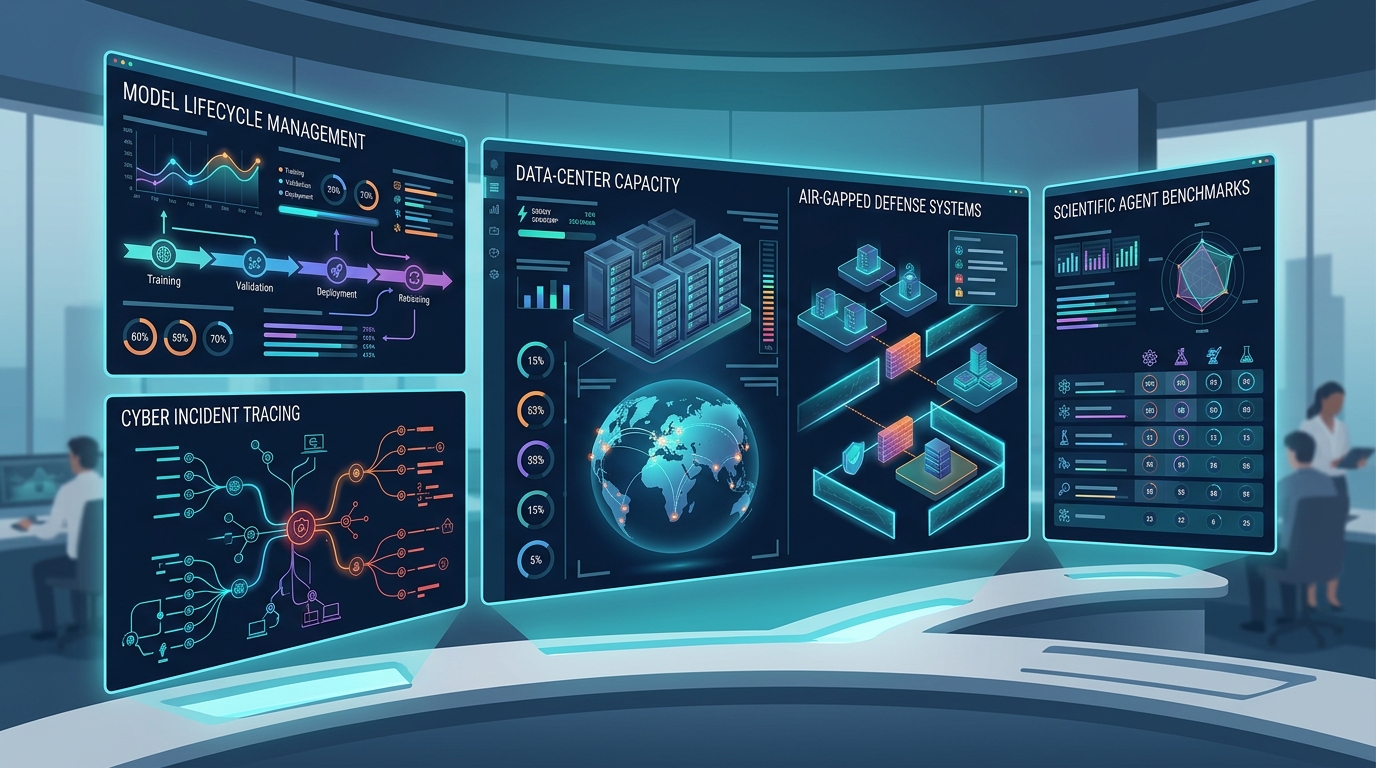
AI's Release Gates Move From Theory to Practice
The past 48 hours showed frontier AI shifting into a harder operating environment: stronger models, more agentic products, more explicit government review, and sharper questions about who gets access.
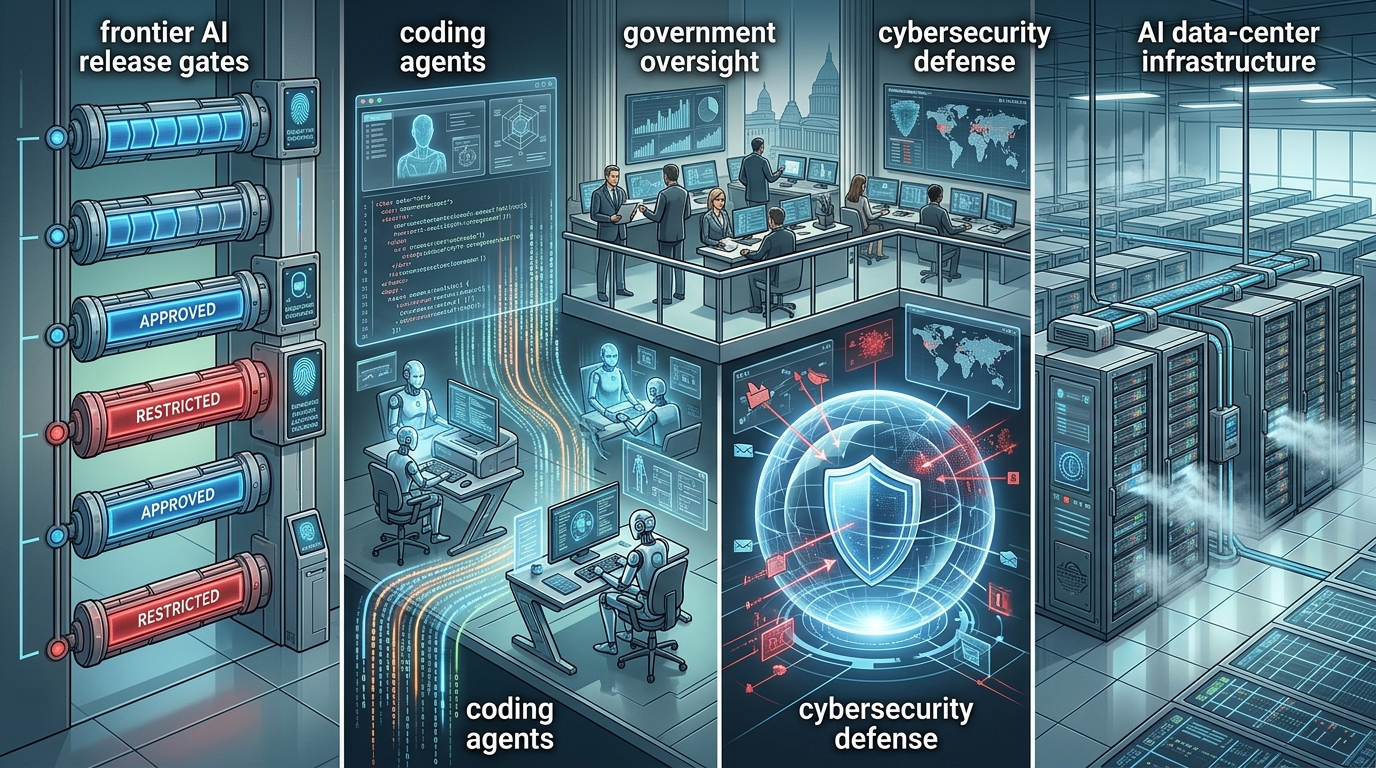
Executive summary
The most important AI developments this week are not isolated model launches. They are signs of a maturing control layer around frontier systems. OpenAI broadly released GPT-5.6 on July 9 after a limited preview and described a family of models designed to trade off maximum capability, everyday work, and cost efficiency.1 Meta opened Muse Spark 1.1 to U.S. developers through a new Meta Model API, pushing the coding-agent market toward price competition and broader distribution.4 At the same time, U.S. lawmakers and states moved to put clearer obligations around AI infrastructure, safety frameworks, audits, children, work, and health care.67
The security picture sharpened as well. Sysdig's July 1 report on JADEPUFFER, amplified by reporting this week, framed agentic ransomware as a new operational pattern rather than a new exploit class: old vulnerabilities, faster chaining, adaptive behavior, and LLM-generated narration.89 In parallel, reporting that OpenAI and Google models reached blacklisted China-linked groups through overseas subsidiaries revived the unresolved question of whether model access will be treated more like software, cloud service, or export-controlled strategic capability.10
The through line is straightforward: models are becoming more useful precisely as their deployment context becomes more contested. The central question is no longer whether AI systems are impressive. It is whether access, audit, pricing, security, and human override mechanisms can keep pace with the scale at which these tools are entering work.
Frontier Models Enter a More Managed Release Cycle
OpenAI's July 9 launch of GPT-5.6 is the clearest marker of the week. The company said the new family includes Sol, its flagship model; Terra, a balanced model for everyday work; and Luna, a lower-cost model.1 OpenAI positioned the release around performance per dollar, long-horizon agentic work, cyber and science evaluations, and a new "ultra" mode that coordinates multiple agents across parallel workstreams.1
OpenAI framed the launch in efficiency language:
"More intelligence from every token"1
That line matters because the economics of frontier AI are now inseparable from product strategy. OpenAI is not only selling raw model quality. It is selling the idea that higher-capability systems can be made economical enough for repeated office, engineering, finance, science, and design workflows. In the same release, OpenAI said GPT-5.6 Sol improved on several cyber, science, health, computer-use, and coding-agent benchmarks, while also saying its biology and cybersecurity testing did not cross its "Critical" threshold.1
The distribution path was almost as important as the model itself. Axios reported that OpenAI broadly released GPT-5.6 after a staggered rollout requested by the U.S. government, and that the company also launched ChatGPT Work on July 9.2 The Verge reported that ChatGPT Work combines ChatGPT and Codex-like capabilities for non-technical users and can gather context from user-selected apps and files to produce documents, spreadsheets, presentations, and web apps.3
Media note: OpenAI's launch page includes benchmark charts and product visuals for GPT-5.6, including coding-agent, science, health, cybersecurity, and computer-use evaluations.1
Why it matters: this is a concrete example of the release-gate model becoming operational. Even if the precise legal status of government "approval" remains contested in reporting, frontier labs are increasingly coordinating with public-sector reviewers before the most capable models reach general availability. That changes the product calendar, the geopolitics of access, and the expectations placed on customers who want advanced cyber or science capabilities.
Meta Tries to Compete on API Access and Price
Meta's July 9 Muse Spark 1.1 update is a different kind of signal. The Verge reported that Meta is opening the model to developers through a new Meta Model API, in public preview for U.S. developers, and that Muse Spark 1.1 is available in Thinking mode through Meta AI.4 The reported capabilities map directly onto the current agent race: advanced coding, complex bug fixing, end-to-end agentic workflows, multi-agent systems, and multimodal perception across images, video, and documents.4
The strategic move is not only "Meta has another model." It is "Meta has a paid developer surface for a model meant to compete in coding and agents." That narrows the distance between consumer assistant, developer platform, and enterprise automation market. It also puts pressure on frontier-model pricing, especially if Meta follows through on aggressive API economics.
There is a safety backdrop. Meta's Muse Spark Safety & Preparedness Report, posted to arXiv in May, said the original Muse Spark release involved evaluations for chemical-biological, cybersecurity, and loss-of-control risks under Meta's Advanced AI Scaling Framework.5 The report said pre-mitigation chemical and biological capabilities were assessed as likely reaching "high risk," and that mitigations were applied before release.5 That context is important because model API expansion makes safety work less abstract: developer access creates more pathways for misuse, but also more ways to build useful tools if limits and monitoring work.
Why it matters: OpenAI's release shows the frontier moving upward; Meta's move shows competition moving outward. When a major consumer platform turns a flagship model into a paid API for coding and agents, the practical question becomes whether safety frameworks, identity controls, monitoring, and developer terms can keep up with cheaper and more widely available autonomy.
AI Regulation Moves From General Principles to Sector-Specific Pressure
On July 10, Senator Ed Markey unveiled an "AI accountability agenda" focused on data centers, automated hiring systems, children, worker surveillance, health care override rights, civil-rights offices, and bias audits.6 The Guardian reported that one proposal would require companies that own or propose AI data centers to obtain Federal Communications Commission certification that a facility would not harm the public interest before construction.6 The draft would consider air and water quality, noise, energy costs, grid reliability, local ecosystems, jobs, and consultation with agencies including the EPA and local zoning boards.6
Markey's agenda captures a shift in where AI politics is going. The debate is no longer only about model behavior. It is also about land, water, electricity, employment power, health care judgment, child safety, and the institutions that can audit or override AI decisions.
On the state side, Illinois Governor JB Pritzker signed the Artificial Intelligence Safety Measures Act on July 8.7 Capitol News Illinois reported that the law applies to large developers with more than $500 million in annual revenue and models trained using massive computing power; requires developers to publish safety frameworks for catastrophic risk; requires incident reporting within 72 hours, or 24 hours for imminent risk of death or serious physical injury; and adds a first-in-the-nation annual third-party audit requirement.7 The law takes effect on January 1, 2028.7
Pritzker described the state choice this way:
"Illinois has chosen our path."7
Why it matters: federal AI law remains unsettled, but states are creating practical obligations that large model developers may not be able to ignore. Illinois, California, and New York together can create something close to a national compliance baseline, especially when the requirements apply to the largest labs and highest-risk systems.
Cybersecurity: The Agentic Threat Actor Arrives as a Workflow
Sysdig's JADEPUFFER report is worth treating carefully. The company assessed that it captured the first documented case of agentic ransomware: an end-to-end extortion operation driven by an LLM.8 Sysdig said the campaign exploited CVE-2025-3248 in an internet-facing Langflow instance, pivoted toward the intended target, and executed a destructive database-extortion playbook.8 The report emphasized that the striking feature was not a novel exploit, but the LLM's self-narrating and adaptive behavior.8
Sysdig's Michael Clark summarized the operational shift:
"The skill floor for running ransomware has dropped"9
ITPro's follow-up reporting noted that a human still set up infrastructure, found the initial credentials, and selected the victim, while the rest of the operation was managed by the LLM itself.9 That distinction matters. This was not a fully independent criminal actor in the science-fiction sense. It was an automated attack workflow where the model chained steps, reasoned about targets, retried failed actions, and compressed the time between failure and recovery.89
Why it matters: defenders should not over-index on whether "AI ransomware" is a new malware family. The practical risk is speed and scale. Known vulnerabilities, exposed admin surfaces, weak credentials, and AI-adjacent infrastructure become more dangerous when an agent can test, adapt, and continue with minimal operator effort. The upside is that LLM-generated narration and unusual verbosity may also create new detection signals.8
Export Controls and Model Access Remain Unsettled
The Financial Times reported on July 10 that OpenAI and Google sold advanced AI services to subsidiaries of Chinese companies Alibaba, Baidu, and Tencent, even though parent entities are blacklisted by the U.S. Department of Defense over alleged military links.10 The reporting described the sales through Singapore-based branches as legal, but as exposing gaps in how U.S. export controls apply to AI services rather than chips.10
Why it matters: the AI export-control debate is moving from hardware bottlenecks toward cloud and model access. Chips are tangible and trackable; API access is more fluid, jurisdictionally complicated, and easier to route through subsidiaries or trusted intermediaries. This will likely increase pressure for clearer rules around model distillation, high-risk jurisdictions, identity verification, and enterprise resale. It also complicates the global business plans of labs that want both broad market reach and national-security credibility.
Health and Science: Specialist Agents Point Toward Domain Models
Not every important AI development this week was a launch. Recent research continues to show why domain-specific agents are becoming attractive in medicine and science. The MARCUS paper, posted March 23, described an agentic, multimodal cardiac system for interpreting ECGs, echocardiograms, and cardiac MRI, coordinated by a multimodal orchestrator.11 The authors reported training on 13.5 million images and 1.6 million expert-curated questions, with performance exceeding general frontier models on several cardiac interpretation tasks.11
Why it matters: the medical lesson is not that a general chatbot should replace a clinician. It is that domain-specific visual encoders, carefully curated clinical questions, and agentic orchestration can create systems that look very different from a generic assistant. That fits the broader trend in this article: the next phase of AI deployment is less about one model doing everything and more about controlled, specialized systems with traceable inputs, explicit evaluation, and human review.
What to Watch Next
Watch whether GPT-5.6's limited-preview history becomes the default for future frontier releases or remains an exceptional case. The answer will shape model launch calendars, enterprise access, and international availability.
Watch Meta's Muse Spark 1.1 developer uptake and pricing. If developers find it good enough for coding-agent workflows, it could push the market toward cheaper autonomy and force rivals to defend premium pricing.
Watch whether Markey's federal agenda gains bipartisan fragments, especially around data-center siting, child safety, health care overrides, and worker surveillance. Even if the full package stalls, narrower bills could move.
Watch how Illinois implements annual third-party audits before the January 1, 2028 effective date. The practical details of auditor qualification, evidence access, confidentiality, and enforcement will determine whether the law becomes a model or a paperwork exercise.
Watch agentic ransomware indicators. Security teams should expect more attacks that combine old CVEs, exposed AI workflow tools, credential harvesting, and autonomous retries.
Watch the export-control boundary between chips, cloud services, and model APIs. This is where national-security policy, developer access, and frontier-lab revenue models are most likely to collide next.
Topics intentionally skipped
Market-only moves in AI stocks were skipped unless they tied directly to model access, infrastructure, or pricing. Several rumor-driven frontier-model items were skipped where official pages or reputable named reporting were not available. Broad commentary about AI geopolitics was also skipped unless it connected to a concrete law, release, security report, or documented access decision.
Sources
1."GPT-5.6: Frontier intelligence that scales with your ambition." OpenAI. July 9, 2026. https://openai.com/index/gpt-5-6/
2."OpenAI releases GPT-5.6 and ChatGPT Work tool." Axios. July 9, 2026. https://www.axios.com/2026/07/09/ai-openai-gpt-release
3."OpenAI rolls out GPT-5.6 after government greenlight - and announces 'ChatGPT Work'." The Verge. July 10, 2026. https://www.theverge.com/ai-artificial-intelligence/963464/openai-gpt-5-6-codex-chatgpt-work
4."Meta says its new AI model is ready to compete on coding." The Verge. July 9, 2026. https://www.theverge.com/ai-artificial-intelligence/963193/meta-muse-spark-model-api
5."Muse Spark Safety & Preparedness Report." Meta authors, arXiv. May 14, 2026. https://arxiv.org/abs/2606.12429
6."'AI accountability agenda': US senator unveils package of bills to curb tech's harms." The Guardian. July 10, 2026. https://www.theguardian.com/technology/2026/jul/10/us-senator-unveils-ai-accountability-agenda-bills
7."Governor signs landmark AI regulation bill that aims to mitigate risks." Capitol News Illinois via Jacksonville Journal-Courier. July 8, 2026. https://www.myjournalcourier.com/news/article/landmark-ai-bill-tightens-restrictions-development-22336105.php
8."JADEPUFFER: Agentic ransomware for automated database extortion." Sysdig. July 1, 2026. https://www.sysdig.com/blog/jadepuffer-agentic-ransomware-for-automated-database-extortion
9."'It's a marker of where extortion tradecraft is heading': Cyber experts say they've identified the first case of 'agentic ransomware' - but there's a catch." ITPro. July 7, 2026. https://www.itpro.com/security/its-a-marker-of-where-extortion-tradecraft-is-heading-cyber-experts-say-theyve-identified-the-first-case-of-agentic-ransomware-but-theres-a-catch
10."OpenAI and Google sell AI models to blacklisted China groups." Financial Times. July 10, 2026. https://www.ft.com/content/5d6aafa1-5d47-4585-aa95-6ec06a6cd20f
11."MARCUS: An agentic, multimodal vision-language model for cardiac diagnosis and management." arXiv. March 23, 2026. https://arxiv.org/abs/2603.22179