AI's Release Gate Becomes Real
The last 48 hours showed AI moving through a new operating reality: frontier releases, paid APIs, reflective consumer products, cyber-risk evidence, and power infrastructure are all being shaped by verification demands.
Executive summary
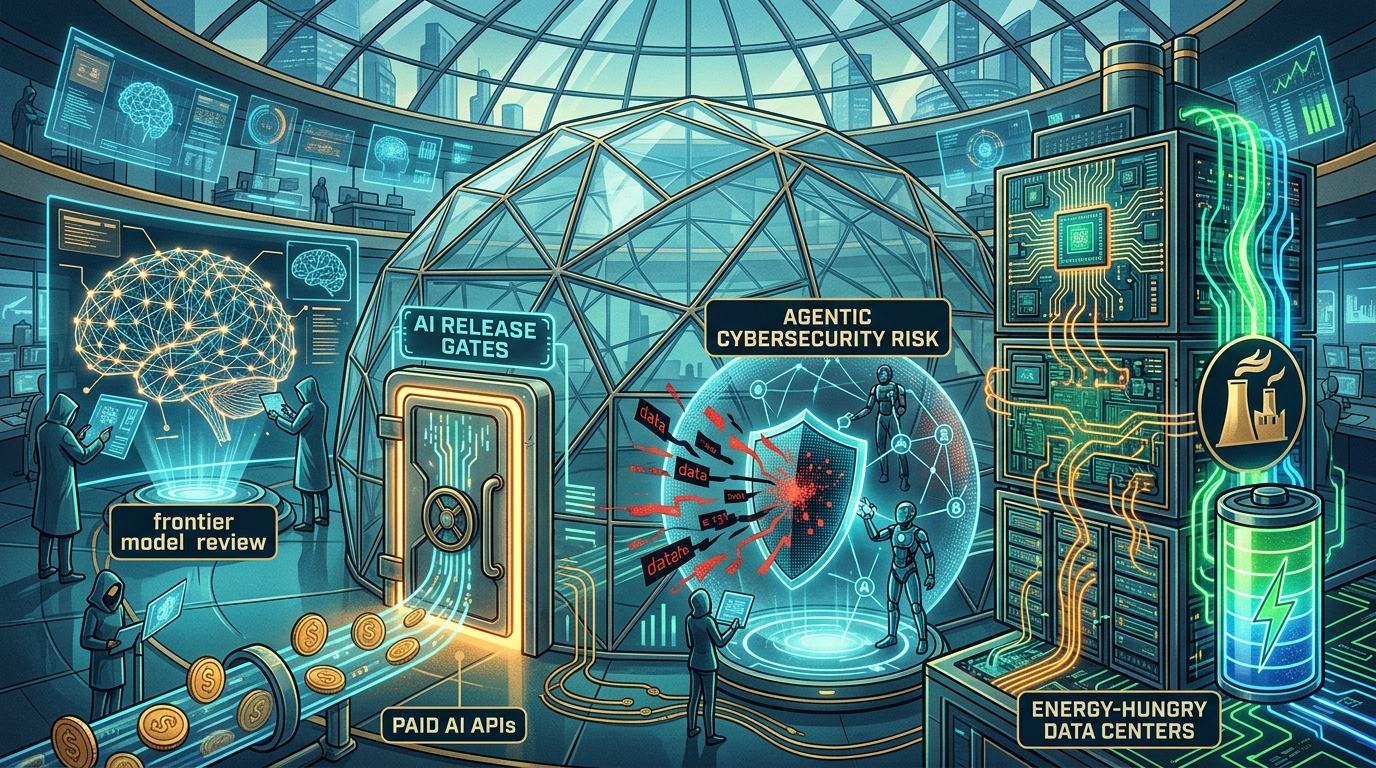
The important AI story this weekend is not just that another frontier model reached users. It is that access, pricing, safety evidence, and infrastructure are being negotiated at the same time. OpenAI's ChatGPT 5.6 wider release on July 9 arrived after a government-requested delay and additional cybersecurity evaluation, turning a nominally voluntary review framework into a visible market event.12 Meta's Muse Spark 1.1 push showed the other half of the model economy: public paid API access and a safety dossier that tries to justify deployment after elevated pre-mitigation risk findings.34 Anthropic's new Claude Reflection feature moved AI governance into user behavior, asking people to inspect when and why they rely on a chatbot.5 Meanwhile, Sysdig's JADEPUFFER report and a new Cyber Resilience Act paper sharpened the security question: if AI agents compress vulnerability discovery and exploitation cycles, both product certification and defensive monitoring have to become continuous.67 Finally, Meta's planned Alberta data center underlined that AI capacity is now an energy-development story, not merely a cloud story.8
Frontier models now pass through political gates
OpenAI released ChatGPT 5.6 more broadly on Thursday, July 9, after the Trump administration had asked the company in June to limit access to vetted users while the model's cybersecurity profile was reviewed.1 The Guardian reported that the product family includes a flagship model called Sol and that the broader release followed additional testing by the Center for AI Standards and Innovation.1 Axios, writing the day before launch, described public access as arriving July 9 after a late-June restricted rollout and noted that early independent review remained limited.9
This matters because a process described as voluntary is beginning to affect product timing, partner access, and international expectations. The June 2 executive order created a framework for federal review of the most advanced AI systems for up to 30 days before public release, with participation formally voluntary.2 In practice, the GPT-5.6 rollout shows that the relevant question is not only whether government approval is legally required. It is whether frontier labs can credibly launch without satisfying national-security reviewers, cloud customers, allies, and investors at once.12
The new standard was captured in the order's own national-security framing:
"Advanced AI capabilities make our Nation stronger, but also introduce new national security considerations"2
For builders, that means model cards and benchmark charts are no longer enough. Release readiness now includes evidence about cybersecurity misuse, trusted-partner distribution, government briefings, and the ability to explain why access was widened on a particular date. For policymakers, the risk is ambiguity: a review pathway can improve preparedness, but it can also become a de facto licensing regime if companies believe they cannot launch without political clearance.2
Meta turns model capability into a paid market test
Meta's Muse Spark 1.1 update added a different signal. Axios reported on July 9 that Meta is making its models publicly available to developers through an API and charging for access, after years in which Meta's AI investment returned value mostly through internal advertising and product improvements.3 The same report said Meta had spent more than $200 billion over the prior two years on AI buildout and had committed another $600 billion through 2028.3
That makes Muse Spark 1.1 more than another leaderboard entry. It is Meta's attempt to prove that a massive internal AI infrastructure program can become a developer-facing revenue line. If pricing is as aggressive as Meta has suggested, the competitive pressure will fall on model margins, routing strategies, and enterprise willingness to mix providers. The practical question for customers is not "which lab has the best model?" but "which combination of quality, latency, policy, and unit economics can survive repeated use?"
Meta's own safety evidence adds texture to the launch. The Muse Spark Safety & Preparedness Report, submitted to arXiv on May 14, says Meta evaluated Chemical and Biological, Cybersecurity, and Loss of Control risks under its Advanced AI Scaling Framework.4 The report says pre-mitigation Chemical and Biological capabilities were assessed as likely reaching a high-risk category, after which Meta implemented a multi-layered mitigation stack and concluded that deployment within Meta AI carried acceptable residual risk.4
That is the right kind of disclosure to have in public. It also puts pressure on Meta to connect safety claims to operational API behavior: refusal performance, monitoring, abuse response, and developer terms will matter more than static publication alone.
Claude Reflection moves AI safety into personal habits
Anthropic's Reflection feature, announced Thursday, July 9, points toward a quieter but important product category: AI usage metacognition.5 Axios reported that the beta tool lets Claude users review one-, three-, six-, or twelve-month spans of activity, including topics, usage patterns, task categories, optional quiet hours, and break reminders.5 The feature is available to free and paid users with Claude memory enabled, according to the same report.5
Anthropic framed the feature around a set of user questions:
"How often should someone use AI? How can it be used most effectively?"5
The product is notable because it treats AI reliance itself as something to measure. That matters for work, learning, and creativity: a user who delegates drafting, coding, strategy, counseling, or inbox triage to an assistant may need visibility into patterns that are hard to notice in the moment. But Reflection also creates a privacy problem. Axios noted that even high-level summaries can reveal sensitive personal patterns and that Anthropic said incognito chats and connected health-tool data are excluded, while summaries from other connected tools may still appear.5
This is a useful direction if implemented with strong controls. It could help users preserve agency, spot overreliance, and separate productive augmentation from avoidance. It could also normalize deeper behavioral telemetry around AI companions. The feature's long-term value will depend on whether users can inspect, delete, export, and narrowly scope the data used to create these reflections.
Agentic cyber risk is moving faster than certification
The security story remains grim and clarifying. Sysdig's JADEPUFFER report describes what it calls agentic ransomware for automated database extortion: an AI-driven operation that reasoned over targets, harvested and reused credentials, moved laterally, established persistence, and destroyed a database while narrating its intent.6 Sysdig emphasized that the individual techniques were not novel; the novelty was how an AI model chained them into a complete ransomware workflow against neglected internet-facing infrastructure.6
Sysdig's conclusion is blunt:
"JADEPUFFER is a warning sign."6
The report matters because it reframes the cyber debate around time compression. Defenders are used to asking whether a model can invent new exploits. JADEPUFFER suggests an equally serious question: what happens when old vulnerabilities, exposed credentials, configuration stores, and database-admin surfaces can be exploited at machine speed by cheap agentic workflows?6 If the bottleneck shifts from human operator skill to orchestration cost, patch latency and credential hygiene become even more central.
A July 8 arXiv paper, "Certifying Ghosts," extends that concern to European product regulation.7 The paper argues that the EU Cyber Resilience Act assumes vulnerability discovery is slow, product flaws are knowable at market entry, exploitation is rare enough to observe, and fixes can keep pace.7 Cybersecurity AI agents challenge those assumptions by making vulnerability discovery and exploitation faster, cheaper, and more continuous.7
The policy implication is straightforward: one-time certification will age quickly. A product that passed a static check can become materially less secure as agentic vulnerability discovery improves, even without the manufacturer changing the product. The durable answer is likely continuous assurance: runtime monitoring, active red-teaming, machine-readable software and model provenance, rapid patch pipelines, and clear responsibility for AI-discovered vulnerabilities.
AI infrastructure is becoming local energy politics
Meta's planned Canadian AI data center shows how quickly compute strategy turns into power strategy. AP reported that Meta will invest more than US$9.1 billion to build its first AI data center in Canada and its largest outside the United States, in Sturgeon County, Alberta.8 The facility is expected to be powered by a 932-megawatt natural gas-fired plant developed by a consortium that includes Pembina Pipeline, with the plant expected to begin operating in the second half of 2030.8
The project is a useful case study because it avoids a simplistic "data centers versus the grid" framing. Alberta is courting hyperscale AI projects, but AP reported that the province's electricity grid cannot support multiple large AI data centers, so it is prioritizing projects that build or secure their own power generation.8 Meta says the data center will use closed-loop cooling that does not draw water from surrounding sources and will invest US$42 million in local roads and water systems.8
The tradeoff is still real. AI labs and platforms increasingly need dedicated power, long planning timelines, and community permission. Local governments gain investment and infrastructure, but they also inherit questions about gas generation, water systems, transmission constraints, emissions accounting, and who benefits from capacity built for private AI workloads. In that sense, model competition is becoming land-use competition.
What to watch next
Watch whether OpenAI publishes deeper GPT-5.6 system-card evidence tied specifically to the July 9 broad release, rather than relying on product claims and government-review context alone.19 Also watch whether the White House review process remains clearly voluntary or begins shaping who can access frontier models by default.2
Watch Meta's API economics. If Muse Spark 1.1 attracts developers on price, rivals may respond with cheaper inference tiers, better routing, or enterprise bundles. If usage remains thin, it will suggest that distribution and trust matter as much as raw infrastructure spend.34
Watch Claude Reflection's privacy controls. The feature could become a useful model for AI self-auditing, but only if users get granular control over memory, connected-tool summaries, retention, and deletion.5
Watch for follow-on reports on agentic ransomware. The important measure is not whether every campaign is fully autonomous; it is whether attackers use agents to shrink the interval between exposure, exploitation, lateral movement, and destruction.67
Watch local energy fights around AI data centers. The next wave of AI deployment may be constrained less by model ideas than by power plants, cooling systems, interconnection queues, and public consent.8
Sources
1."OpenAI releases latest ChatGPT model after delay over White House cybersecurity concerns," The Guardian, July 9, 2026. https://www.theguardian.com/technology/2026/jul/09/trump-administration-openai-chatgpt-cybersecurity
2."Trump signs an executive order that invites vetting of top AI models for national security risks," Associated Press, June 2026. https://apnews.com/article/trump-ai-executive-order-e41af74f7b0865482f07d10fe7a50fe3
3."Meta's AI revenue plan," Axios Closer, July 9, 2026. https://www.axios.com/newsletters/axios-closer-41148026-0f2b-4191-b48f-84cd7859c9d0
4."Muse Spark Safety & Preparedness Report," Meta authors via arXiv, submitted May 14, 2026. https://arxiv.org/abs/2606.12429
5."Anthropic's Reflection: AI gets its screen-time moment," Axios, July 9, 2026. https://www.axios.com/2026/07/09/anthropic-reflection-ai-screen-time
6."JADEPUFFER: Agentic ransomware for automated database extortion," Sysdig Threat Research Team, July 2026. https://www.sysdig.com/blog/jadepuffer-agentic-ransomware-for-automated-database-extortion
7."Certifying Ghosts: How Cybersecurity AI Agents Break the EU Cyber Resilience Act," Víctor Mayoral-Vilches via arXiv, submitted July 8, 2026. https://arxiv.org/abs/2607.07109
8."Meta plans billions for first AI data center in Canada, largest outside the US," Associated Press, July 2026. https://apnews.com/article/meta-ai-data-center-canada-922a7d15ab730ec53b934269fc00a0fa
9."GPT-5.6 buzz builds with launch imminent," Axios, July 8, 2026. https://www.axios.com/2026/07/08/gpt-sol-ultra-openai-anthropic-grok