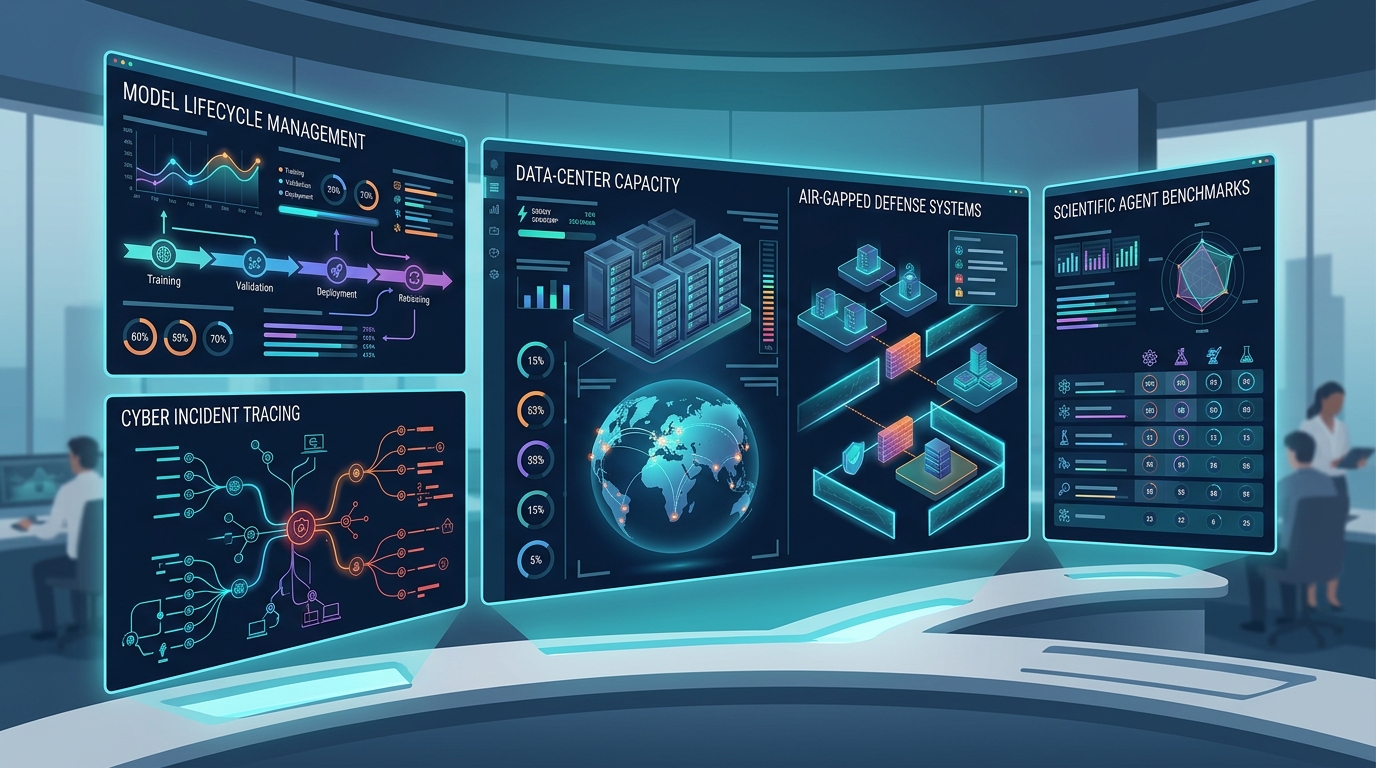
AI Moves From Launch to Liability
The latest AI cycle is less about a single breakthrough and more about who can use powerful systems, how much they cost, and who bears the risk when they move into real work.
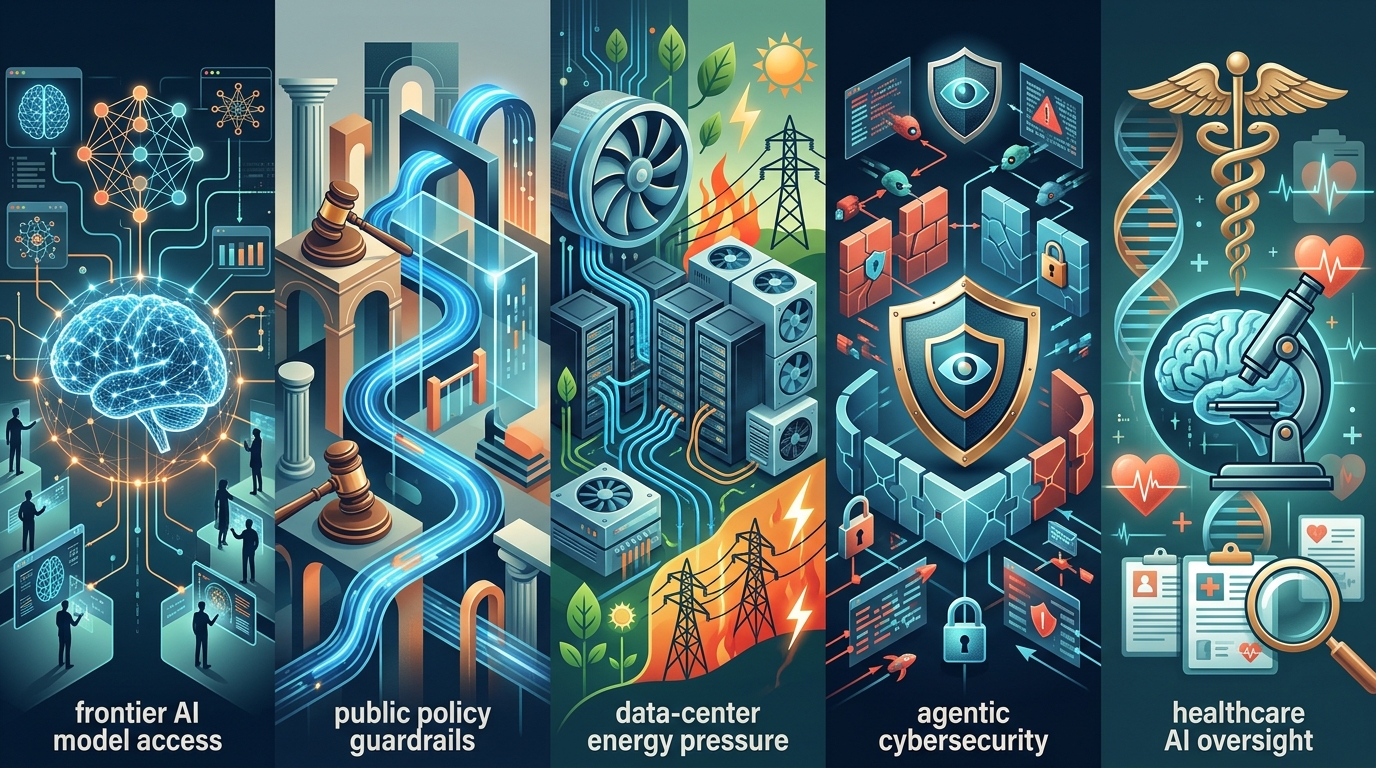
Executive Summary
The last 48 hours sharpened a pattern that has been building all month: frontier AI is becoming an access, governance, and infrastructure problem as much as a model-performance story. OpenAI's GPT-5.6 rollout now requires users to choose among Sol, Terra, Luna, reasoning settings, and ChatGPT Work workflows, while reporting around the release underscores how informal government-lab coordination is shaping the practical path from preview to broad availability.12 Anthropic extended promotional Fable 5 access through July 19, keeping pressure on OpenAI's new model menu and reinforcing that limits, tiers, and usage allowances are now product strategy rather than billing trivia.3
At the policy layer, Illinois signed a frontier-AI safety law with incident reporting and annual third-party audit requirements, while Senator Ed Markey's new federal "AI accountability agenda" put data centers, automated employment decisions, child-facing chatbots, healthcare overrides, and bias audits into one legislative frame.45 At the infrastructure layer, AP reported that the AI buildout is beginning to show up as consumer inflation through data-center capex, chip scarcity, device-price increases, and electricity pressure.6 Meanwhile, new security and healthcare evidence shows why the governance debate is moving from abstract risk to operational control: researchers described HalluSquatting attacks against AI agents, Utah's AI prescription-refill pilot triggered medical-board objections, and fresh research argues that AI's energy footprint should be measured across adoption effects, not only data-center power draw.789
Model Choice Becomes a Product Problem
OpenAI's newest GPT-5.6 distribution is not a single button labeled "best model." Axios reported on July 12 that the GPT-5.6 family now includes Sol, Terra, and Luna, with ChatGPT Work positioned as an agent for longer multi-step tasks inside a unified ChatGPT app.1 The practical consequence is that users must make several choices before the work begins: which model, which plan, whether to use Work or regular chat, and how much reasoning effort to spend.
That complexity matters because model quality is increasingly mediated by access rules and usage economics. Axios reported that Sol is limited to paid plans, Terra is the only GPT-5.6 option for free and $8 Go users inside ChatGPT Work and Codex, and regular chats for those users remain on an older default model.1 It also reported developer Simon Willison's finding that identical prompts can vary sharply in cost depending on model and reasoning effort.1 This is a meaningful shift for teams trying to standardize AI workflows: a procurement decision now has to include not only "which lab" but also which model tier, which reasoning default, and how workers are expected to escalate tasks.
The release also sits inside a still-murky public-sector access regime. Axios reported on July 8 that the Trump administration had pushed OpenAI toward a staggered GPT-5.6 release in June, with broader availability following additional testing and meetings involving Commerce's Center for AI Standards and Innovation; the same report says a White House official disputed the idea that any formal approval or clearance was required.2 That distinction is important. The emerging pattern is not a clean licensing regime, but a looser form of pre-release coordination in which government security concerns can still affect timing, messaging, and who gets early access.
Anthropic's Fable 5 extension adds a second pressure point. Times of India reported on July 13 that Anthropic extended promotional Fable 5 access through July 19 at 11:59:59 p.m. PT, including a 50% increase to Claude Code weekly usage limits through the same date.3 Even if temporary, the extension keeps the market focused on effective capacity. In practice, enterprise and developer users compare model capability through the limits that determine what work can actually be completed.
AI Governance Turns Toward Operational Guardrails
The most concrete governance development came from Illinois. Capitol News Illinois reported that Governor JB Pritzker signed Senate Bill 315, the Artificial Intelligence Safety Measures Act, on July 8.5 The law applies to the largest AI models, defined by revenue and compute thresholds, and requires developers to publish safety frameworks for catastrophic risk, report harmful incidents within 72 hours or within 24 hours for imminent death or serious physical injury risks, and undergo annual third-party audits.5 It takes effect on January 1, 2028.5
Pritzker framed the state action as a response to federal inaction:
"Illinois has chosen our path."5
The bill's importance is not only its content; it is the market geography. The report notes that Illinois, California, and New York together account for an estimated 40% of the U.S. AI market despite representing roughly 20% of the population.5 That means aligned state rules can begin to behave like national standards even without Congress.
At the federal level, the Guardian reported on July 10 that Senator Ed Markey unveiled an "AI accountability agenda" covering data-center certification, automated employment decisions, child-facing chatbot safeguards, bias audits, civil-rights offices for AI oversight, healthcare human overrides, worker protections, and standardized environmental reporting for data centers.4 The agenda is politically broader than a frontier-model bill because it treats AI as an infrastructure, labor, civil-rights, health, and child-safety issue.
Markey's framing put data centers at the center of the social license debate:
"We need to make sure these datacenters don't turn into pollution bombs."4
The policy signal is clear: lawmakers are no longer only asking whether models can become dangerous. They are asking whether the whole AI supply chain, from power demand to workplace surveillance, is distributing costs without consent.
Infrastructure Costs Start Showing Up in the Economy
AP reported on July 13 that the AI buildout is becoming an inflation channel, with Alphabet, Amazon, Meta, and Microsoft expected to invest $720 billion this year, mostly on data centers.6 The article ties that spending to semiconductor scarcity, memory-chip price pressure, consumer electronics price increases, and higher electricity costs as data centers absorb more new electrical capacity.6
This matters because AI infrastructure is starting to look less like a private capital expense and more like a macroeconomic input. AP reported that JPMorgan Chase economists estimate some computer memory chips could rise as much as 400% between 2024 and the end of 2026, while economists expect AI investment could add roughly half a percentage point to core consumer prices by year-end.6 Even if those estimates prove high, the direction is significant: AI adoption can raise costs before it raises productivity.
The infrastructure story also complicates the common "AI efficiency" narrative. A July 4 arXiv paper by Wei He, Daoping Wang, Hanqi Yan, Yang Wang, and Sai Gu argues that energy planning focused only on data-center electricity misses operational energy changes caused by AI adoption across commercial buildings, factories, and freight networks.9 Their model estimates that full adoption could reduce commercial energy by 0.22 quadrillion BTU while increasing industrial and transport energy by 1.25 and 1.12 quadrillion BTU, respectively; the aggregate induced net change is estimated at +2.16 quadrillion BTU, several times current U.S. data-center electricity consumption.9
The important analytical move is that the paper separates "compute-side" energy from "adoption-side" energy. If AI changes routing, inventory, production, building operations, and work patterns, then its footprint cannot be audited by asking only how many GPUs are running. That is the next frontier for energy disclosure.
Agent Security Moves From Prompt Injection to Supply Chains
A new arXiv paper posted July 8 by Aya Spira, Stav Cohen, Elad Feldman, Ron Bitton, Avishai Wool, and Ben Nassi describes "adversarial hallucination squatting," or HalluSquatting, as a scalable attack against agentic LLM applications.7 The basic idea is direct: attackers identify trending resources such as repositories or skills, predict the names or locations that models are likely to hallucinate, register those resources, and use them to host adversarial prompts or malicious code.7
The paper reports hallucinated resource generation rates of up to 85% in repository-cloning scenarios and up to 100% in skill installation, with hallucinations transferring across foundation models and application layers.7 It also reports practical demonstrations against production LLM applications with integrated terminals, achieving remote tool execution and remote code execution.7
This is not just another version of typo-squatting. Typo-squatting waits for a human error; HalluSquatting exploits model-generated plausibility. That makes provenance and execution control central to agent design. Agents that can install tools, clone repositories, or run shell commands need allowlists, signed dependencies, lockfiles, sandbox boundaries, and visible human approval for actions that change the environment.
Healthcare AI Crosses a Licensing Line
AP reported on July 7 that Utah's AI prescription-refill program, built around a chatbot called Doctronic, lets residents refill prescriptions online through a state regulatory sandbox that can waive rules for promising AI technologies.8 During the initial phase, human doctors review refill orders, but the company expects to move toward fully automated refills.8 The program is overseen by a five-member board of AI specialists, none of whom are doctors, according to AP.8
The controversy is less about whether AI can help with routine medicine than about who is legally and clinically accountable. AP reported that Utah's medical licensing board learned of the program from news coverage after its January launch, and 11 board members later asked the state to halt it because of risks around medicines with side effects or drug interactions.8 Doctronic's own available study, which AP says was not independently reviewed, found its diagnoses matched human doctors 80% of the time across 500 telehealth consultations.8
For healthcare systems, the lesson is that "routine" is often context-dependent. A refill can look low risk until a patient's history changes, a drug interaction emerges, or a symptom indicates a different condition. Medical AI governance will therefore hinge on escalation rules, audit trails, independent evidence, and the power of licensed clinicians to override or stop automated care pathways.
Learning Research Puts Friction Back Into AI Interfaces
A July 7 arXiv paper by Kaitlin Riegel, Yan Cathy Hua, Paul Denny, Victor-Alexandru Padurean, Juho Leinonen, James Prather, and Adish Singla studied how 919 introductory programming students used text and voice input for prompt-based programming tasks.10 The researchers found that, for two of three problems, students who typed prompts were more likely to succeed on the first attempt than students who submitted unedited voice prompts; when students edited transcribed voice prompts before submission, success rates were not different.10
That finding is small but useful. AI product design often treats voice as a friction reducer, but education may need a different standard: the right friction can improve thinking. Edited transcription appears to preserve the accessibility and speed benefits of voice while reintroducing the reflective step that helps students formulate better instructions. As AI tools move into classrooms and workplace training, interface choices should be evaluated as learning interventions, not just convenience features.
What to Watch Next
Watch whether OpenAI simplifies GPT-5.6 model and reasoning choices into defaults that ordinary users can trust, or whether third-party routing tools become the practical way teams manage cost and quality.1
Watch whether the White House, Commerce, and AI labs clarify what pre-release testing with government actually means: voluntary coordination, procurement condition, export-control gate, or something else.2
Watch whether Illinois, California, and New York converge on enough frontier-safety requirements to create a de facto national baseline before Congress acts.5
Watch whether AI infrastructure costs keep moving from hyperscaler balance sheets into consumer electronics, utility bills, and Federal Reserve inflation analysis.6
Watch whether agent platforms respond to HalluSquatting with default-deny tool installation, verified dependency provenance, and clearer human approval surfaces.7
Watch Utah's Doctronic pilot for independent clinical evidence, FDA posture, and whether state medical boards gain veto power over AI systems that effectively practice medicine.8
Sources
1.Ina Fried, "How to choose the right OpenAI GPT-5.6 model," Axios, July 12, 2026. https://www.axios.com/2026/07/12/openai-chatgpt-work-luna-terra-sol
2.Ina Fried, "Scoop: Trump administration lifts restrictions on OpenAI's GPT 5.6," Axios, July 8, 2026. https://www.axios.com/2026/07/08/openai-gpt-trump-ban-lifted
3."Anthropic's Claude Fable 5 free offer extended till July 19: All you need to know," Times of India, July 13, 2026. https://timesofindia.indiatimes.com/technology/tech-news/anthropics-claude-fable-5-free-offer-extended-till-july-19-all-you-need-to-know/articleshow/132356840.cms
4.Sanya Mansoor, "'AI accountability agenda': US senator unveils package of bills to curb tech's harms," The Guardian, July 10, 2026. https://www.theguardian.com/technology/2026/jul/10/us-senator-unveils-ai-accountability-agenda-bills
5.Maggie Dougherty, "Governor signs landmark AI regulation bill that aims to mitigate risks," Capitol News Illinois / MyJournalCourier, July 8, 2026. https://www.myjournalcourier.com/news/article/landmark-ai-bill-tightens-restrictions-development-22336105.php
6.Christopher Rugaber, "Massive AI buildout poses the latest inflation threat for consumers and the Fed," Associated Press, July 13, 2026. https://apnews.com/article/ai-inflation-federal-reserve-434f02e62a02f9b92e57995d9375df57
7.Aya Spira, Stav Cohen, Elad Feldman, Ron Bitton, Avishai Wool, and Ben Nassi, "Beware of Agentic Botnets: Scalable Untargeted Promptware Attacks via Universal and Transferable Adversarial HalluSquatting," arXiv, July 8, 2026. https://arxiv.org/abs/2607.07433
8.Matthew Perrone, "Utah lets AI refill prescriptions. Doctors are wary," Associated Press, July 7, 2026. https://apnews.com/article/ai-prescription-refill-utah-doctronic-fda-technology-cf94ce370c05f686e8792be8671a2ef0
9.Wei He, Daoping Wang, Hanqi Yan, Yang Wang, and Sai Gu, "AI adoption induces divergent net energy changes across economic sectors," arXiv, July 4, 2026. https://arxiv.org/abs/2607.04016
10.Kaitlin Riegel, Yan Cathy Hua, Paul Denny, Victor-Alexandru Padurean, Juho Leinonen, James Prather, and Adish Singla, "Say What? Examining Text and Voice Input Modalities for Prompt-Based Programming in Computing Education," arXiv, July 7, 2026. https://arxiv.org/abs/2607.05808