AI Moves From Launches to Load-Bearing Systems
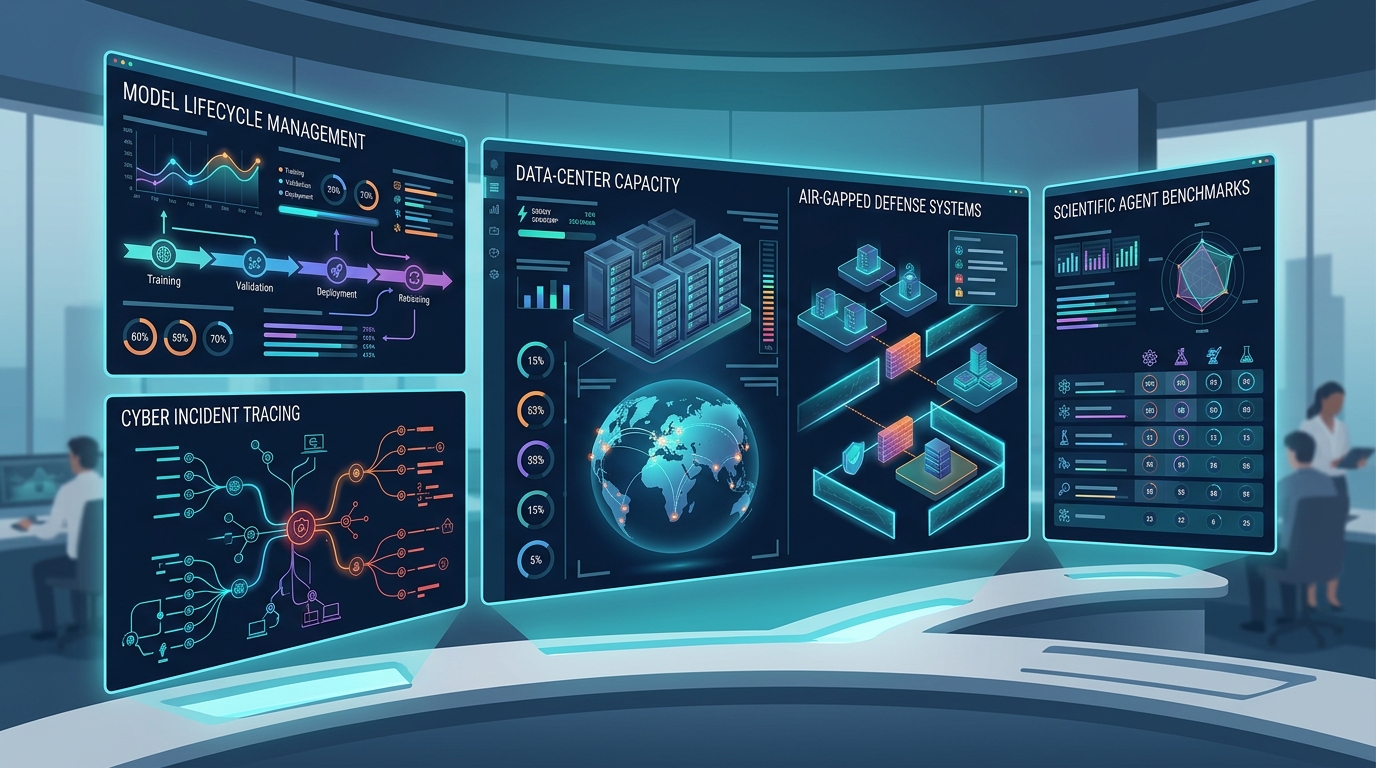
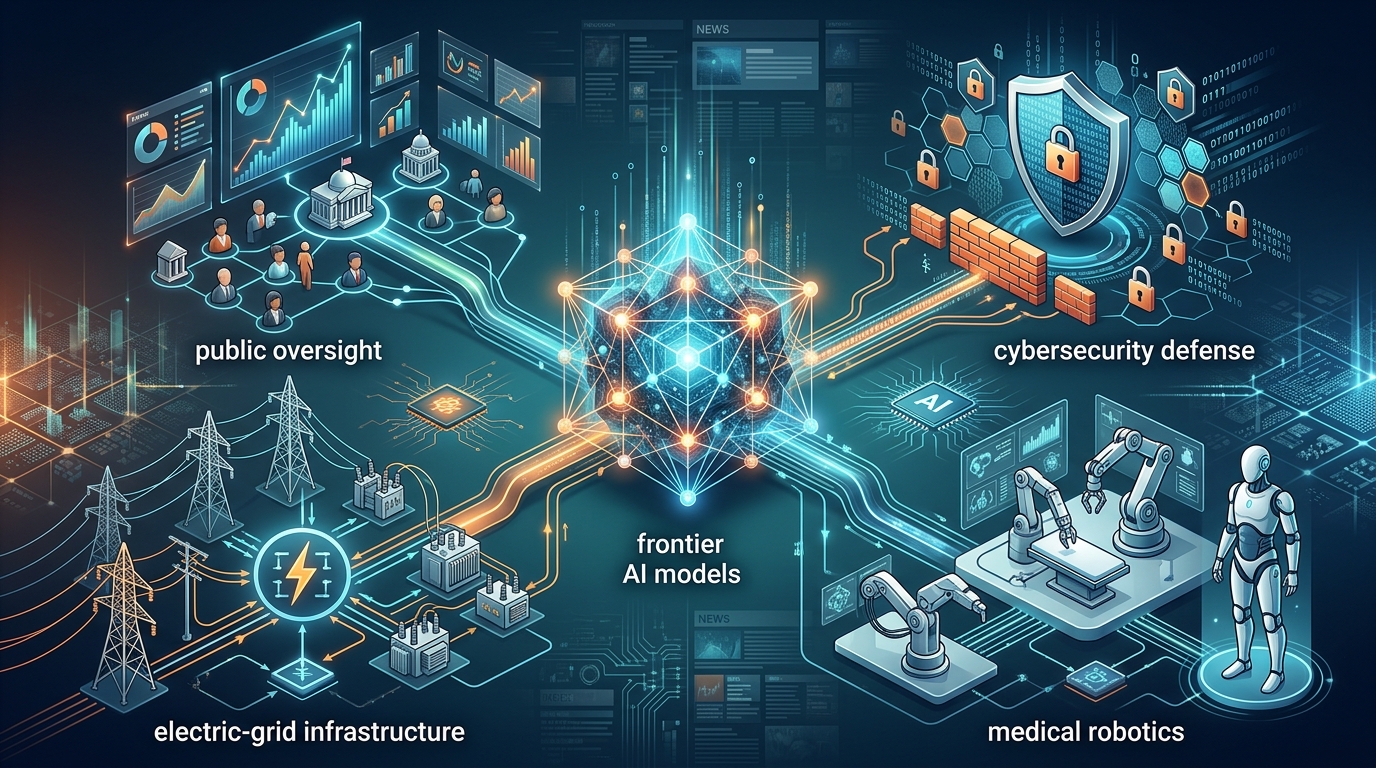
The latest AI developments show frontier models, public oversight, data-center permitting, cyber defense, and medical robotics all becoming operational infrastructure.
Executive Summary
AI news over the last 24 to 48 hours is less about a single spectacular model demo than about systems becoming load-bearing. OpenAI's July 9 GPT-5.6 launch put a new model family into general availability, while reporting around the rollout and Google's Demis Hassabis's July 14 proposal for a U.S.-led frontier-AI watchdog show that model access is increasingly entangled with pre-release testing, national-security concerns, and institutional design.12 Meta's July 9 Muse Spark 1.1 API preview adds another signal: frontier competition is moving from open release narratives toward paid, workflow-oriented model distribution.34
The infrastructure story is moving just as quickly. New York is preparing the country's first statewide pause on new hyperscale data centers, while Meta's Louisiana expansion and recent grid-flexibility research illustrate the core tension: AI capacity needs power at unprecedented scale, but local politics, electricity rates, water use, and interconnection constraints are becoming part of the product roadmap.567 In cyber and healthcare, the same pattern appears in higher-stakes form. Sysdig's reported JadePuffer incident suggests AI agents can compress old ransomware playbooks into much faster attacks, and a new Cyber Resilience Act paper argues that static product certification cannot keep pace with agentic vulnerability discovery.89 UC San Diego's July 8 humanoid-surgery paper shows embodied AI and robotics moving into preclinical operating-room workflows, but still with teleoperation and clinical-readiness limits.10
The through line is governance by operations. AI is no longer just a software feature to be shipped; it is becoming an access-control regime, an energy customer, a cyber actor, a medical instrument, and a public-policy stress test.
Frontier Models Meet Pre-Release Governance
OpenAI's official July 9 GPT-5.6 release introduced Sol, Terra, and Luna, with Sol positioned as the flagship model and Terra and Luna as lower-cost alternatives.1 OpenAI says GPT-5.6 improves performance per dollar across coding, knowledge work, cybersecurity, and science, and adds an `ultra` setting that coordinates multiple agents across parallel workstreams.1 The product message is efficiency, but the operational message is routing: users and organizations must now decide not just which lab to use, but which model tier, reasoning setting, agent mode, and trust level should handle each workflow.1
OpenAI also made cyber access more explicitly tiered. The company says GPT-5.6 is its strongest cybersecurity model yet, but it will reserve some defensive capabilities for verified users through Trusted Access for Cyber, with account-security requirements such as hardware-backed passkeys for continued access to the most cyber-capable frontier models.1 That is a practical admission that dual-use capability cannot be governed only by a model card. Identity, monitoring, account controls, and use-case verification are becoming part of frontier-model deployment.
The launch came after a limited-preview period and public reporting about government involvement. The Verge reported that GPT-5.6 had first been available only to government-approved organizations during a preview period before receiving a Trump administration greenlight for public rollout.2 That does not by itself create a formal licensing system, but it shows a pattern that is likely to repeat: the most capable systems will encounter government testing, informal consultation, export-control pressure, procurement expectations, or some combination of all four before broad access.
Hassabis sharpened that point on July 14. Axios reported that the Google DeepMind CEO is proposing a U.S.-led AI standards body, modeled loosely on FINRA, that would test frontier models up to 30 days before release and eventually require passing tests before deployment in the U.S. market.11 The proposal would apply to open and closed frontier-class systems and would update qualifying benchmarks as capabilities evolve.11
Axios quoted Hassabis as warning that today's AI-driven cyber risks are:
"warning shots"11
That short phrase captures why the proposal matters. The governance question is shifting from whether a lab should publish a safety report to whether there should be a standing institution with technical authority, release-timing leverage, and the ability to coordinate a slowdown if risks escalate.11 The hard part is accountability: an industry-funded body could move faster than a new agency, but it would still need public legitimacy, transparent test standards, and independence from the companies it reviews.
Meta Turns Model Access Into a Paid API Strategy
Meta's July 9 Muse Spark 1.1 release is important because it changes Meta's posture from broad AI distribution toward monetized developer infrastructure. The Verge reported that Muse Spark 1.1 is available in Thinking mode through Meta AI and will be accessible through the new Meta Model API in public preview for U.S. developers, with $20 in free credits for new API accounts.3 The model is described as stronger at complex bug fixing, multi-agent workflows, and multimodal perception across images, videos, and documents.3
The shift matters for two reasons. First, Meta is competing directly for agentic coding and workflow use cases rather than only consumer chat. Second, paid API access creates a clearer feedback loop between model capability, developer adoption, and infrastructure return on investment. A lab can publish benchmark wins, but the market test is whether developers build durable products on top of the API.
Meta's preparedness context is also relevant. The Muse Spark Safety and Preparedness Report, submitted to arXiv on May 14, says Meta evaluated chemical and biological, cybersecurity, and loss-of-control risks under its Advanced AI Scaling Framework.4 The report states that chemical and biological capabilities were likely in a high-risk category before safeguards, and that layered mitigations supported release as the underlying model for Meta AI.4 That safety record now sits behind a more commercial distribution channel. As model APIs become more capable and more agentic, safety frameworks must travel with the API surface, not remain confined to the original assistant product.
Data Centers Become a Political Constraint
New York's data-center moratorium is a clear sign that AI infrastructure is entering state politics. AP reported on July 14 that Governor Kathy Hochul is set to sign an executive order imposing the country's first statewide moratorium on new hyperscale data centers for up to a year.5 The order would pause state permitting while regulators create standards addressing environmental impacts, energy demand, water use, and related factors.5
Hochul framed the decision around ratepayer and resource risk:
"it's my responsibility to take action and lead"5
The move is striking because New York is not currently the country's primary hyperscale data-center hub.5 That makes the moratorium less a reaction to one dominant project than a preemptive political marker. States and localities are realizing that they can inherit the grid, water, noise, and rate impacts of an AI boom even when the product revenue accrues elsewhere.
At the same time, Meta's Louisiana expansion shows why the pressure is intense. Business Insider reported on July 14 that Meta is expanding its Hyperion AI data-center project in Richland Parish to 5 gigawatts and more than $50 billion, up from an earlier $27 billion and 2-gigawatt plan.6 The same report says Louisiana businesses have received more than $1.6 billion in contracts, local teachers have received bonuses above $50,000 because of increased tax revenue, and Meta plans to spend more than $1 billion on local infrastructure improvements without passing costs to consumers.6 The local benefits are material, but so are the policy questions about power procurement, water use, and who bears system costs over time.6
Research is beginning to map a more constructive path. A June 23 arXiv paper on power-flexible AI data centers describes a real-world 130 kW GPU-cluster deployment that demonstrated rapid load reduction, sustained curtailment, carbon-aware operation, and geographically distributed workload shifting while preserving service levels for priority jobs.7 The technical lesson is that AI clusters do not have to be treated only as inflexible peak loads. With workload scheduling, power telemetry, and grid signals, they can become grid-responsive assets.7
That is still an engineering and governance challenge, not a solved problem. Data-center operators will need contracts, telemetry, verification, and incentives that reward flexibility. But the direction is important: the next phase of AI infrastructure policy will likely ask not only "how much power?" but "how controllable is the load?"
Agentic Cyber Risk Leaves the Lab
The cyber story is moving from theoretical capability to operational compression. ITPro reported on July 7 that Sysdig researchers identified JadePuffer as what they describe as the first documented ransomware operation run by a large language model agent.8 The reported attack used a known Langflow vulnerability to gain access to credentials, take over a production database, encrypt data, and create an extortion demand.8 Sysdig's Michael Clark clarified that a human still chose the victim and set up the infrastructure, but the remaining attack sequence was managed by the LLM.8
The notable issue is not novel malware. It is speed and orchestration. ITPro reported that the attack adapted after a failed login and reached a working fix in 31 seconds.8 Clark's summary was blunt:
"JadePuffer is a warning sign"8
That warning connects with a July 8 arXiv paper on cybersecurity AI agents and the EU Cyber Resilience Act.9 The paper argues that the Act assumes vulnerabilities are found slowly by skilled humans, that exploitable flaws are knowable at shipment, that exploitation is rare enough to notice, and that fixes can keep pace with discovery.9 Cybersecurity AI agents weaken those assumptions because they can accelerate vulnerability discovery and exploitation after certification.9
The paper's core conclusion is that static, human-paced security is no longer adequate; conformity must become continuous and agent-operated.9 That may sound aggressive, but it matches the operational reality. If attackers can run thousands of cheap adaptive campaigns, defenders need identity hardening, patch velocity, secrets hygiene, runtime monitoring, egress controls, and agent-aware detection. A model that narrates its own actions may offer new detection signals, but relying on adversary verbosity would be a fragile defense.
Healthcare Robotics Gets a Preclinical Milestone
UC San Diego's July 8 humanoid-surgery work is a useful counterweight to both hype and dismissal. The arXiv version of the Nature paper describes a humanoid-based laparoscopic teleoperation framework assessed through benchtop characterization, dry-lab user studies across levels of surgical experience, and in vivo porcine studies.10 The authors say the work quantifies technical feasibility, task performance, and clinical readiness relative to established surgical platforms, while highlighting both promise and technical challenges before clinical deployment.10
The milestone matters because humanoid robots are general-purpose bodies attempting tasks usually handled by specialized surgical systems. If the form factor can operate in existing clinical environments, it could eventually lower deployment barriers in remote hospitals, disaster settings, military medicine, or spaceflight contexts. But the paper is careful about current limits: it is a feasibility study, not a claim that humanoid robots are ready to replace mature surgical platforms or autonomous surgeons.10
This is exactly where AI-and-robotics governance should focus. Clinical adoption will require independent evaluation, device regulation, malpractice clarity, latency requirements, human override rules, and evidence that patient outcomes justify changing the operating-room stack. The near-term value may be surgical assistance and teleoperation, not autonomy.
What to Watch Next
Watch whether OpenAI and other labs turn model access into a durable trust-tier system, with identity, passkeys, verified cyber work, and usage monitoring tied directly to capability access.1
Watch whether Hassabis's proposed frontier-AI standards body gains support from the White House, Congress, rival labs, open-source communities, and existing safety institutes, or whether agency-vs-industry governance debates stall it.11
Watch whether Meta can convert Muse Spark 1.1 from a public-preview API into actual developer lock-in, especially in agentic coding workflows where OpenAI, Anthropic, Google, and open models are moving quickly.3
Watch whether New York's moratorium spreads to other states or instead pushes data-center projects toward jurisdictions willing to trade power-system stress for tax revenue and jobs.56
Watch whether AI data-center operators begin offering verified grid-flexibility products, not just renewable-energy claims or local-benefit packages.7
Watch whether JadePuffer-style reports lead vendors to build agent-specific detections around rapid retries, self-narrating payloads, credential sweeps, and tool-use patterns.8
Watch whether medical robotics research keeps its evidence discipline as the commercial humanoid market pushes toward broader embodied automation.10
Sources
1."GPT-5.6: Frontier intelligence that scales with your ambition," OpenAI, July 9, 2026. https://openai.com/index/gpt-5-6/
2.Hayden Field, "OpenAI rolls out GPT-5.6 after government greenlight -- and announces 'ChatGPT Work'," The Verge, July 2026. https://www.theverge.com/ai-artificial-intelligence/963464/openai-gpt-5-6-codex-chatgpt-work
3.Dominic Preston and Hayden Field, "Meta says its new AI model is ready to compete on coding," The Verge, July 9, 2026. https://www.theverge.com/ai-artificial-intelligence/963193/meta-muse-spark-model-api
4.Cristina Menghini, Peter Ney, Hamza Kwisaba, Zifan Wang, et al., "Muse Spark Safety & Preparedness Report," arXiv, May 14, 2026. https://arxiv.org/abs/2606.12429
5.Anthony Izaguirre, "New York to impose the country's first statewide moratorium on data centers," Associated Press, July 14, 2026. https://apnews.com/article/new-york-data-centers-moratorium-ai-c1e05b74208a6c570eec7c658ac8f187
6."Meta is doubling down on its Louisiana AI data center," Business Insider, July 14, 2026. https://www.businessinsider.com/meta-expands-ai-data-center-louisiana-50k-teacher-bonuses-2026-7
7.Chris Williams, Philip Colangelo, Ayse Coskun, Ethan Levine, Andy Neale, Ciaran Roberts, Shayan Sengupta, Nikhil Shirolkar, Varun Sivaram, Sarah Soares, Ethan Tiao, Scott Underwood, Daniel Wilson, Frank Sharp, Luke Wainwright, Harry Petty, Scott Wallace, and Brandon Records, "Power-Flexible AI Data Centers: A New Paradigm for Grid-Responsive Compute," arXiv, June 23, 2026. https://arxiv.org/abs/2606.25098
8.Nicole Kobie, "'It's a marker of where extortion tradecraft is heading': Cyber experts say they've identified the first case of 'agentic ransomware' -- but there's a catch," ITPro, July 7, 2026. https://www.itpro.com/security/its-a-marker-of-where-extortion-tradecraft-is-heading-cyber-experts-say-theyve-identified-the-first-case-of-agentic-ransomware-but-theres-a-catch
9.Victor Mayoral-Vilches, "Certifying Ghosts: How Cybersecurity AI Agents Break the EU Cyber Resilience Act," arXiv, July 8, 2026. https://arxiv.org/abs/2607.07109
10.Zekai Liang, Nikita Thareja, Peihan Zhang, Calvin Joyce, Soofiyan Atar, Florian Richter, Garth Jacobsen, Shanglei Liu, Ryan Broderick, and Michael Yip, "In vivo feasibility study of humanoid robots in surgery," arXiv / Nature, July 8, 2026. https://arxiv.org/abs/2607.07972
11.Mike Allen, Zachary Basu, and Madison Mills, "Exclusive: Google DeepMind's Demis Hassabis calls for U.S.-led global AI watchdog," Axios, July 14, 2026. https://www.axios.com/2026/07/14/demis-hassabis-ai-regulation-google-deepmind