
The New AI Scorecard
AI's latest developments point toward a harder question than model capability alone: who measures useful work, who authorizes risky action, and who verifies that AI systems remain safe in the settings where people actually use them.

AI's latest developments point toward a harder question than model capability alone: who measures useful work, who authorizes risky action, and who verifies that AI systems remain safe in the settings where people actually use them.
Executive Summary
The clearest signal from the last 48 hours is that AI is being judged less by demos and more by control. On July 17, OpenAI published a business-facing "scorecard" that argues AI value should be measured by useful work completed, cost per successful task, dependability, and return on compute rather than by seats or token price alone.1 On the same day, Representatives Don Beyer, Tom Barrett, and Sara Jacobs introduced the Human Authority over Autonomous Weapons Act, a bipartisan bill that would require meaningful human oversight before any U.S. autonomous or AI-enabled military system carries out an intentionally lethal strike.2
Product, safety, and research updates are moving in the same direction. Meta's Muse Image rollout shows how image generation is becoming embedded directly into social apps, while Meta also removed a controversial feature that let people generate images by referencing public Instagram accounts after user feedback.3 Google Research published a mathematical account of why diffusion models generate novel outputs rather than merely memorizing training examples, a small but important step toward explaining generative "creativity."4 Mandiant published a playbook for AI-assisted vulnerability management as security teams confront faster exploit timelines, and Common Sense Media's Youth AI Safety Institute warned that Google's AI Search features are not yet safe enough to be a default answer layer for children.56
The pattern is plain: frontier AI is entering workflows where value, safety, privacy, and accountability must be measured at the task level. The next advantage will belong not only to the labs with stronger models, but to the organizations that can prove when AI should act, when humans should review, and when a system should stand down.
Enterprise AI: The Metric Moves From Seats To Work
OpenAI's July 17 scorecard is important because it gives enterprises a vocabulary for AI return on investment that goes beyond usage dashboards. The post argues that a cheaper model is not necessarily cheaper if it creates more retries, slower review, or more rework, and that a more capable model can be more economical when it completes a task correctly in one pass.1 The proposed metric, "Useful Intelligence per Dollar," asks whether AI is completing meaningful work, what successful outcomes cost, how dependable the outputs are, and whether each dollar buys more work as usage scales.1
OpenAI framed the shift this way:
"Understanding the value of AI demands a more powerful measure: work accomplished."1
That matters because the enterprise AI market is moving from experimentation to operational finance. A support team does not ultimately care how many tokens were generated; it cares how many customer issues were resolved without escalation. A software team does not care whether an agent ran for five minutes; it cares whether the code change passed tests, merged cleanly, and did not create a hidden security problem. The scorecard is also a strategic product argument for model families such as GPT-5.6, where OpenAI positions Sol, Terra, and Luna as different points in the cost-capability tradeoff.1
The harder part will be measurement discipline. "Done" has to be defined inside each workflow, human review has to be counted as a cost, and dependability has to include sourcing, permissions, escalation behavior, and recovery from mistakes. In other words, AI governance is becoming part of AI accounting.
Government And Defense: Human Judgment Becomes The Bright Line
The Human Authority over Autonomous Weapons Act introduced on July 17 would write a human-in-the-loop requirement into law for U.S. military use of autonomous or AI-enabled weapon systems that carry out intentionally lethal strikes.2 The bill's sponsors said it would require commanders and operators to retain appropriate human judgment in decisions involving lethal force, extending a principle already present in Pentagon policy into a clearer statutory guardrail.2
This matters because military AI is no longer a distant theoretical category. The White House's June 5 national-security AI directive called for accelerating the use of advanced, secure, and reliable AI systems across the national-security enterprise while preserving accountability under the constitutional chain of command.7 Congress is now wrestling with the legal version of the same question: when AI systems support targeting, planning, sensing, or weapons control, who is responsible for the final act?
The bill will not settle the broader debate over autonomy in defense. It leaves room for military innovation while focusing on decisions that intentionally apply lethal force.2 But that boundary is significant. It says that the most consequential AI actions cannot be treated as just another optimization layer. The model may help find, classify, or recommend, but the authority to authorize lethal force remains human.
Creative Models: Meta Pushes Image Generation Into The Social Layer
Meta's July 7 Muse Image announcement, updated July 15, is a useful marker for where consumer image generation is heading. Muse Image is Meta Superintelligence Labs' first image generation model, is available in Meta AI, and powers creative experiences across Instagram and WhatsApp, with Facebook, Messenger, and Advantage+ creative planned for later rollout.3 Meta says the model uses advanced reasoning to understand complex prompts, blend multiple visual references, support direct photo markup, and produce images that users can share in chats, stories, and feeds.3
The launch also carried a governance lesson. Meta originally described a feature that allowed people to generate images by mentioning public Instagram accounts, but it removed that capability after feedback, saying the feature "missed the mark."3 That reversal is more revealing than the feature list. As image models move from standalone tools into social platforms, public content, creator identity, likeness, and user expectations become part of the model interface.
For creators and brands, the frontier is not only image quality. It is consent-aware reference use, clear controls over public media, provenance expectations, and the ability to understand where generated outputs can travel. The companies that own social graphs have a distribution advantage in generative media, but they also inherit a sharper trust burden.
Research: Diffusion Creativity Gets A Mechanism
Google Research's July 15 post on diffusion models addresses a different part of the stack: interpretability. The research argues that diffusion models' ability to generate novel outputs can arise from neural networks learning a smoothed version of the score function, which leads the model to interpolate between training examples along the hidden data manifold rather than collapsing into memorization.4 The authors connect this to regularization and show why smoothing can preserve realistic structure while creating new samples.4
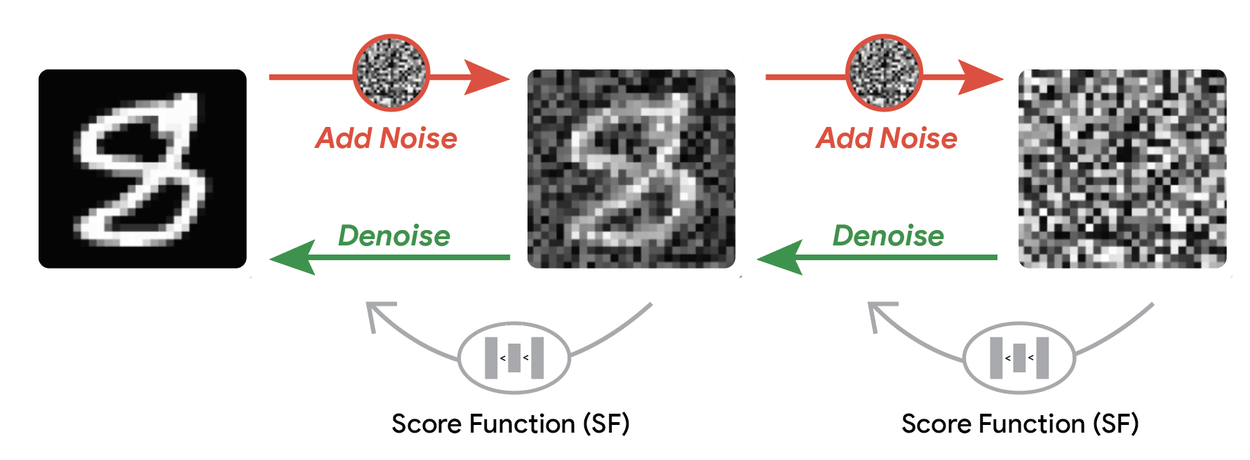
*Google Research illustration of how a score function guides denoising from noise toward meaningful data.4*
This is not a consumer product launch, but it matters for generative AI governance. Copyright, originality, memorization, and model evaluation debates often treat "creative output" as a black box. A mathematical account of interpolation does not resolve those debates, but it gives researchers and policymakers a more precise object to study. It also suggests that better controls may come from shaping how models generalize, not merely filtering outputs after the fact.
The practical watch item is whether these mechanisms become testable evaluation tools. If labs can measure when a diffusion model is interpolating responsibly versus reproducing specific training examples, product teams will have a stronger basis for safety controls, dataset choices, and creator-rights commitments.
Cybersecurity: AI Defense Needs Architecture, Not Just Advice
Mandiant's July 16 guidance on AI-assisted vulnerability management starts from a blunt premise: many organizations are already facing exploit timelines that outpace traditional patch processes.5 The post cites M-Trends 2026's finding that mean time-to-exploit has fallen to negative seven days, meaning exploitation can begin before a patch exists, and it recommends guardrails for using LLM agents in codebases, development environments, and CI/CD pipelines.5
That guidance lands in a threat environment where AI-enabled offense is becoming more concrete. Sysdig's July 1 JADEPUFFER report described what it assessed as a complete database-extortion operation driven end to end by an LLM agent after exploitation of an internet-facing Langflow instance.8 Sysdig pointed to self-narrating payloads, machine-speed error correction, and more than 600 purposeful payloads as evidence that an autonomous agent, not a conventional human-driven toolkit, was operating the campaign.8
The point is not that every attacker has frontier-level autonomous capability. It is that defenders cannot respond to AI-accelerated vulnerability discovery with ticket queues designed for a slower era. Agentic security tools will need narrow permissions, auditable actions, reproducible findings, safe rollback, and clear human approval points. Otherwise, the defensive AI layer can become another privileged system that has to be defended.
Youth Safety: Default AI Answers Face A Higher Bar
Youth safety moved from principle to product design this week. Meta said on July 16 that supervising parents in the United States, United Kingdom, Australia, and Canada will now receive alerts if their teen's Meta AI conversation suggests the teen may be in distress, with global availability planned by the end of the year; Meta also said flagged conversations are manually reviewed before a parent alert is sent.9 OpenAI's July 16 teen-safety post described age prediction, parental controls, Study Mode defaults for linked teen accounts, break reminders, and additional safeguards around sensitive content for users estimated to be under 18.10
Common Sense Media's Youth AI Safety Institute added a sharper external critique. Its July 15 risk assessment found that Google's AI Overview and AI Mode in Search pose "unacceptable risks" for children, citing more than 2,600 searches conducted with accounts configured for 11- and 15-year-old users and warning that schools and parents cannot turn off the AI answer layer in Google Search.6
The institute's head of AI and digital assessments put the standard plainly:
"A product this central to kids' lives, especially an unavoidable one, should be held to a higher standard."6
The debate is shifting from whether children will use AI to what defaults they encounter first. Search summaries, chatbots, study modes, parental notifications, and age prediction are different control surfaces, but they share one design question: does the system help a young person learn and seek support, or does it replace judgment with a fluent answer at exactly the wrong moment?
Health And Science: Generalist Signals Move Toward Personal Agents
Google Research's SensorFM work from July 9 remains one of the most consequential recent health-AI releases. The model was pretrained on more than one trillion minutes of de-identified wearable sensor data from five million consented participants and was evaluated across 35 health prediction tasks spanning cardiovascular, metabolic, sleep, mental-health, demographic, and lifestyle domains.11 Google reported that SensorFM embeddings outperformed feature-engineered supervised baselines on 34 of 35 tasks, and that adding SensorFM predictions improved clinician-rated summaries from a Personal Health Agent over a baseline using daily wearable metrics alone.11
This matters because personal health AI is becoming less like a chatbot and more like an interface to longitudinal physiology. Wearable signals are noisy, incomplete, and highly individual, so a general representation that tolerates missingness and adapts label-efficiently could make health agents more useful. But the same qualities raise governance questions: consent scope, clinical validation, bias across devices and populations, and the boundary between wellness coaching and medical advice.
The near-term opportunity is better personal insight. The long-term risk is over-trusting inferred health states before prospective validation catches up.
What To Watch Next
Watch whether enterprises actually adopt task-level AI metrics like cost per successful outcome, or whether dashboards fall back to easier but weaker measures such as usage, seats, and token spend.1
Watch the Human Authority over Autonomous Weapons Act for committee movement, companion language, or incorporation into defense authorization negotiations.2
Watch Meta's Muse Image rollout for stronger creator controls, especially around public-content references, photo editing, ad generation, and cross-app sharing.3
Watch whether Google Research's diffusion-creativity mechanism becomes part of reproducible tests for memorization, originality, and dataset influence in generative image systems.4
Watch how security teams grant permissions to AI agents in vulnerability management. The useful pattern is not "AI can patch everything," but carefully scoped agents with logs, rollback, and human approval around risky changes.58
Watch youth-safety defaults across AI search and assistant products, especially whether schools and families get controls over embedded answer layers rather than only standalone chatbot settings.6910
Sources
1."A scorecard for the AI age," OpenAI, July 17, 2026. https://openai.com/index/a-scorecard-for-the-ai-age/
2."Beyer, Barrett, Jacobs Introduce Bipartisan Legislation Requiring Human Control Over Autonomous Weapons," U.S. Representative Don Beyer, July 17, 2026. https://beyer.house.gov/news/documentsingle.aspx?DocumentID=9164
3."Introducing Muse Image: Image Generation Built for Your World," Meta, July 7, 2026; updated July 15, 2026. https://about.fb.com/news/2026/07/introducing-muse-image-meta-ai/
4."Towards demystifying the creativity of diffusion models," Google Research, July 15, 2026. https://research.google/blog/towards-demystifying-the-creativity-of-diffusion-models/
5."Demystifying AI Exploits: A Blueprint for AI-Assisted Vulnerability Management," Mandiant, Google Cloud Blog, July 16, 2026. https://cloud.google.com/blog/topics/threat-intelligence/ai-assisted-vulnerability-management/
6."Google's AI Search Poses Unacceptable Risk to Kids, Common Sense Media Finds," Common Sense Media, July 15, 2026. https://www.commonsensemedia.org/press-releases/googles-ai-search-poses-unacceptable-risk-to-kids-common-sense-media-finds
7."Fact Sheet: President Donald J. Trump Signs Historic Directive on AI in the National Security Enterprise," The White House, June 5, 2026. https://www.whitehouse.gov/fact-sheets/2026/06/fact-sheet-president-donald-j-trump-signs-historic-directive-on-ai-in-the-national-security-enterprise/
8."JADEPUFFER: Agentic ransomware for automated database extortion," Sysdig, July 1, 2026. https://www.sysdig.com/blog/jadepuffer-agentic-ransomware-for-automated-database-extortion
9."Alerting Parents if Teens Show Signs of Distress in Conversations With Meta AI," Meta, July 16, 2026. https://about.fb.com/news/2026/07/keeping-parents-informed-teens-distress-conversations-meta-ai/
10."Why teens deserve access to safe AI," OpenAI, July 16, 2026. https://openai.com/index/why-teens-deserve-access-safe-ai/
11."SensorFM: Towards a general intelligence and interface for wearable health data," Google Research, July 9, 2026. https://research.google/blog/sensorfm-towards-a-general-intelligence-and-interface-for-wearable-health-data/