AI's Control Layer Widens
AI's latest developments show a field moving beyond bigger models into a more consequential phase: who can run them, who can verify their work, and which institutions are allowed to coordinate the risks.

AI's latest developments show a field moving beyond bigger models into a more consequential phase: who can run them, who can verify their work, and which institutions are allowed to coordinate the risks.
Executive Summary
The clearest signal from the last few days is that AI deployment is becoming more institutional. Moonshot AI introduced Kimi K3 on July 17 as a 2.8-trillion-parameter open model with native vision and a 1-million-token context window, while Thinking Machines Lab released Inkling on July 15 as a 975-billion-parameter open-weights multimodal model.12 These are not just leaderboard entries. They are arguments that frontier-class capability should be available outside the largest closed labs, with all the integration and governance burdens that openness creates.
At the same time, governments and standards coalitions are building machinery around AI. China used the 2026 World Artificial Intelligence Conference in Shanghai to launch the World Artificial Intelligence Cooperation Organization, presented as the world's first intergovernmental AI organization.3 The White House announced GOLD EAGLE, a federal-industry clearinghouse for coordinating AI-discovered cyber vulnerabilities across critical infrastructure.4 The Federal Reserve published a July 17 framework for tracking whether the AI buildout is actually showing up in capabilities, costs, firm adoption, productivity, and labor-market data.5
Healthcare and creative rights are moving through the same transition. CHAI launched PULSE on July 16 to let public-health agencies test generative AI in governed pilots, and released ambient-AI implementation and testing guidance on July 15.67 Chai Discovery, meanwhile, raised $400 million and deepened pharma partnerships around AI-designed molecules.89 In publishing, Hachette, Cengage, Elsevier, Scott Turow, and S.C.R.I.B.E. filed a copyright case against Google over Gemini training, keeping data rights at the center of AI economics.10
The pattern is not hype giving way to disappointment. It is capability giving way to control: model access, vulnerability triage, health governance, economic measurement, and rights clearance are now part of the core AI story.
Open Models: Frontier Ambition Moves Outside The Closed Labs
Moonshot AI's Kimi K3 announcement is the week's most direct open-model signal. The company describes Kimi K3 as a 2.8T-parameter model using Kimi Delta Attention, Attention Residuals, native vision, and a 1-million-token context window, with availability through Kimi.com, Kimi Work, Kimi Code, and the Kimi API; it says full weights will be released by July 27, 2026.1 Moonshot also says K3 activates 16 of 896 experts in a Stable LatentMoE setup and reports strong long-horizon coding, knowledge-work, multimodal, kernel-optimization, and chip-design case studies.1
Moonshot framed the release bluntly:
"It is the world's first open 3T-class model."1
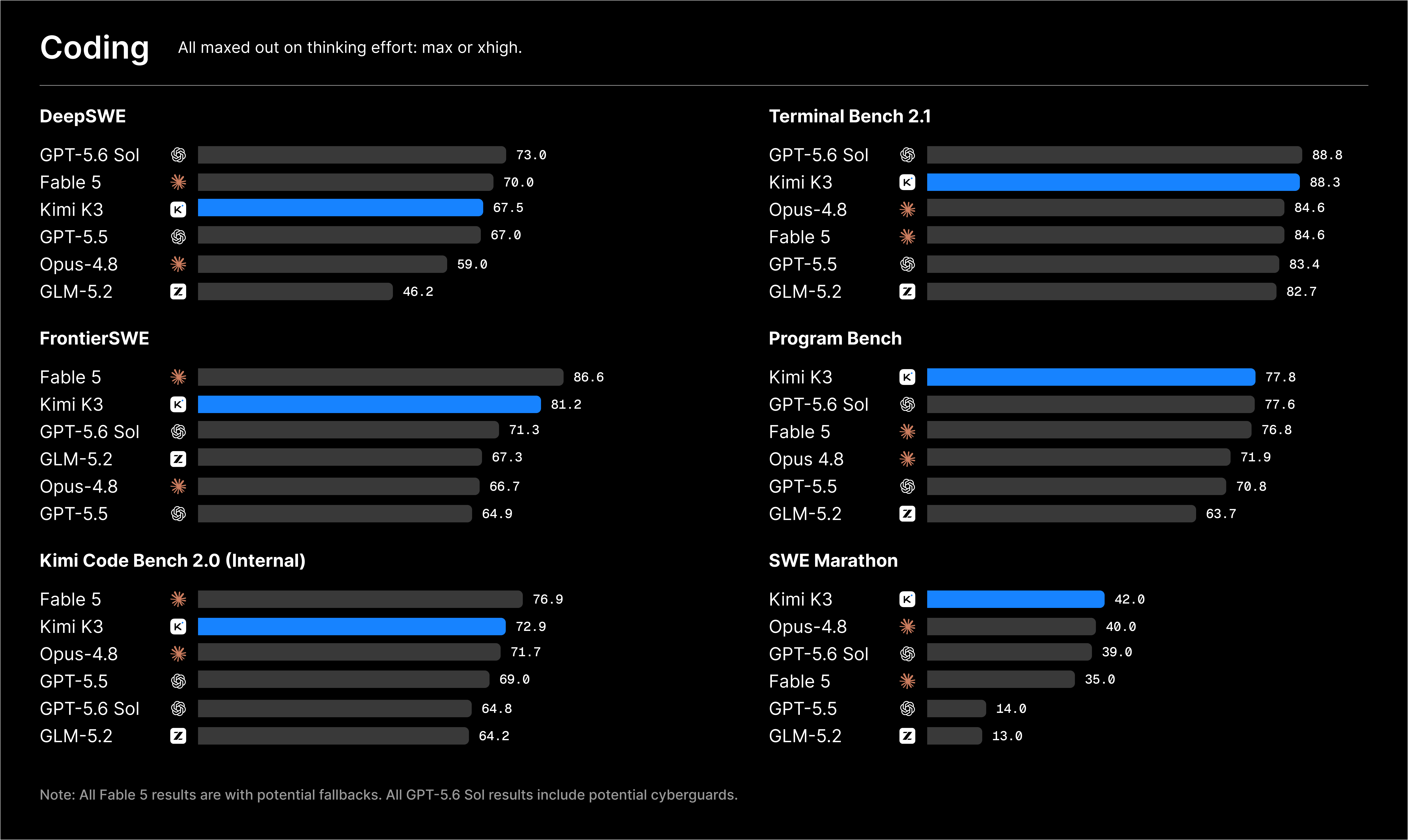
*Official Kimi K3 coding benchmark comparison from Moonshot AI.1*
The release matters because open-weight competition is shifting from "good enough local model" to "who controls the frontier stack." A 1-million-token, multimodal, agent-oriented model can change procurement choices for companies that need model portability, auditability, regional control, or long-context codebase work. But Kimi's own limitations section is a reminder that openness does not remove operational risk: the company warns about sensitivity to thinking-history handling and excessive proactiveness when ambiguous tasks are under-specified.1
Thinking Machines Lab's Inkling release pushes the same access debate from another direction. The company says Inkling is a 975B-parameter Mixture-of-Experts transformer with 41B active parameters, a context window up to 1M tokens, native reasoning over text, images, and audio, pretraining on 45 trillion tokens, and full weights available for customization.2 It also released a preview of Inkling-Small with 12B active parameters, signaling that the lab wants a family of customizable systems rather than a single flagship.2
The strategic question is whether open models can remain open while still being governable. Enterprise buyers will want deployability, data boundaries, cost predictability, and visible model behavior. Regulators and safety teams will ask how powerful open weights are evaluated, monitored, and patched once they are outside the original lab's infrastructure.
Product Workflows: Research Assistants Become Computing Environments
Google's July 16 renaming of NotebookLM to Gemini Notebook looks modest on the surface, but the product change says a lot about where AI work tools are heading.11 Google says the tool remains a standalone research product while expanding across the Gemini app and Google Search, and that notebooks will sync across the Gemini app and the standalone Gemini Notebook experience.11 More importantly, Google says it has started giving every notebook a secure cloud computer, allowing the product to write and execute code natively for source-grounded data analysis; the feature is available first to Google AI Ultra users and certain Workspace business customers, with a Pro web rollout planned over the coming weeks.11
That is a meaningful change in the shape of consumer and enterprise AI. A notebook that can cite, summarize, reason, run code, and move across search and assistant surfaces is less like a chatbot and more like a workspace runtime. The benefit is obvious: students, analysts, researchers, and teams can keep sources, computations, and synthesis in one environment. The risk is also obvious: once an AI workspace can execute code, manage source collections, and appear inside search, organizations need sharper controls around permissions, provenance, execution logs, and source boundaries.
Governance: AI Institutions Become Geopolitical Infrastructure
China's July 17 chair's statement from the 2026 World Artificial Intelligence Conference says the meeting was held in Shanghai from July 17 to 20 under the theme "AI Partnership for a Brighter Future," with participation from leaders, official representatives, companies, scholars, and researchers from more than 100 countries and international organizations.3 During the conference, the agreement establishing the World Artificial Intelligence Cooperation Organization was signed, with the new body headquartered in Shanghai and described as open to all countries.3
The statement's most consequential line is institutional:
"WAICO will be the world's first intergovernmental international organization on AI."3
That claim matters even if many countries remain outside the effort. AI governance is no longer only a standards conversation among labs, companies, and technical agencies. It is becoming an arena for global alignment, export-control politics, development finance, language and cultural policy, and public-sector capacity building. WAICO is explicitly framed around bridging the AI divide and supporting Global South countries in AI development, application, and governance.3 That gives Beijing a forum for AI diplomacy at the same time U.S.-led controls and allied supply-chain initiatives are trying to shape who can access the most advanced chips and models.
Cybersecurity: Finding Flaws Is Becoming Easier Than Fixing Them
The White House's July 14 GOLD EAGLE announcement captures the new cybersecurity bottleneck. The initiative is described as a clearinghouse for cybersecurity vulnerability coordination that uses frontier AI capabilities, reduces duplicative scanning, and delivers prioritized remediation information to federal and private-sector defenders across critical infrastructure.4 The White House says Treasury, DHS through CISA, and the Department of War worked with industry partners on faster exploit detection and response across critical infrastructure sectors.4
The important shift is from discovery to triage. Advanced models can surface more vulnerabilities than traditional security teams can verify and patch. That can improve defense only if reports are deduplicated, prioritized, validated, assigned to maintainers, and converted into fixes before attackers act. Otherwise AI simply floods already overloaded maintainers with more vulnerability claims.
GOLD EAGLE is also a governance experiment. It asks companies, open-source communities, and federal agencies to share sensitive vulnerability information under a coordinated process. The success metric will not be how many flaws are found. It will be whether the program shortens the gap between credible discovery and deployed remediation without creating new disclosure, liability, or operational-security problems.
Markets And Labor: The AI Buildout Gets A Measurement Framework
The Federal Reserve's July 17 FEDS Note is useful because it resists both triumphalism and dismissal. The authors organize public AI indicators into capabilities and costs, firm investment and adoption, and productivity and labor, arguing that the current question is whether AI's effects remain concentrated in investment-led growth or begin showing up in labor markets and aggregate productivity.5 As of 2026, they write, evidence points to an economy reorganizing around the technology while broad output and labor data show limited signs of transformation.5
That distinction matters for anyone watching AI markets. Hyperscaler capital expenditure, data-center construction, chip costs, token pricing, adoption surveys, and task-completion horizons are all useful signals, but none alone proves that AI is raising economy-wide productivity. The Fed note specifically warns that task-level gains may not translate directly into firm-level output when adjustment costs or bottlenecks absorb the upstream productivity gains.5
For operators, the takeaway is practical: AI return on investment should be measured by work completed, costs avoided, quality maintained, and human bottlenecks removed. For policymakers, the watch item is whether early-career labor markets and high-exposure sectors begin to diverge from the rest of the economy as AI substitutes for entry-level tasks or changes how workers learn on the job.5
Health And Science: Deployment Discipline Reaches Public Health And Drug Discovery
CHAI's July 16 PULSE initiative is a public-sector version of governed AI rollout. The coalition says OpenAI and Anthropic donated 10 enterprise licenses with up to 2,000 seats for public-health practitioners, and that 10 selected jurisdictions will pilot generative AI across use cases including drug-wave prediction, social-determinants mapping, community-feedback analysis, multilingual translation, and FHIR query automation.6 CHAI says pilots will begin this fall, with national playbooks expected next year.6
The day before, CHAI released an ambient-AI implementation playbook and testing-and-evaluation framework covering procurement, pre-deployment, piloting, deployment, and monitoring.7 The guidance points to consent and recording rules, patient audio storage, vendor model training, licensing models, shadow AI, vendor drift, clinician wellness, and patient experience as implementation issues that health systems need to handle explicitly.7
That is the right level of seriousness for health AI. A public-health assistant, ambient documentation system, or FHIR query engine can produce real operational gains, but only if it has workflow-specific evaluation, privacy boundaries, auditability, fallback procedures, and post-deployment monitoring.
In drug discovery, Chai Discovery's July 14 and July 15 announcements show capital and pharma adoption moving together. The company announced $400 million in new funding at a $3.8 billion valuation, saying Chai-3 is helping make difficult targets tractable design problems.8 It also announced an argenx collaboration that gives the immunology company early access to Chai's AI platform for de novo antibody discovery, following earlier agreements with Novartis, Pfizer, and Eli Lilly.912
The scientific promise is not that AI makes clinical evidence optional. It is that model-guided molecular design may compress the expensive early loop between hypothesis, candidate generation, and experimental validation. The governance question is how quickly regulators, pharma teams, and AI labs can build evidence trails robust enough for molecules that were not discovered by the usual screening pipeline.
Copyright And Creative Markets: Training Data Remains The Business Model Fight
The Hachette-led Google lawsuit is not fresh because copyright litigation is new; it is important because it targets a specific relationship between publishers and Google.10 Hachette's July 13 announcement says Hachette Book Group, Cengage Learning, Elsevier, Scott Turow, and S.C.R.I.B.E. filed a putative class action against Google over alleged willful infringement of textual works used to develop Gemini models.10 Justia's docket listing identifies the case as filed in the Southern District of New York on July 10, 2026, under copyright law.13
The publishers allege that Google copied works obtained for limited uses such as Google Books and other services, used unauthorized web scrapes including alleged pirate sources and paywalled material, removed copyright-management information, and trained Gemini on those materials without authorization.10 These are allegations, not findings of fact. But they underline the commercial issue that will keep returning: if high-quality books, textbooks, journals, images, music, or code are valuable training inputs, markets need a durable answer for permission, compensation, and auditability.
The outcome will matter well beyond Google. Licensing deals, opt-out systems, public-domain corpora, model transparency, and fair-use litigation all become part of the cost structure of AI. Creative and educational markets will not accept a future in which model capability is monetized while source labor is treated as an unpriced externality.
What To Watch Next
Watch whether Moonshot releases the full Kimi K3 weights by July 27, 2026, and whether third-party evaluators reproduce its long-horizon coding and multimodal claims outside Moonshot's harnesses.1
Watch how Thinking Machines Lab handles safety, licensing, and customization around Inkling's open weights, especially for 1M-context multimodal use cases.2
Watch WAICO membership, funding, and standards output after the Shanghai conference closes on July 20, because the new organization could become a counterweight to U.S.- and EU-centered AI governance forums.3
Watch GOLD EAGLE for concrete intake rules, partner names, liability protections, and patch-throughput metrics. Finding vulnerabilities is no longer the scarce step; verified remediation is.4
Watch the Fed's AI indicators for divergence between investment signals and labor/productivity signals, especially in high-exposure sectors and early-career hiring.5
Watch CHAI's PULSE pilots and ambient-AI playbook adoption for a practical answer to whether public agencies and health systems can use generative AI without weakening trust, privacy, or accountability.67
Watch the Google publishing case for discovery over training data provenance, because the legal fight is likely to turn on how material was obtained, not only whether training is transformative.1013
Sources
1."Kimi K3: Open Frontier Intelligence," Moonshot AI / Kimi, July 17, 2026. https://www.kimi.com/blog/kimi-k3
2."Inkling: Our Open-Weights Model," Thinking Machines Lab, July 15, 2026. https://thinkingmachines.ai/news/introducing-inkling/
3."Chair's Statement of the 2026 World Artificial Intelligence Conference & High-Level Meeting on Global AI Governance," Ministry of Foreign Affairs of the People's Republic of China, July 17, 2026. https://www.mfa.gov.cn/eng/xw/zyxw/202607/t20260717_11984715.html
4."White House Launches Gold Eagle Initiative for Unprecedented Cybersecurity Vulnerability Coordination," The White House, July 14, 2026. https://www.whitehouse.gov/releases/2026/07/white-house-launches-gold-eagle-initiative-for-unprecedented-cybersecurity-vulnerability-coordination/
5."The AI Buildout and the Economy: Publicly Available Data to Assess AI's Impact," Board of Governors of the Federal Reserve System, July 17, 2026. https://www.federalreserve.gov/econres/notes/feds-notes/the-ai-buildout-and-the-economy-publicly-available-data-to-assess-ais-impact-20260717.html
6."Coalition for Health AI (CHAI) Launches PULSE, a National Initiative to Help Public Health Agencies Responsibly Implement AI at Scale," Coalition for Health AI, July 16, 2026. https://www.chai.org/news/coalition-for-health-ai-chai-launches-pulse-a-national-initiative-to-help
7."Coalition for Health AI (CHAI) Releases New Implementation Playbook and Testing & Evaluation Framework for Ambient AI," Coalition for Health AI, July 15, 2026. https://www.chai.org/blog/coalition-for-health-ai-chai-releases-new-implementation-playbook-and
8."Series C: Announcing our $400M fundraise," Chai Discovery, July 14, 2026. https://www.chaidiscovery.com/news/series-c
9."Chai Discovery Enters Into Collaboration Agreement With argenx to Advance AI-Driven Immunology Breakthroughs," Chai Discovery, July 15, 2026. https://www.chaidiscovery.com/news/argenx-partnership
10."Publishers and Authors File Class Action Lawsuit Against Google for Willful Copyright Infringement to Develop Gemini AI Models," Hachette Book Group, July 13, 2026. https://www.hachettebookgroup.com/hachette-book-group-news/publishers-and-authors-file-class-action-lawsuit-against-google-for-willful-copyright-infringement-to-develop-gemini-ai-models/
11."NotebookLM is now Gemini Notebook," Google, July 16, 2026. https://blog.google/innovation-and-ai/products/gemini-notebook/notebooklm-gemini-notebook/
12."Chai Discovery Announces Collaboration with Novartis to Advance AI-Driven Antibody Discovery," Chai Discovery, July 13, 2026. https://www.chaidiscovery.com/news/novartis-partnership
13."Hachette Book Group, Inc. et al v. Google LLC, 1:2026cv05869," Justia Dockets, filed July 10, 2026. https://dockets.justia.com/docket/new-york/nysdce/1%3A2026cv05869/668113