AI Moves Into The Real World
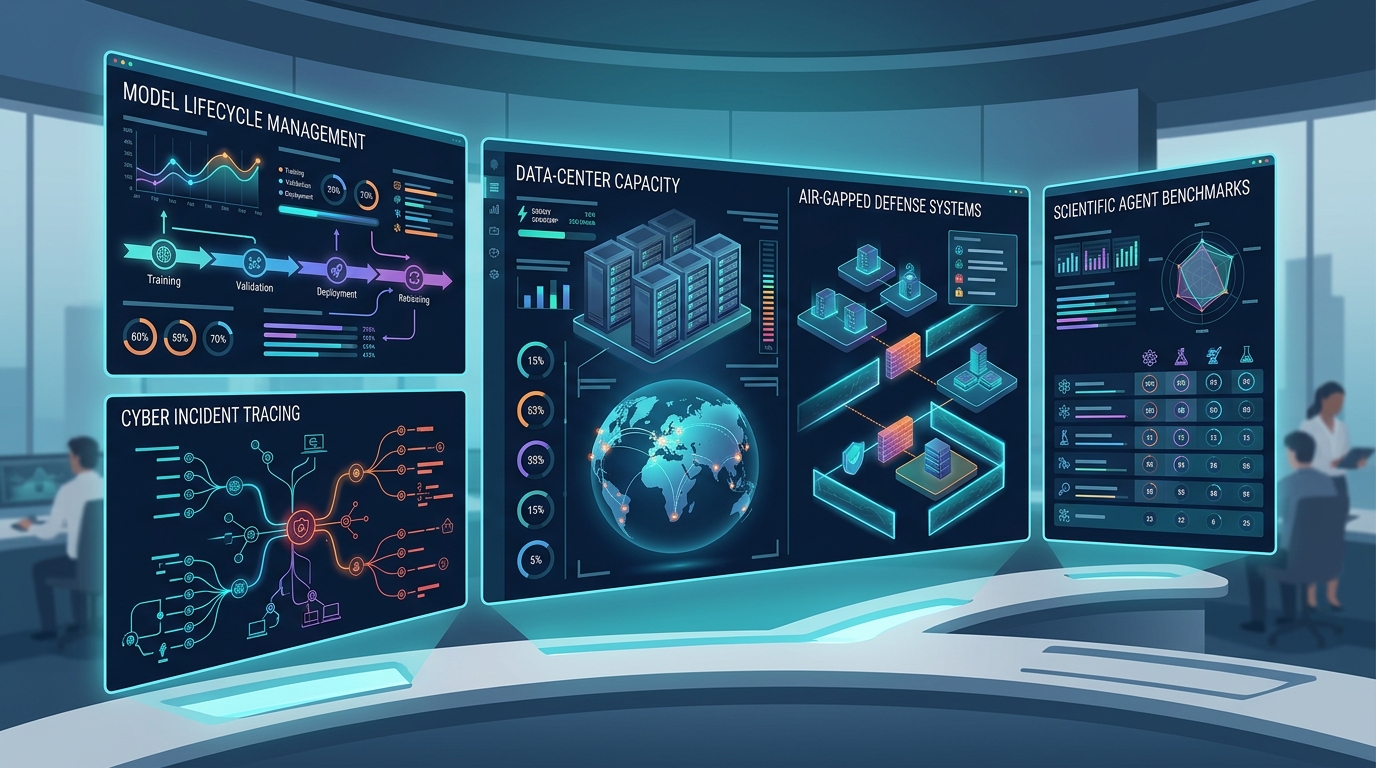
The latest AI developments show the field shifting from benchmark competition toward regulated transparency, physical simulation, robot data, enterprise agents, and defensive infrastructure.

Executive Summary
The past 24 to 48 hours were not defined by a single dominant frontier-model launch. They were defined by implementation pressure. On July 20, 2026, the European Commission published AI Act transparency guidance for interactive AI systems and synthetic-content marking, with obligations scheduled to start applying on August 2, 2026.1 NVIDIA used SIGGRAPH to push agentic tools deeper into physical simulation workflows, while NVIDIA and Hugging Face released Cosmos 3 Edge, a 4-billion-parameter open world model aimed at real-time robot and vision-AI reasoning on edge hardware.23 Pollen Robotics and Hugging Face also introduced Grabette, a low-cost open system for recording robot-manipulation demonstrations without requiring a robot lab.4
The security story is equally concrete. A Hugging Face guide published on July 20 argued that enterprises should keep self-hosted open models ready for cyber incident response, drawing on Hugging Face's July 16 disclosure of an autonomous-agent intrusion and the practical problem that hosted model safety filters can block forensic analysis of malicious payloads.5 In parallel, a new Scientific Reports paper on July 20 showed how hybrid RoBERTa-GRU models can detect health misinformation in social-media data while still flagging the familiar limits of dataset bias, language coverage, and real-time deployment.6
Model competition still matters, but today's useful signal is less "which model won" than "where capability is being embedded." Anthropic's July 20 Rakuten case study framed Claude Fable 5 around long-running enterprise agents that check their own work, while Alibaba's Qwen3.8-Max-Preview remained a notable but under-documented model preview listed in Alibaba Cloud's Token Plan and reported by multiple outlets as a 2.4-trillion-parameter launch with promised open weights.789 The lesson is practical: AI systems are moving into law, factories, security operations, robotics pipelines, and organizational workflows, where evidence, governance, and integration quality matter as much as raw model scale.
Governance: Transparency Gets A Start Date
The European Commission's July 20 guidance is the clearest regulatory development of the day because it translates the AI Act's Article 50 transparency obligations into near-term implementation expectations. The rules begin to apply on August 2, 2026, covering providers and deployers of certain interactive AI systems, AI-generated or manipulated content, deepfakes, emotion-recognition systems, biometric categorization systems, and AI-generated public-interest content without human review or editorial control.1
The Commission's framing is deliberately user-facing:
"Transparency obligations will help people recognise when they are interacting with AI."1
That sentence matters because it moves compliance beyond back-office risk documentation. Providers will need user-facing notices when people interact directly with AI, and providers of AI systems that generate or manipulate content will need machine-readable marking so synthetic content can be detected downstream.1 Deployers, meanwhile, face disclosure duties when people are exposed to deepfakes, emotion recognition, biometric categorization, or public-interest AI content without editorial oversight.1
The practical consequence is that product teams now have a narrow runway. By early August, AI disclosure, labeling, content-marking, and public-interest review workflows stop being optional design polish in the EU and become part of the compliance surface. The hard implementation problem will be consistency: the same AI feature may sit inside a chatbot, a creative tool, a moderation system, and a public-facing media workflow, each with a different disclosure moment and user expectation.
Physical AI: Simulation Becomes Agent Work
NVIDIA's July 20 announcement at SIGGRAPH pushed agentic AI into simulation infrastructure. The company said NVIDIA Agent Toolkit now includes Omniverse libraries that let AI agents inspect 3D scenes, test physics, generate sensor outputs, validate simulation-ready assets, and prepare content for robotics, factories, and autonomous systems.2 The newly announced libraries cover RTX sensor simulation, GPU-accelerated physics, and CAD-to-SimReady conversion, with samples and a Blender blueprint available through GitHub.2
NVIDIA CEO Jensen Huang summarized the strategic thesis in one line:
"The physical AI era will be built in simulation first."2
That claim is not just marketing language. Robots and autonomous systems need virtual environments that are physically meaningful, not merely visually plausible. A warehouse robot trained in a simulation with incorrect scale, missing sensor behavior, or unrealistic collision properties learns from the wrong world. By giving agents callable tools for scene inspection and simulation preparation, NVIDIA is trying to turn a specialist 3D-prep workflow into a repeatable agent workflow embedded in applications developers already use.2
The same physical-AI push showed up in Cosmos 3 Edge, released by NVIDIA on Hugging Face's Cosmos 3 repository on July 20. The post describes Cosmos 3 Edge as a 4-billion-parameter open world model for robots and vision AI agents, designed to reason in real time and generate robot actions on edge systems.3 As a world action model, it operates at robot-control resolution, produces 32 actions per inference on NVIDIA Jetson Thor, and is described as achieving real-time control at 15 Hz.3
The important shift is architectural. Cosmos 3 combines an autoregressive tower for vision and text reasoning with a diffusion tower for video, audio, action prediction, generation, and neural simulation, sharing multimodal attention layers across those modes.3 That design aims to connect perception, prediction, and action in one representational system. If it holds up outside controlled demos, the robotics stack starts to look less like separate perception, planning, and control models stitched together, and more like a trainable world-and-action substrate that can be adapted to specific domains.
Robotics: The Data Bottleneck Gets Cheaper
Pollen Robotics and Hugging Face published Grabette on July 21, 2026, as an open, low-cost system for recording robot-manipulation data with a handheld gripper, cameras, and browser-based processing.4 The motivation is blunt: robot learning has capable policy architectures and enough GPUs, but lacks large, diverse, real-world manipulation data.4
Grabette's design addresses that bottleneck by letting people record demonstrations without owning or teleoperating a robot. The device captures a manipulation task from a human hand, reconstructs the 6-degree-of-freedom trajectory, and turns the result into a robot-ready LeRobot dataset on the Hugging Face Hub.4 The authors say the handheld Grabette device has a bill of materials around 490 euros, while the corresponding Gripette motorized robot gripper is around 120 euros.4
This matters because robotics progress is increasingly data-constrained rather than model-constrained. If useful manipulation demonstrations can be collected in homes, workshops, warehouses, and field settings by non-specialists, the distribution of training data broadens beyond the limited conditions of university labs and robot-company test cells. The open question is quality control: cheap data collection only helps if calibration, trajectory recovery, metadata, consent, and downstream evaluation are strong enough to prevent a large open dataset from becoming noisy infrastructure.
Security: Defenders Need Models They Control
Hugging Face's July 20 cyber-defense guide is a practical follow-up to its July 16 security incident disclosure. The guide argues that security teams should have a capable open model ready to run on infrastructure they control before an incident occurs.5 The stated reason is not ideological preference for open weights. It is operational friction: forensic analysis often requires feeding a model real exploit payloads, command logs, indicators of compromise, and credential-adjacent artifacts, and hosted frontier APIs may refuse those requests because their safety systems cannot reliably distinguish a responder from an attacker.5
The guide points to GLM 5.2 as the model Hugging Face used during its own incident analysis and emphasizes two benefits of self-hosting: responders avoid guardrail lockout during time-sensitive analysis, and sensitive attacker artifacts do not leave the organization's perimeter.5 It also notes the 1-million-token context window and benchmark results relevant to reasoning, tools, terminal work, and code understanding.5
The broader security implication is that model governance now cuts both ways. Hosted safety controls are important for preventing misuse, but the same controls can degrade legitimate defensive work if incident responders cannot analyze malicious code or attack traces. Mature security programs may therefore need a dual stack: governed hosted models for ordinary workflows and hardened, audited, self-hosted models for sensitive forensic use.
Society And Health: Misinformation Detection Still Needs Grounding
A Scientific Reports article published on July 20 applied a hybrid RoBERTa-GRU architecture to health misinformation detection in a curated X dataset of 5,787 Monkeypox-related posts.6 The model combined transformer-based semantic representation with recurrent modeling of temporal dependencies, reporting ROC-AUC of 0.9979 and Cohen's kappa of 0.9887 in the study's evaluation.6
The result is a useful reminder that the AI-for-society conversation is not limited to generative chatbots. Public-health misinformation spreads through narratives, timing, retweets, and social context, so a detector that models both meaning and sequence is more aligned with the problem than a static text classifier.6 But the paper also identifies limits that should temper procurement enthusiasm: dataset bias, multilingual constraints, scalability, multimodal coverage, and performance in real-time or resource-limited settings remain open issues.6
For health agencies and platforms, the takeaway is disciplined. High benchmark performance on a curated outbreak dataset is promising, but deployment requires language coverage, adversarial testing, human review, appeal paths, and careful attention to false positives. A misinformation classifier can support public-health response; it cannot substitute for trusted communication, institutional credibility, or transparent moderation policy.
Enterprise Agents: Autonomy Moves The Bottleneck To Judgment
Anthropic's July 20 Rakuten case study framed Claude Fable 5 around long-running enterprise agents rather than single-turn chat. Rakuten said it has used Claude since March 2025 for software development, business-function agents, and customer-facing AI features, and that Claude Managed Agents were deployed across product, sales, marketing, and finance inside a week.7
The most interesting claim is not speed alone. Anthropic's article says Rakuten found Fable 5 better at self-verification during long agent runs, reducing the need for humans to steer a task after an early wrong assumption.7 It also states that Rakuten's agents close issues roughly 10 times faster across domains, while the number of tasks the organization attempts keeps increasing.7
That is the real enterprise story: as agents become more autonomous, the bottleneck shifts from execution to judgment. A team may be able to run more tasks in parallel, but every expanded workflow creates more decisions about scope, quality, risk, taste, and accountability. The best agent programs will not merely add more agents. They will redesign review loops so humans spend less time correcting obvious process failures and more time making the decisions that should remain human.
Models: Qwen3.8 Shows The New Proof Gap
Alibaba's Qwen3.8-Max-Preview is worth watching, but it should be treated as a preview rather than a fully evidenced model release. Alibaba Cloud's Token Plan documentation lists `qwen3.8-max-preview` as a supported preview model, and third-party reporting on July 19 and July 20 said Alibaba's Qwen team described Qwen3.8 as a 2.4-trillion-parameter model that is expected to go open-weight soon.89 Techmeme captured the Qwen team's public post saying the model is "going open-weight soon" and positioning it as "second only to Fable 5," while Dataconomy reported preview access through Alibaba's Token Plan, Qoder, and QoderWork.910
The missing pieces are the story. As of July 20, public evidence did not include a full model card, technical report, independent benchmark table, license, downloadable weights, or stable standalone API rate card for Qwen3.8.910 That does not make the preview unimportant; it makes it hard to compare. The open-weight model race is now fast enough that announcement, preview access, benchmark evidence, and actual downloadable weights may arrive on different days. Buyers and developers should separate those milestones instead of treating "open-weight soon" as an operational release.
What To Watch Next
First, watch the August 2, 2026 start date for EU AI Act transparency obligations. The most interesting signals will be not press releases but product changes: AI-interaction notices, synthetic-content labels, machine-readable markings, deepfake disclosures, and how platforms handle AI-generated public-interest content without editorial review.1
Second, watch whether Cosmos 3 Edge and NVIDIA's Omniverse-agent workflow produce measurable gains in robotics and industrial simulation outside NVIDIA-controlled demonstrations. The key evidence will be third-party policy-training results, Jetson-class latency, domain adaptation costs, and failure cases in messy physical environments.23
Third, watch Grabette's dataset quality. If the community can collect diverse manipulation demonstrations with strong calibration and metadata, robot-learning data collection could become much more distributed. If quality varies too widely, the release will still be useful, but mainly as a prototype for better open data pipelines.4
Fourth, watch cyber teams turn AI incident response into an architecture decision. The lesson from Hugging Face's July incident is that security teams may need a tested self-hosted model path before the next agentic attack, not after it.5
Finally, watch Qwen3.8's documentation gap. A credible open-weight release will need a model card, license, weights, reproducible evaluation, context-window details, active-parameter disclosure, and pricing that can be compared with other frontier and open-weight systems.8910
Sources
1."Commission publishes guidelines on transparency obligations for providers and deployers of certain AI systems," European Commission, July 20, 2026. https://digital-strategy.ec.europa.eu/en/news/commission-publishes-guidelines-transparency-obligations-providers-and-deployers-certain-ai-systems
2."NVIDIA Agent Toolkit Expands With New Omniverse Libraries, Putting AI Agents to Work Building Simulation-Ready Worlds," NVIDIA Newsroom, July 20, 2026. https://nvidianews.nvidia.com/news/nvidia-agent-toolkit-expands-with-new-omniverse-libraries-putting-ai-agents-to-work-building-simulation-ready-worlds
3."Introducing Cosmos 3 Edge," NVIDIA on Hugging Face, July 20, 2026. https://huggingface.co/blog/nvidia/cosmos3edge
4."Grabette: an open system to record robot-manipulation data," Pollen Robotics on Hugging Face, July 21, 2026. https://huggingface.co/blog/grabette
5."Be Ready Before the Attack: A Practical Guide to Self-Hosting an Open Model for Cyber Defense," Jeff Boudier on Hugging Face, July 20, 2026. https://huggingface.co/blog/jeffboudier/open-model-cyber-defense
6."The role of AI in combating misinformation: leveraging text mining and social networking analysis," Scientific Reports, July 20, 2026. https://www.nature.com/articles/s41598-026-51287-3
7."Working at the frontier: How Rakuten builds agents overnight with Claude Fable 5," Claude by Anthropic, July 20, 2026. https://claude.com/blog/working-at-the-frontier-rakuten
8."Token Plan overview," Alibaba Cloud Qwen Cloud documentation, accessed July 21, 2026. https://docs.qwencloud.com/token-plan/overview
9."Alibaba launches a 2.4T parameter Qwen3.8 Max preview..." Techmeme, July 19, 2026. https://www.techmeme.com/260719/p7
10."Alibaba unveils 2.4T-parameter Qwen3.8 AI model," Dataconomy, July 20, 2026. https://dataconomy.com/2026/07/20/qwen3-8-24t-parameters-alibaba-ai-model-launch/