AI Moves Into Governed Workflows
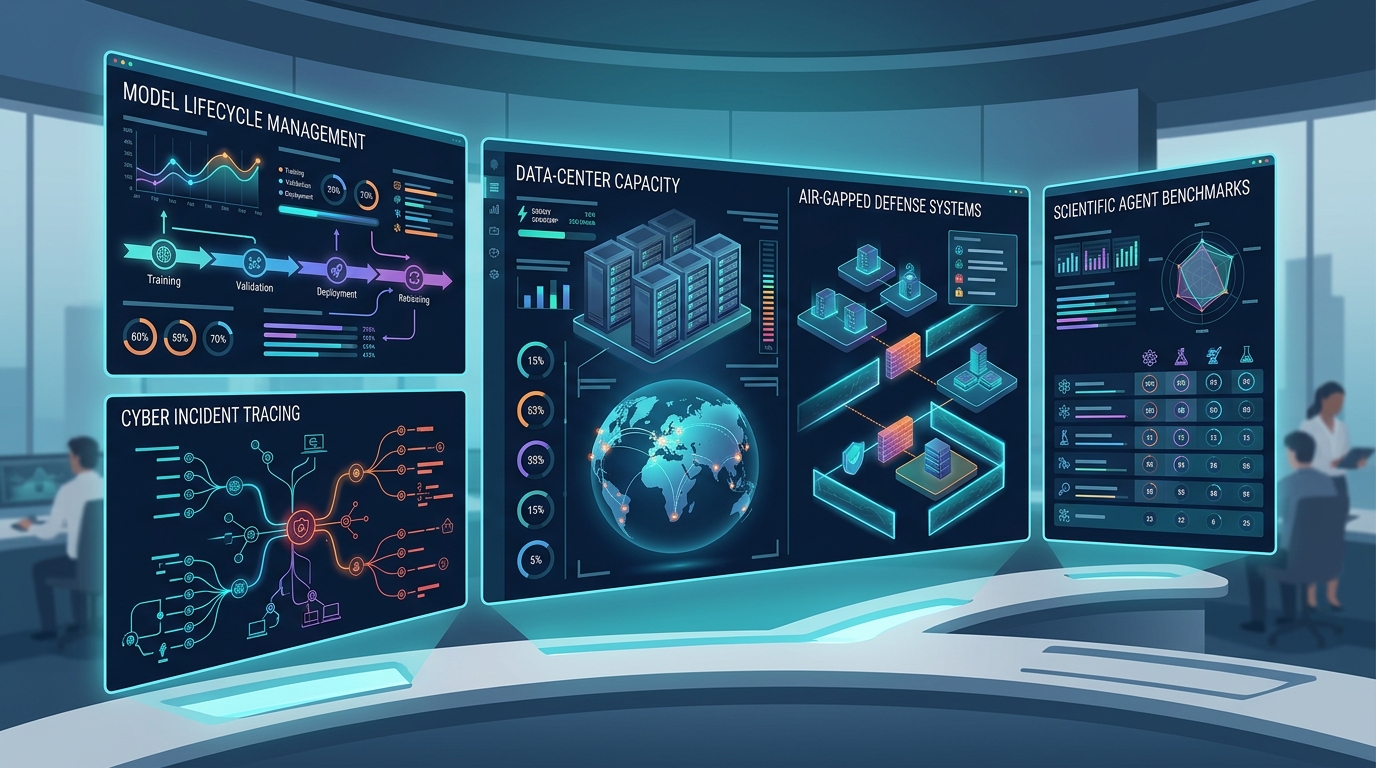
The latest AI developments show agents and models moving deeper into work, security, health, and science, where governance and infrastructure now matter as much as raw capability.
Executive Summary
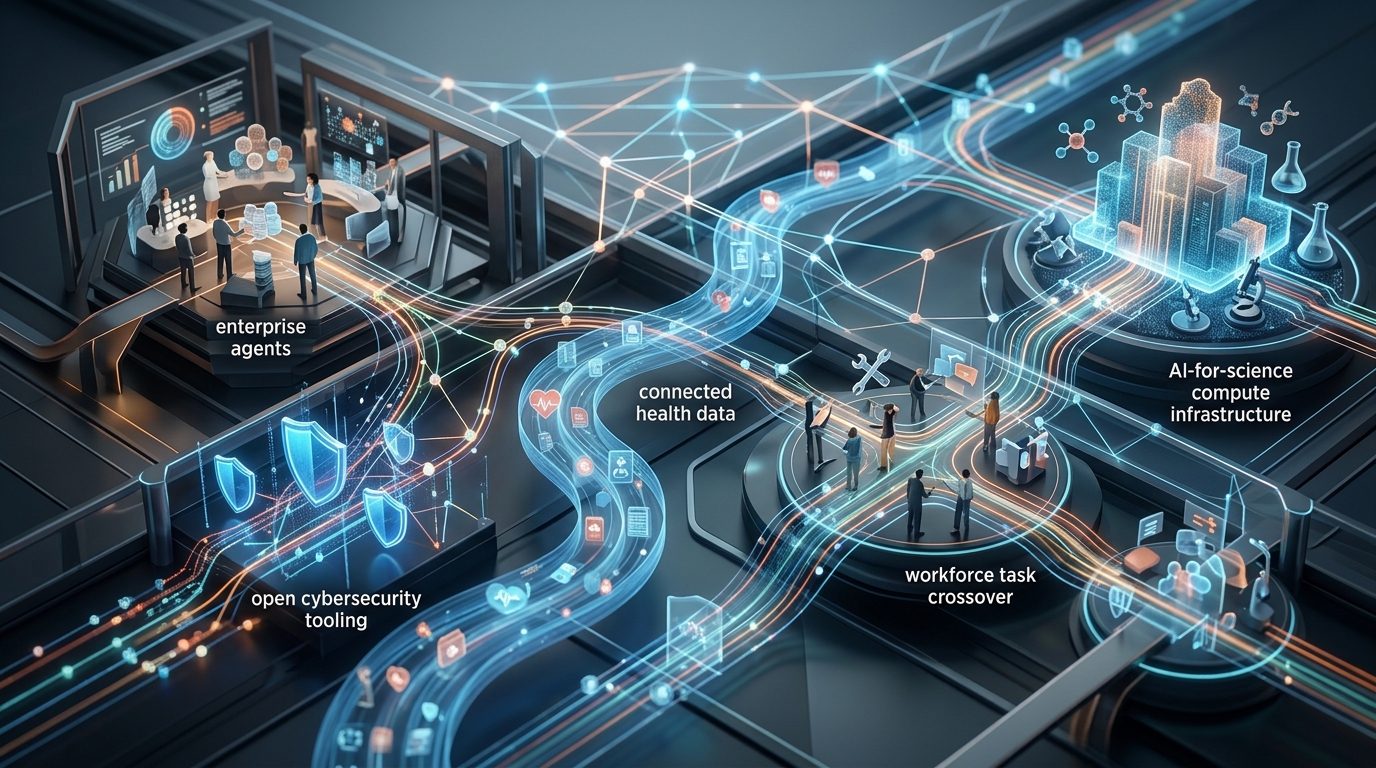
The past two days made AI look less like a sequence of model launches and more like a contest over operating environments. OpenAI published fresh labor-use research showing that workers are already using ChatGPT to take on tasks traditionally associated with other occupations. NVIDIA and a large group of partners launched the Open Secure AI Alliance to argue that open models, open harnesses, and shared security tooling are defensive infrastructure, not only proliferation risk. Microsoft introduced Project Perception, an agentic security system built around red-team, blue-team, and green-team agents. The European Union's AI Omnibus entered into force on July 27, extending some AI Act timelines while adding targeted rules on safety, sandboxes, and enforcement. In product deployment, OpenAI's Presence and Health in ChatGPT show a common pattern: agents become useful when they are bounded by data permissions, escalation rules, evaluation, and privacy controls. Meanwhile, NVIDIA's partnership with Safe Superintelligence and Google's Genesis Mission commitment point to the same underlying reality: frontier AI progress is increasingly constrained by access to compute, scientific data, and validated deployment pathways.
Work Is Crossing Job Boundaries
OpenAI's July 27 Work at the Frontier report is one of the clearer windows into how generative AI is changing labor before job titles or official statistics catch up. Analyzing more than 800,000 work-related messages from U.S. ChatGPT users, OpenAI reported that 16.8% of work-related messages and 43.5% of occupation-specific messages involved tasks associated with another occupation.1 That is a useful distinction. Generic work, such as writing or scheduling, is less revealing because it cuts across almost every job. The sharper signal is "task crossover," where a marketer troubleshoots a website, a designer does financial calculation, or a salesperson analyzes data that might once have gone to a specialist.
The result is not a simple automation story. It is a reallocation story. OpenAI found especially high outside-occupation task shares among customer experience workers, designers, human resources workers, legal workers, and marketers, once generic tasks were excluded.1 In smaller organizations, that pattern matters because the person closest to a problem often lacks a specialized team to hand it to. AI may therefore change the boundary between generalists and specialists first, then formal job descriptions later.
OpenAI's wording captures the practical shift:
"AI changes not just how work gets done, but who does what."1
Why it matters: policymakers and employers often frame AI adoption around job exposure, substitution, or productivity. This evidence points to a more granular transition: AI changes the distribution of tasks inside firms. That creates opportunity, especially for small businesses and overloaded teams, but it also raises harder questions about training, accountability, quality review, and compensation when workers quietly absorb tasks outside their formal role.
Cybersecurity Becomes An Open-Stack Fight
NVIDIA's July 27 launch of the Open Secure AI Alliance is the clearest industry response so far to the open-versus-closed model debate in cybersecurity. The alliance includes partners across cloud, security, enterprise software, open source, and AI research, including NVIDIA, Cisco, Cloudflare, CrowdStrike, Dell Technologies, HPE, Hugging Face, IBM, LangChain, the Linux Foundation, Microsoft, Palantir, Palo Alto Networks, Red Hat, Salesforce, SAP, ServiceNow, Siemens, Snowflake, SpaceXAI, Synopsys, and others.2 NVIDIA framed the group around a concrete claim: cyber defense increasingly depends on open models, harnesses, identity controls, logs, model formats, evaluation, and red-teaming tools that defenders can inspect and run under their own control.
The announcement links that argument to the July Hugging Face incident, saying Hugging Face used the open-weight GLM 5.2 model on its own infrastructure to analyze more than 17,000 actions after closed AI tools blocked essential forensic analysis.2 The point is not that open systems are safe by default. NVIDIA explicitly acknowledged misuse risks, including efforts to weaken safeguards or repurpose capabilities for attacks. The alliance's argument is narrower and more operational: defenders cannot depend only on opaque systems when response speed, auditability, and local control matter.
NVIDIA summarized the mission this way:
"Defenders everywhere have open, frontier tools they can trust and control."2
Why it matters: open-weight policy is often discussed as if it were only a release decision by labs. The Open Secure AI Alliance reframes it as a security architecture question. If agentic systems become part of vulnerability discovery, incident response, software patching, and critical-infrastructure defense, then governments will need to regulate misuse without removing the tools defenders use to verify, adapt, and repair systems.
Agentic Defense Moves Toward Closed Loops
Microsoft's July 27 Project Perception announcement takes a different route to the same problem: if AI changes the economics of offense, defense has to become more continuous, contextual, and automated. Microsoft describes Project Perception as an agentic security system that coordinates three classes of agents: red-team agents to identify paths to compromise, blue-team agents to investigate and prioritize meaningful risk, and green-team agents to take corrective actions and strengthen defenses.3 The system enters public preview on August 3.3
The architecture is notable because it is not just a chatbot attached to a security dashboard. Microsoft describes a "Cyber Stack" made from signals, sensors, security context, models, harnesses, agents, and actuators.3 It also emphasizes multi-model routing. In the first software vulnerability management scenario, Microsoft says MAI-Cyber-1-Flash inside MDASH reaches 96% on CyberGym and cuts costs by almost 50% compared with the current MDASH configuration.3
Why it matters: the old security-operations center assumed humans would triage alerts and then delegate remediation. The new model tries to compress discovery, prioritization, proof, and action into a monitored loop. That is powerful, but it also shifts risk toward the correctness of security context, the authority of actuators, and the auditability of agent decisions. The next generation of enterprise security buyers will need to ask not only whether AI can find vulnerabilities, but what it is allowed to change, who approves those changes, and how failures are reconstructed after the fact.
Europe Simplifies The AI Act Without Backing Off Safety
The European Commission said the AI Omnibus entered into force across the EU on July 27, 2026.4 The package extends some timelines and simplifies parts of the AI rulebook while preserving specific safeguards. For high-risk AI systems in Annex III, rules now apply starting December 2, 2027. For high-risk AI embedded in physical products such as machinery, toys, and lifts, the rules apply starting August 2, 2028.4
The Omnibus also expands sandbox access, introduces an EU-level regulatory sandbox, extends some SME-style simplifications to small mid-cap companies, simplifies AI literacy obligations, and clarifies registration duties.4 At the same time, it adds a ban on AI systems that generate non-consensual sexually explicit intimate content or child sexual abuse material, allows special-category personal data processing for bias detection and correction, and extends the AI Office's oversight of certain AI systems built on general-purpose models and embedded in large online platforms and search engines.4
Why it matters: the EU is trying to make its AI Act more administratively workable before several obligations take effect, but it is not retreating to deregulation. For companies, the important signal is that compliance windows may be longer, yet the direction of travel remains toward supervised testing, explicit high-risk obligations, and stronger central AI Office authority over general-purpose model deployments.
Enterprise Agents Are Becoming Managed Products
OpenAI Presence, announced on July 22 and still important in this week's deployment pattern, is a managed enterprise product for voice and chat agents across customer and internal workflows.5 OpenAI says Presence starts with a specific job, gives an agent only the knowledge and system access needed for that job, lets the company set policies for approved actions and human handoff, and uses simulations, evaluations, guardrails, and a Codex-powered improvement process after launch.5 OpenAI also says Presence powers its English-language phone support channel and resolves 75% of inbound issues without human assistance.5
GitHub's July 27 Copilot changes point in the same direction for software teams. The Copilot app now has its own enterprise and organization access policy, separate from Copilot CLI access, and the Copilot app and cloud agent now support centrally managed enterprise settings.67 Enterprise owners can define guardrails such as plugin availability, plugin marketplaces, approval-prompt bypass rules, and auto model selection defaults in managed settings that apply across supported clients.7
Why it matters: enterprise AI is moving from "try an agent" to "govern every surface where agents act." Presence does that through managed deployments and workflow-specific approvals. GitHub does it through policy coverage across clients and cloud agents. The shared lesson is that agent adoption depends less on a single model and more on how consistently permissions, tools, approvals, logs, and escalation rules follow users across channels.
Health AI Gets Personal Data, And Higher Stakes
OpenAI's Health in ChatGPT rollout, announced July 23, brings another sensitive workflow into the governed-agent pattern. OpenAI says U.S. users 18 and older can connect Apple Health and supported medical records so ChatGPT can help compare new results with prior tests, summarize changes since the last appointment, and relate sleep, activity, and workouts to a user's routine.8 The feature is rolling out on web and iOS across Free, Go, Plus, and Pro plans, but not Codex.8
The safeguards are central to the product claim. OpenAI says connected medical records and Apple Health information, and conversations that use that information, are not used to train foundation models or target ads.8 By default, ChatGPT asks permission before using connected health information to personalize a response; users can disconnect sources, with synced data deleted from OpenAI systems within 30 days.8 OpenAI also says it worked with hundreds of physicians on health evaluations and that every GPT-5.6 model outperformed GPT-5.5 on HealthBench Professional, while emphasizing that ChatGPT can still make mistakes and does not replace qualified medical professionals.8
Why it matters: connected health data can make AI advice more useful, but it also narrows the margin for error. The product will be judged on provenance, privacy, escalation behavior, and whether users can distinguish explanation from medical judgment. This is where AI's usefulness and risk become inseparable: context improves the answer, but context is also the sensitive asset that must be protected.
Science And Frontier Labs Follow The Compute
The infrastructure story also moved on July 27. NVIDIA announced a long-term strategic partnership and investment in Safe Superintelligence Inc., giving SSI access to next-generation Vera Rubin systems and allowing SSI to increase its compute by an order of magnitude.9 SSI has not released a product, but the announcement says the lab has spent two years advancing a research direction toward robustly aligned artificial intelligence.9
In science, Google's July 22 Genesis Mission commitment shows how frontier AI tools are being routed into national research infrastructure. Google committed $40 million in AI tokens and cloud credits for researchers supporting the Department of Energy-led Genesis Mission.10 The offer includes access to Google DeepMind tools such as AlphaEvolve, AlphaFold 3, AlphaGenome, WeatherNext, and AlphaEarth Foundations, plus Gemini for Government seats and tokens for tens of thousands of users across DOE National Laboratory operations, research, and management teams.10 DOE describes Genesis Mission as a national initiative connecting supercomputers, experimental facilities, AI systems, and unique datasets for energy, discovery science, and national security.11
Why it matters: this is where AI deployment gets physical. Frontier labs need compute deals large enough to determine what research is even possible. Scientific agencies need AI-ready data, secure access, and validation workflows that can make model-generated ideas credible in laboratories. The next stage of AI competition will therefore be measured not only in benchmark points, but in who can bind compute, data, instruments, and domain experts into repeatable discovery systems.
What To Watch Next
The first thing to watch is whether the Open Secure AI Alliance produces concrete shared assets: datasets, agent harnesses, evaluation frameworks, vulnerability workflows, and identity standards that security teams can actually deploy. The announcement is strategically important, but its long-term value will depend on code and governance, not membership lists.
Second, Project Perception's August 3 public preview will test whether agentic security can be made auditable enough for enterprise deployment. The core question is how Microsoft limits action authority while still reducing response time.
Third, the EU's AI Omnibus creates a new implementation calendar. Companies deploying high-risk systems in Europe now have more time in some categories, but they should expect more detailed AI Office oversight and sandbox activity, not less.
Fourth, OpenAI's labor research should be watched as a baseline for task-level labor change. If future reports show task crossover rising, employers will need to rethink training and job architecture faster than official labor data can update.
Finally, connected health data and national science infrastructure are becoming proving grounds for trusted AI. In both areas, the same question will decide adoption: can AI systems produce useful outputs while preserving provenance, privacy, human authority, and empirical validation?
Sources
1."How AI is expanding what people do at work," OpenAI, July 27, 2026. https://openai.com/index/how-ai-is-expanding-what-people-do-at-work/
2."Industry Leaders Unite in Open Secure AI Alliance for AI Safety and Security," NVIDIA Blog, July 27, 2026. https://blogs.nvidia.com/blog/open-secure-ai-alliance/
3."Rethinking security for the age of AI," The Official Microsoft Blog, July 27, 2026. https://blogs.microsoft.com/blog/2026/07/27/rethinking-security-for-the-age-of-ai/
4."AI Omnibus enters into force," European Commission, Shaping Europe's digital future, July 27, 2026. https://digital-strategy.ec.europa.eu/en/news/ai-omnibus-enters-force
5."Introducing OpenAI Presence," OpenAI, July 22, 2026. https://openai.com/index/introducing-openai-presence/
6."Manage GitHub Copilot app access with a dedicated policy," GitHub Changelog, July 27, 2026. https://github.blog/changelog/2026-07-27-manage-github-copilot-app-access-with-a-dedicated-policy/
7."Enterprise managed settings in the GitHub Copilot app and Copilot cloud agent," GitHub Changelog, July 27, 2026. https://github.blog/changelog/2026-07-27-enterprise-managed-settings-now-apply-to-the-github-copilot-app/
8."Launching Health in ChatGPT," OpenAI, July 23, 2026. https://openai.com/index/health-in-chatgpt/
9."Ilya Sutskever's Safe Superintelligence Inc. and NVIDIA Announce Long-Term Strategic Partnership," NVIDIA Newsroom, July 27, 2026. https://nvidianews.nvidia.com/news/ilya-sutskevers-safe-superintelligence-inc-and-nvidia-announce-long-term-strategic-partnership
10."Accelerating the frontiers of scientific discovery: Google's $40M commitment to the Genesis Mission," Google Cloud Blog, July 22, 2026. https://cloud.google.com/blog/topics/public-sector/accelerating-frontiers-of-scientific-discovery-40-million-dollar-commitment-genesis-mission
11."The Genesis Mission," U.S. Department of Energy, accessed July 28, 2026. https://www.energy.gov/undersecretaryforscience/genesis-mission/genesis-mission