
AI's Control Plane Gets Practical
The latest AI developments point less to a single spectacular model jump than to a harder question: who controls agents, evidence, safety, creative output, infrastructure, and institutional judgment once AI is embedded in real workflows.
Executive Summary
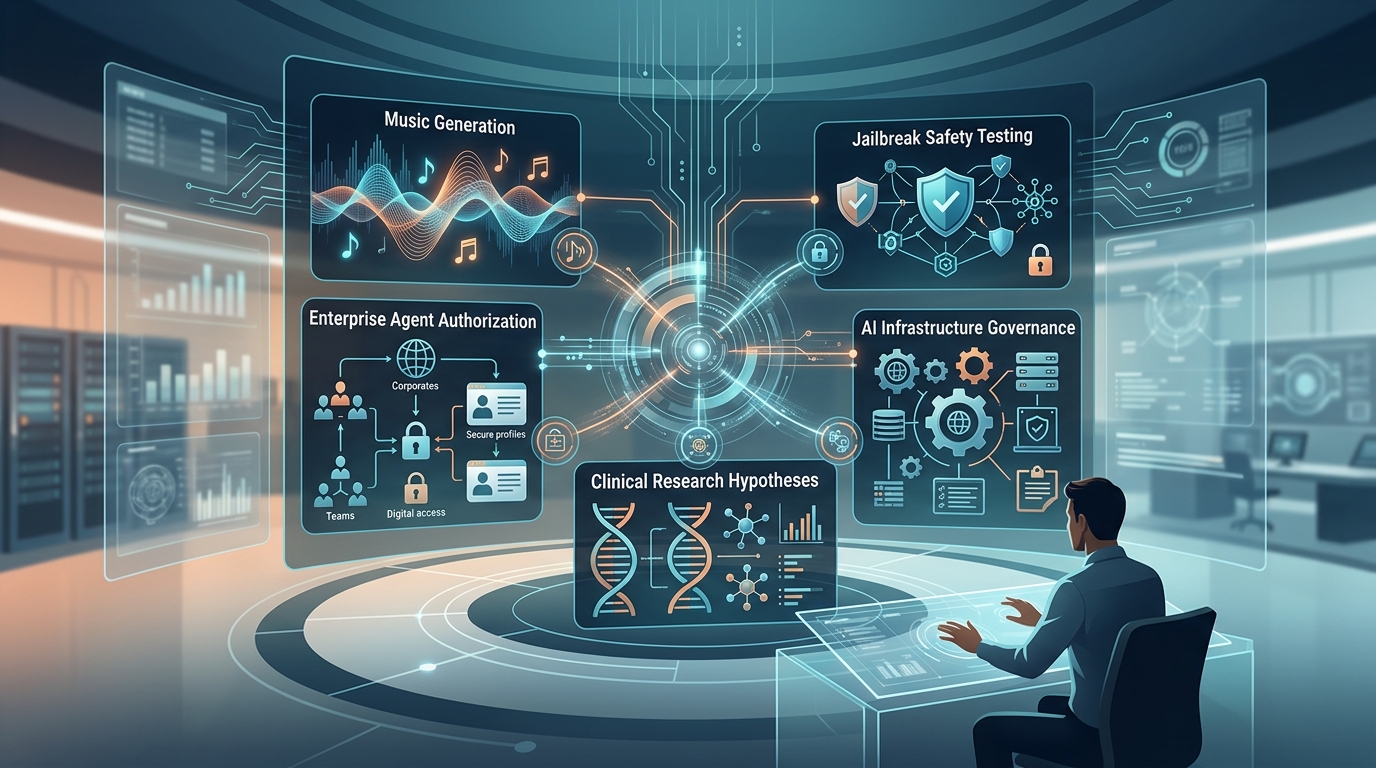
The last 48 hours brought a useful cross-section of where AI is moving. Google launched Lyria 3.5 in Flow Music on July 29, making music generation more controllable at the level of lyrics, vocals, tempo, and duration.1 WIRED reported on July 29 that FAR.AI's latest jailbreak testing found large differences across frontier model safeguards, including many successful attacks against Grok and Gemini but none against the Anthropic and OpenAI models in that test set.2 The FTC is taking comments until July 31 on a proposed policy statement that would treat some undisclosed manipulation of AI outputs as a consumer-protection problem.4 Google separately published Beyond Zero, an AI-era enterprise-security framework that moves authorization down to individual actions on specific resources.5 AWS's July 30 access cutoff for several SageMaker AI features, including Ground Truth, A2I, Clarify, Model Monitor, Studio Lab, and Mechanical Turk, marks a symbolic turn in the old human-labeling stack that helped train modern AI.6
Two science and health items sharpen the same pattern. OpenAI's July 30 Forum event on Boston Children's Hospital's rare-disease work highlights a published AI-assisted reanalysis workflow in which specialists reviewed model-generated hypotheses rather than treating the model as a diagnostic authority.7 A Nature Electronics article in the July issue shows multimodal AI agents estimating electronics life-cycle emissions in under a minute and within 19% of expert life-cycle assessments, reframing sustainability analysis as a tool-mediated agent workflow rather than a static reporting task.9
Models and Media: Generation Becomes More Directed
Google's July 29 Lyria 3.5 release is a compact but telling model update. The company says the model is rolling out in Google Flow Music and improves musicality, lyric generation, vocal quality, pronunciation, emotional nuance, prompt adherence, tempo control, and duration control.1 That list matters because the creative frontier is moving from "can it generate a song?" to "can a creator shape the output with enough control to make iteration feel like authorship rather than lottery sampling?"1
The creative AI market has spent the past year racing through modalities: text, image, video, speech, avatars, and music. Lyria 3.5 fits the next phase, where the model itself is only one layer of a product that has to expose useful handles to users. Tempo and duration may sound mundane next to model benchmarks, but they are the kind of controls that turn a demo into a workflow. The same point applies to lyrics and vocals: if generated music is going to be used in campaigns, games, prototypes, or creator channels, expressive control becomes a rights, quality, and brand-safety issue as much as a technical feature.1
Safety: Jailbreak Testing Becomes Comparative Infrastructure
WIRED's July 29 report on FAR.AI's jailbreak work is important less because any single benchmark should be treated as definitive and more because it shows how quickly safety testing is becoming comparative infrastructure. The report says FAR.AI tested models from Anthropic, OpenAI, Google, and SpaceXAI using automated prompt generation to seek policy-violating responses across harmful domains.2 In WIRED's account, Grok had 448 successful jailbreaks and Gemini had 249, while the tested Claude, Fable, and GPT models resisted the tested attacks.2 FAR.AI also maintains a public leaderboard for model-safety evaluations.3
The numbers should be read carefully. A jailbreak benchmark is not a complete safety case; it depends on prompts, policies, model versions, refusal definitions, and severity calibration. But the public comparison changes the governance surface. If one lab can show that a class of automated attacks fails against its deployed model while another lab's model fails cheaply, then regulators, enterprise buyers, and insurers have a more concrete basis for asking why safeguards differ.2
WIRED quoted FAR.AI CEO Adam Gleave arguing that voluntary commitments are not enough:
"AI models right now are less regulated than restaurants."2
The better takeaway is not that one benchmark should become law. It is that frontier-model safety is beginning to look more like security testing: continuous, adversarial, reproducible where possible, and tied to versioned deployment claims. That is where yesterday's autonomy incidents, today's jailbreak measurements, and the emerging safety-reporting laws converge.2
Policy: The FTC Turns AI Accuracy Into a Consumer-Protection Question
The FTC's July policy statement proposal shows another control-plane move: accuracy and objectivity are being framed as representations to consumers, not just abstract model-quality concepts. The Commission says it is seeking public comment on concerns that AI companies may manipulate the behavior of AI systems contrary to reasonable consumer expectations for objectivity and accuracy.4 The proposal invokes Section 5 of the FTC Act, which prohibits unfair or deceptive conduct, and comments are due July 31, 2026.4
The politics around this proposal are explicit. The FTC press release discusses alleged ideological manipulation, possible conflict with state laws such as Colorado's AI Act, and a federal-preemption theory for state requirements that conflict with a federal scheme.4 That framing will be contested. But the durable policy question is broader than ideology: when a chatbot, search answer, agent, or decision-support tool is marketed as useful for a task, what output-shaping choices must be disclosed to users?
FTC Chairman Andrew Ferguson introduced the comment process in unusually direct terms:
"The FTC wants to hear from businesses and consumers about their experiences and concerns regarding the subversion of AI systems for ideological ends."4
Even organizations that disagree with the FTC's theory should pay attention to the underlying compliance direction. AI product claims are becoming product-liability claims, consumer-protection claims, procurement claims, and audit claims. "The model said so" is not a sufficient control when the vendor also designs the incentives, filters, ranking rules, and hidden system instructions that shape what users see.4
Enterprise Security: Authorization Moves From Login To Action
Google's July 27 Beyond Zero post is a strong example of security architecture catching up with agents. The company describes Beyond Zero as an AI-era security paradigm that authorizes individual actions on specific resources, including access through interfaces, APIs, and Model Context Protocol connections.5 It pairs static policy with dynamic controls, enriches decisions with context about the user and data, and can trigger investigations, challenges, or containment measures when risk signals rise.5
This is a practical response to a real AI deployment problem. Agent systems blur the old security boundary between "user logged in" and "user intentionally performed this action." Once an agent can read a file, call tools, update a CRM record, invoke an MCP connector, or initiate a workflow, the enterprise needs a policy engine that can judge the action itself. Coarse application permissions are too blunt for a world where a single agent session might move across mail, documents, code, tickets, analytics, and customer data.5
The broader significance is that AI governance is becoming operational. A policy document is not enough. Companies will need identity, resource graphs, event streams, risk scoring, authorization services, logs, and review flows that understand both human and agent behavior. Beyond Zero is not the only possible architecture, but it is a useful marker: the AI control plane is moving into runtime infrastructure.5
Infrastructure and Labor: The Old Labeling Stack Enters Maintenance Mode
July 30 is also the date AWS set for several services and SageMaker AI features to stop being accessible to new customers. AWS says existing customers can continue using services moving to maintenance, but new customers lose access starting July 30, 2026.6 The affected SageMaker AI features include A2I, Clarify, Debugger, Geospatial, Ground Truth, Mechanical Turk, Model Monitor, Role Manager, and Studio Lab; Ground Truth Plus reached end of support on June 30.6
The Mechanical Turk and Ground Truth pieces are especially symbolic. Mechanical Turk was one of the original marketplaces for distributed human microtasks, and Ground Truth helped industrialize labeling and human-in-the-loop data workflows for machine learning. Their move to maintenance does not mean human feedback is disappearing. It suggests the center of gravity has shifted toward specialized data vendors, expert review, synthetic-data pipelines, model-assisted evaluation, and product-integrated feedback loops.6
That shift should not be read as a simple labor replacement story. AI systems still need people, but the work is changing. The valuable human contribution increasingly sits in domain expertise, preference specification, safety adjudication, legal review, clinical review, and evaluation design. The old "label this image" task is giving way to "judge whether this autonomous workflow is safe, correct, useful, and accountable."6
Health and Science: AI Becomes a Hypothesis Engine, Not a Decision Maker
OpenAI's July 30 Forum event with Boston Children's Hospital puts a public spotlight on a rare-disease workflow that is easy to overstate and important to understand precisely. The event description says researchers used OpenAI o3 Deep Research to reanalyze difficult pediatric cases and surface new leads for expert review.7 OpenAI's June 18 write-up of the underlying NEJM AI study says the workflow analyzed 376 previously unsolved cases and helped surface evidence-linked leads that, after expert review and clinical confirmation, contributed to 18 diagnoses, a 4.8% additional diagnostic yield.8
The guardrails in that sentence are the point. OpenAI says the model did not diagnose any patient, did not make clinical decisions, and produced hypotheses for specialists to review through established processes.8 That distinction is likely to define the next phase of AI in medicine. In high-stakes domains, the best early uses may be maintenance and search problems: rechecking old cases as literature changes, connecting phenotype terms to variant evidence, surfacing contradictions, and helping experts decide where to spend scarce attention.8
Nature Electronics points to a similar science pattern outside medicine. In a June 12 article featured in the July issue, researchers reported a multimodal multi-agent system for electronics life-cycle assessment that builds inventories from public sources and estimates product carbon footprints in under one minute, within 19% of expert assessments.9 That is not a magic replacement for environmental accounting. It is a way to compress the early analysis loop so engineers can ask more questions earlier, before design choices harden.9
Together, these examples show a healthier frame for scientific AI: not autonomous truth production, but structured hypothesis generation with audit trails, external tools, and expert adjudication. The model widens the search space. Institutions still own the evidence standard.
What To Watch Next
Watch whether music-generation tools expose enough control to make output provenance, licensing, and brand safety manageable rather than reactive. Lyria 3.5's tempo, duration, lyric, and vocal controls are small product details with large workflow consequences.1
Watch whether public jailbreak leaderboards become part of enterprise procurement. Buyers may begin asking vendors for benchmark-specific safety claims, versioned model cards, and evidence that fixes persist across model updates.23
Watch the FTC comment process after July 31. The immediate policy fight is about ideological manipulation and federal preemption, but the larger precedent is whether hidden output-shaping choices can become consumer-protection violations.4
Watch runtime authorization for agents. Google's Beyond Zero architecture points toward a world where every tool call, data access, and resource mutation by a person or agent is separately authorized and logged.5
Watch the human-feedback labor market. AWS's maintenance shift for Mechanical Turk, Ground Truth, A2I, Clarify, and Model Monitor is a reminder that AI's support stack is consolidating around higher-skill review, governance, and evaluation work rather than simple task labeling.6
Watch prospective clinical studies. The rare-disease reanalysis result is promising but retrospective; the next question is whether AI-assisted workflows improve diagnostic yield, time, cost, and clinician workload in real clinical operations without increasing false-positive burden.8
Sources
1."Introducing Lyria 3.5 in Google Flow Music." Google / Google Labs, July 29, 2026. https://blog.google/innovation-and-ai/models-and-research/google-labs/lyria-3-5/
2."It's Frighteningly Easy to Jailbreak Some Frontier AI Models." WIRED, July 29, 2026. https://www.wired.com/story/jailbreaking-ai-models-google-anthropic-openai-spacexai/
3."FAR.AI Leaderboard 2026." FAR.AI, 2026. https://leaderboard.far.ai/
4."FTC Seeks Public Comment on Policy Statement Addressing AI Accuracy." Federal Trade Commission, July 2026. https://www.ftc.gov/news-events/news/press-releases/2026/07/ftc-seeks-public-comment-policy-statement-addressing-ai-accuracy
5."Going Beyond Zero: A New Paradigm For Enterprise Security." Google Security Blog, July 27, 2026. https://blog.google/security/going-beyond-zero-a-new-paradigm-for-enterprise-security/
6."AWS Service Availability Updates." Amazon Web Services, June 30, 2026. https://aws.amazon.com/about-aws/whats-new/2026/06/aws-service-availability/
7."How AI Helps Solve Medical Mysteries at Boston Children's Hospital." OpenAI Forum, July 30, 2026. https://forum.openai.com/public/events/how-ai-helps-solve-medical-mysteries-at-boston-childrens-hospital-fpq2m4y6lg
8."Using AI to help physicians diagnose rare genetic diseases affecting children." OpenAI, June 18, 2026. https://openai.com/index/diagnose-rare-childhood-diseases/
9."Sustainability assessment using multimodal artificial intelligence agents." Nature Electronics, published June 12, 2026; featured in Volume 9 Issue 7, July 2026. https://www.nature.com/articles/s41928-026-01653-w