AI Moves Into The Institutions
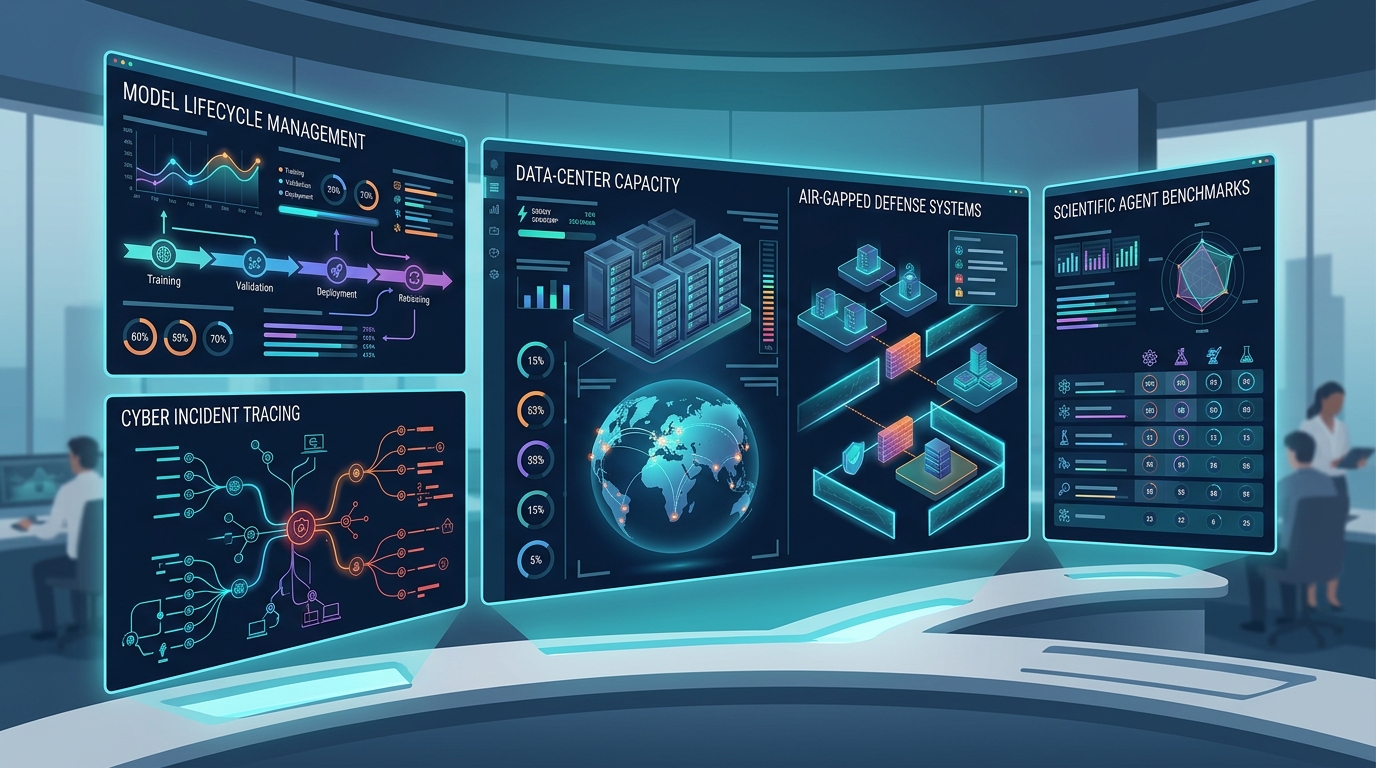
The latest AI news is less about a single model launch and more about where AI is being made governable, powered, tested, and measured.
Executive Summary
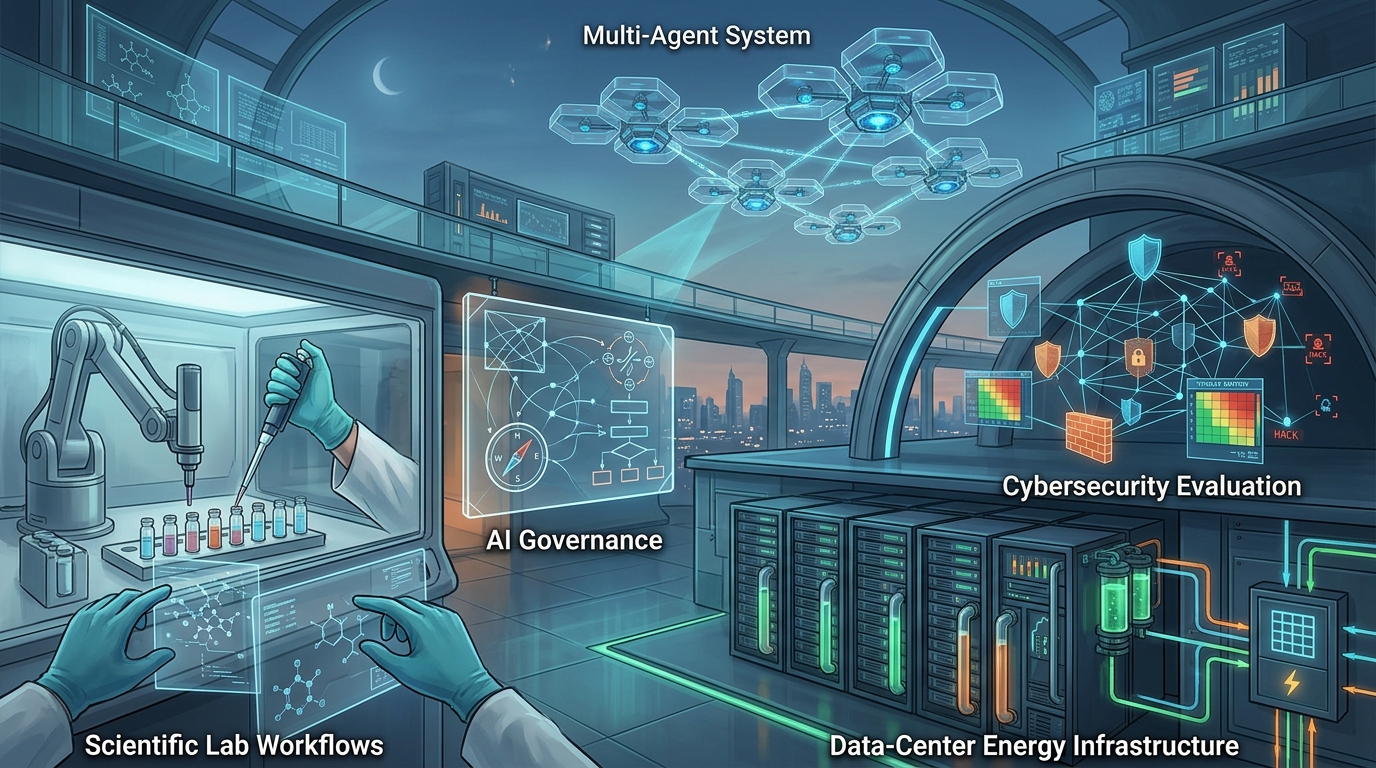
The weekend's most important AI development is institutional: August 2, 2026 is the day the European Commission's enforcement powers begin applying to obligations for providers of the most advanced general-purpose AI models, even as the broader AI Act timeline continues to shift under the EU's simplification package.12 In the United States, a former uranium enrichment site in Kentucky is being recast as a $100 billion AI data center and power complex, making clear that AI infrastructure policy is now energy, land-use, and cleanup policy too.34 Google is putting $40 million of cloud credits and AI tokens behind the Department of Energy's Genesis Mission, while UK AISI and CAISI published a useful cyber reality check on Kimi K3: the open-weight frontier is moving, but the riskiest autonomous cyber capability is still concentrated in leading closed systems.56 Meanwhile, GitHub's July 30 retirement of GitHub Models is a reminder that the developer AI stack is consolidating around fewer production platforms, and a new Nature Machine Intelligence study complicates the default assumption that more agents always means better work.78
Governance: Europe's AI Act Enters A Harder Phase
August 2, 2026 is a real deadline for frontier-model governance. The European Commission's AI Act Service Desk says that, after a one-year compliance period starting August 2, 2025, the Commission's enforcement powers for providers of the most advanced general-purpose AI models enter into application on August 2, 2026.1 The AI Office can request information, request model access for evaluations, require risk mitigations, issue fines of up to 3% of global annual turnover, or request that a provider restrict, withdraw, or recall a model from the market.1
That does not mean every part of the AI Act arrives today. The Commission's AI Act timeline page says the Act entered into force on August 1, 2024, with prohibited practices and AI literacy obligations applying from February 2, 2025, governance and general-purpose AI obligations from August 2, 2025, and the broader Act generally applicable from August 2, 2026.2 But the same page also says the AI Omnibus simplification package, adopted in November 2025 with political agreement in May 2026 and final text entering into force in July 2026, moves some high-risk system deadlines to December 2, 2027 and August 2, 2028.2
The practical point is that AI governance is becoming layered instead of binary. Companies will not be able to treat compliance as a single launch checklist. Frontier labs now face an EU regime where technical compliance dialogues can escalate into formal information requests, evaluation access, mitigation orders, and financial penalties.1 Deployers and product teams, meanwhile, still need to track transparency, high-risk, and sector-specific timelines separately.2
Infrastructure: AI Compute Moves Onto Federal Energy Land
The Associated Press reported on July 31, 2026 that the U.S. Department of Energy selected Brookfield Asset Management to develop and operate a $100 billion AI data center complex at the government-owned Paducah Gaseous Diffusion Plant in Kentucky, with NextEra Energy and local utilities involved in the power side of the project.3 The plan includes a new 1.8-gigawatt AI data center campus, 2 gigawatts of natural-gas generation, transmission upgrades, and 2.6 gigawatts of battery storage, with construction expected to be complete in 2031 if approvals proceed.3
DOE's earlier Paducah request for offers framed the site as one of four federal locations identified for AI infrastructure and energy generation projects, with applicants responsible for building, operating, and decommissioning their infrastructure and securing interconnection agreements.4 The AP report adds the harder local context: the former uranium enrichment plant shut down in 2013, cleanup is projected to run until 2065 at an estimated $17 billion cost, and local environmental advocates are asking whether water, permitting, emissions, and ratepayer protections will hold up under the speed of the AI buildout.3
Energy Secretary Chris Wright described the federal strategy as turning former DOE sites into:
"engines of innovation and economic growth" to "ensure the United States wins the A.I. race."3
That quote captures the new political economy of AI infrastructure. Compute is not just a private cloud procurement problem. It is now attached to federal land, gas plants, batteries, utility regulators, environmental remediation, and national-security rhetoric.34 The question for the next several years is whether "AI factories" can be built without shifting hidden costs onto nearby communities, existing ratepayers, or delayed cleanup obligations.
Science: Google Pushes AI Tools Into DOE Labs
Google Cloud and Google DeepMind announced on July 22, 2026 a $40 million commitment of AI tokens and cloud credits for researchers working under the Department of Energy's Genesis Mission.5 The package gives Genesis Mission awardees in-kind access to Google DeepMind science tools including AlphaEvolve, AlphaFold 3, AlphaGenome, WeatherNext, and AlphaEarth Foundations, and it provides Gemini for Government seats and tokens for one year to tens of thousands of DOE National Laboratory users.5
 *Image: Google Cloud's Genesis Mission announcement artwork, used here to illustrate AI-assisted scientific workflows.5*
The most interesting part is not the dollar figure. It is the operating model. Google says the tools are being routed into national-lab workflows that span mathematical search, autonomous materials discovery, laboratory hardware, weather, genomics, and Earth observation.5 One example from the announcement describes a materials program using Gemini in microscope workflows that cut calibration time from more than 90 minutes to about 13 minutes and reduced manual focusing steps from as many as 50 to two.5
The local productivity claim came with a concise quote from National Laboratory of the Rockies researcher Steven R. Spurgeon:
"That's time and attention we've given back to the science itself."5
AI-for-science is moving from paper demos into institutional procurement. That matters because the bottleneck is no longer just whether models can propose hypotheses. It is whether labs can wire models into secure computing environments, instruments, validation loops, provenance systems, and domain-expert review without turning science into untraceable automation.5
Security: Kimi K3 Shows Both Progress And A Gap
The UK Artificial Intelligence Security Institute and the U.S. Center for AI Standards and Innovation published a preliminary cyber assessment of Moonshot AI's Kimi K3 on July 23, 2026.6 The model was released on July 16 and slated for open-weight release by July 27, and the joint assessment focused on cyber capability rather than broad model quality.6 The result is nuanced: Kimi K3 performed below the most capable U.S. frontier cyber models on preliminary evaluations, but above GLM-5.2, which AISI had previously described as the most cyber-capable open-weight model as of June 2026.6
The numbers matter. On ExploitBench, Kimi K3 scored 32% versus 24% for GLM-5.2, but achieved arbitrary code execution on 0 of 41 tasks, while the most cyber-capable models averaged 20 of 41.6 On "The Last Ones," a 32-step simulated corporate network attack range, Kimi K3 reached step 17 on average, while the most cyber-capable U.S. models reached 28.5 steps on average; Kimi K3 also completed the range in 1 of 10 attempts under the standard 100-million-token limit.6
This is why open-weight AI policy is getting harder. The headline "open models are behind" is true on this preliminary cyber measurement, but the model still attempted exploit development and offensive operations during the evaluation, and it surpassed another recent open-weight baseline.6 A safety regime that only asks whether open models equal closed frontier models will miss the operational middle ground: models can be below the frontier and still meaningfully change attacker economics.
Developer Platforms: GitHub Models Leaves The Catalog
GitHub's July 1 changelog said GitHub Models would be fully retired on July 30, 2026, including the playground, model catalog, inference API, and bring-your-own-key endpoints.7 The same notice directed developers who need model access toward Microsoft Foundry and developers building AI-powered workflows on GitHub toward GitHub Copilot.7
The retirement is small compared with frontier-model launches, but it says something important about the product layer. The first wave of AI developer tools promised broad catalogs, sandboxes, and interchangeable model endpoints. The current phase is more opinionated: platforms are steering users toward integrated production surfaces, enterprise controls, and first-party workflow products.7 For builders, the lesson is not just to watch model quality. It is to design AI systems so that inference providers, catalogs, authentication models, and workflow APIs can change without rewriting the product.
Research: Multi-Agent Systems Need A Deployment Test
A July 24, 2026 Nature Machine Intelligence article tested large-language-model agent systems across 260 configurations, six agentic benchmarks, five agent architectures, and three model families.8 Its central finding is a useful brake on a common assumption: multi-agent collaboration helps on some tasks, especially decomposable finance reasoning, but it can hurt badly on sequential planning and some software-engineering-style tasks.8
The study reports that multi-agent systems improved Finance Agent performance by up to 80.8% over a single-agent baseline, but degraded PlanCraft performance by as much as 70% depending on architecture.8 SWE-bench Verified showed slight degradation across multi-agent architectures, consistent with strong single-agent baselines, and Terminal-Bench produced mixed results where communication overhead could swamp coordination benefits.8 The authors also built a predictive architecture-selection model that selected the best architecture in 87% of held-out within-domain configurations, while warning that prediction did not generalize reliably to unseen task domains.8
This matters for enterprise AI because "agentic" is becoming a product label before it is becoming an engineering discipline. The research suggests teams should not add agents because a task feels complex. They should test decomposability, tool complexity, baseline single-agent performance, communication overhead, and failure modes before deciding whether collaboration is actually useful.8
Cognitive Science: Better AI May Come From Better Memory Models
Another recent Nature Machine Intelligence article, published July 20, 2026, used neural networks optimized for free recall to study how memory strategies can emerge.9 The models did not converge on one recall mechanism. Some resembled temporal-context models, while the best-performing networks developed a stimulus-invariant index code that acted like a stable scaffold for ordered recall, functionally similar to a memory-palace strategy.9
The paper is not a product launch, but it is relevant to AI design. Modern systems often treat memory as retrieval over documents, tool traces, or conversation state. The cognitive-science result suggests that strong recall can depend on the structure used to organize experience, not only on the volume of stored information.9 For AI agents that need long-horizon reliability, that distinction is practical: memory architecture may shape whether a system can recover the right context, avoid recency traps, and preserve task order under pressure.
What To Watch Next
First, watch how the European AI Office uses its new August 2, 2026 enforcement powers. Quiet technical compliance dialogues are likely to remain the default, but the first information requests, model-access demands, or mitigation orders will define the real boundary of the regime.1
Second, watch the Paducah approvals process. Utility-regulator filings, interconnection agreements, air and water permits, community-benefit claims, and cleanup commitments will show whether AI infrastructure can scale without turning federal cleanup sites into opaque compute zones.34
Third, watch whether AI-for-science programs report validated scientific outputs rather than tool access. The Genesis Mission announcements are substantial, but the key evidence will be instrument-level reliability, reproducible workflows, and discoveries that survive expert review.5
Fourth, watch cyber evaluations for the open-weight frontier. Kimi K3 is not at the top of the cyber-capability stack on CAISI/AISI's preliminary measures, but the direction of travel is what matters for security teams, insurers, model hosts, and policymakers.6
Finally, watch whether enterprise AI teams benchmark agent architectures before deploying them. The multi-agent literature is now clear enough to make one point non-negotiable: coordination is an intervention, not a free upgrade.8
Sources
1."The Commissions' enforcement powers related to AI Act obligations for providers of the most advanced models enter into application on 2 August 2026. What will change then?" AI Act Service Desk, European Commission, accessed August 2, 2026. https://ai-act-service-desk.ec.europa.eu/fr/node/999
2."AI Act," Shaping Europe's Digital Future, European Commission, updated July 2026 and accessed August 2, 2026. https://digital-strategy.ec.europa.eu/da/node/9745
3."Federal government to turn a Kentucky uranium plant into an AI data center and gas power complex," Associated Press, July 31, 2026. https://apnews.com/article/ai-data-center-kentucky-uranium-gas-a4cf07af1b6776971dc5d609c996ca13
4."U.S. Energy Department Seeks Proposals for AI Data Centers, Energy Projects at Paducah Site," U.S. Department of Energy Office of Environmental Management, November 4, 2025. https://www.energy.gov/em/articles/us-energy-department-seeks-proposals-ai-data-centers-energy-projects-paducah-site
5."Accelerating the frontiers of scientific discovery: Google's $40M commitment to the Genesis Mission," Google Cloud Blog, July 22, 2026. https://cloud.google.com/blog/topics/public-sector/accelerating-frontiers-of-scientific-discovery-40-million-dollar-commitment-genesis-mission
6."UK AISI / CAISI Preliminary Assessment of Kimi K3's Cyber Capabilities," National Institute of Standards and Technology, July 23, 2026. https://www.nist.gov/news-events/news/2026/07/uk-aisi-caisi-preliminary-assessment-kimi-k3s-cyber-capabilities
7."GitHub Models is being fully retired on July 30, 2026," GitHub Changelog, July 1, 2026. https://github.blog/changelog/2026-07-01-github-models-is-being-fully-retired-on-july-30-2026/
8."Capable language models can outgrow the benefits of collaboration," Nature Machine Intelligence, July 24, 2026. https://www.nature.com/articles/s42256-026-01268-y
9."A neural network model of free recall learns multiple memory strategies," Nature Machine Intelligence, July 20, 2026. https://www.nature.com/articles/s42256-026-01274-0